
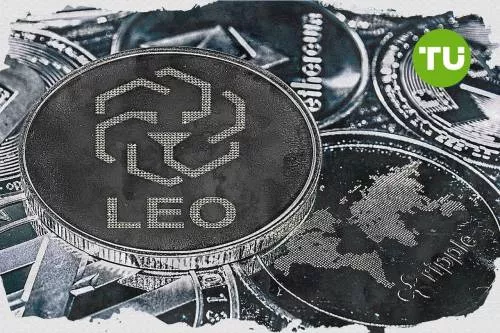
LEO token price prediction for 2030: Burn mechanism and tokenized securities target $40

LEO is a utility token launched by iFinex (Bitfinex's parent company) in 2019 to recover from a 2016 hack.
Highlights
- LEO trades near $8.28, consolidating around $8–$9 after the December 2025 spike to $11 on the zero-fee trading announcement.
- 2030 forecasts target $40–$45, assuming Bitfinex maintains revenue through tokenized securities and the burn mechanism accelerates.
- Price depends on Bitfinex defending market share (ranks 14th–16th), tokenized securities capturing RWA demand, and 27% burn continuing.
The token features a mandatory 27% monthly revenue buyback and burn mechanism, designed to eventually burn itself out of existence while delivering returns through programmatic scarcity.
Technical breakdown and chart analysis
LEO is trading around $8.28 after consolidating from December 2025 highs near $11. Price sits near key moving averages: 20 EMA at $8.088, 50 EMA at $8.282, and 100 EMA at $8.456.

LEO price dynamics (Source: TradingView)
Bollinger Bands show price near the middle band at $8.131, indicating consolidation. The chart reveals a sharp December 2025 spike to $11 on zero-fee trading news, followed by gradual decline. Support sits at $6.964, with resistance at $8.687 and $9.298.
Burn mechanism and zero-fee trading pivot
LEO's model strengthened despite consolidation. Bitfinex uses 27% of monthly revenue to buy back and burn LEO tokens. As of July 2024, they burned 7.4% of the total supply. Unlike Binance, which burns from treasury, Bitfinex executes market purchases, creating direct price support. Every three hours, tokens disappear forever, tracked on a public dashboard. Bitfinex announced using 80% of any recovered funds from the 2016 hack to repurchase and burn LEO over 18 months.
Bitfinex eliminated trading fees in December 2025 across spot, derivatives, and OTC markets, triggering an 11% LEO price jump. The logic: eliminate fees to boost volume, which increases other revenue streams, funding larger burns. Holders now value LEO for lending discounts (0.05% per 10,000 USDT held, capped at 5%) and the burn mechanism.
Bitfinex secured regulatory approval in Kazakhstan to expand tokenized securities, raising operating limit to $310 million. This aligns with the $37 billion RWA sector. If Bitfinex captures RWA market share, it creates new revenue streams feeding burns. However, centralization risk looms. Bitfinex ranks 14th–16th among exchanges. A wallet linked to Bitfinex held 65% of LEO supply as of March 2025.
LEO's potential outlook toward 2030
By 2030, forecasts target $40–$45 if burns and platform demand remain strong. Conservative forecasts see $14–$16 by 2026, building toward $40–$45 by 2030. Bullish scenarios suggest $14.69 by end 2026, with $25.93 in 2028. Key resistance sits at $8.687, $9.298, and $14.
A move above $10 signals reversal. The ceiling depends on Bitfinex's revenue and burn execution. Higher revenues mean more burns, reduced supply creates upward pressure.
What investors should expect and monitor
Watch Bitfinex exchange volume ranking. Monitor tokenized securities expansion in Kazakhstan. Track monthly burn rates on transparency dashboard. Zero-fee trading impact on volumes matters: if volumes surge, other revenue streams fund larger burns. RWA sector growth validates tokenized securities bet.
Analyst Viktoras Karapetjanc observed:
“LEO at $8.28 with 27% revenue burns is designed to disappear, which could make it valuable. If Bitfinex defends the share and tokenized securities scale, $40 by 2030 is achievable, but ranking 14th–16th is a concern.”
As previously discussed, LEO presents a unique thesis: programmed extinction through burns creates scarcity. Success depends on Bitfinex executing burns before competition erodes position.




Latest LEO News



-
 Afghanistan
-
 Albania
-
 Algeria
-
 Angola
-
 Argentina
-
 Armenia
-
 Australia
-
 Austria
-
 Azerbaijan
-
 Bahamas
-
 Bahrain
-
 Bangladesh
-
 Belarus
-
 Belgium
-
 Bolivia
-
 Botswana
-
 Brazil
-
 Brunei
-
 Bulgaria
-
 Cambodia
-
 Cameroon
-
 Canada
-
 Chile
Chile
-
 China
China
-
 Colombia
-
 Congo
Congo
-
 Costa Rica
-
 Cote d'Ivoire
-
 Croatia
-
 Cuba
Cuba
-
 Cyprus
-
 Czechia
-
 DR Congo
-
 Denmark
-
 Dominican Republic
-
 Ecuador
-
 Egypt
Egypt
-
 El Salvador
-
 Estonia
-
 Eswatini
-
 Ethiopia
-
 Finland
-
 France
-
 Georgia
-
 Germany
-
 Ghana
Ghana
-
 Greece
-
 Haiti
Haiti
-
 Hong Kong
-
 Hungary
-
 India
India
-
 Indonesia
-
 Iran, Islamic republic
-
 Iraq
Iraq
-
 Ireland
-
 Israel
-
 Italy
Italy
-
 Jamaica
-
 Japan
Japan
-
 Jordan
-
 Kazakhstan
-
 Kenya
Kenya
-
 Korea
Korea
-
 Kuwait
-
 Kyrgyzstan
-
 Laos
Laos
-
 Latvia
-
 Lebanon
-
 Lesotho
-
 Libya
Libya
-
 Lithuania
-
 Luxembourg
-
 Madagascar
-
 Malaysia
-
 Malta
Malta
-
 Mauritius
-
 Mexico
-
 Moldova
-
 Mongolia
-
 Montenegro
-
 Morocco
-
 Mozambique
-
 Myanmar
-
 Namibia
-
 Nepal
Nepal
-
 Netherlands
-
 New Zealand
-
 Nigeria
-
 North Macedonia
-
 Norway
-
 Oman
Oman
-
 Pakistan
-
 Palestine
-
 Panama
-
 Papua New Guinea
-
 Paraguay
-
 Peru
Peru
-
 Philippines
-
 Poland
-
 Portugal
-
 Puerto Rico
-
 Qatar
Qatar
-
 Reunion
-
 Romania
-
 Rwanda
-
 Saudi Arabia
-
 Serbia
-
 Singapore
-
 Slovakia
-
 Slovenia
-
 Somalia
-
 South Africa
-
 Spain
Spain
-
 Sri Lanka
-
 Sweden
-
 Switzerland
-
 Syria
Syria
-
 Taiwan
-
 Tajikistan
-
 Tanzania
-
 Thailand
-
 Trinidad and Tobago
-
 Tunisia
-
 Turkey
-
 UAE
UAE
-
 Uganda
-
 Ukraine
-
 United Kingdom
-
United States
-
 Uruguay
-
 Uzbekistan
-
 Venezuela
-
 Vietnam
-
 Yemen
Yemen
-
 Zambia
-
 Zimbabwe
- Forex
- Crypto












