
The tweet was deleted by the author.
But we saved everything 🙂.
Stablecoin adoption is on the rise as investors seek financial stability amid volatile markets, with Circle’s USDC and Tether’s USDT emerging as leaders.
The top 10 stablecoins now boast a combined market capitalization of about $220 billion, up from under $120 billion two years ago.
- Growing Stablecoin Adoption: Investors in Latin America increasingly prefer USDC and USDT for stability, leading to a 9% rise in stablecoin purchases.
- Shifting Market Dynamics: Bitcoin’s trading volume has declined significantly, reflecting a broader shift toward stablecoins.
- Expanding Market Cap: The 10 largest stablecoins have a market capitalization of $220 billion.
- Regulatory Focus: As legal risks mount, regulators are drafting targeted rules for stablecoins.
According to a study by exchange Bitso, stackablecoin purchases on the platform grew by 9%, while bitcoin's share of trading volume fell from 38% in the second half of 2023 to 22% in 2024.
Stablecoin purchases have increased sharply in Latin America as users turn to USDC and USDT to hedge against local currency volatility and economic uncertainty. This shift has coincided with a notable drop in Bitcoin trading volume, highlighting a preference for assets that offer a stable store of value.
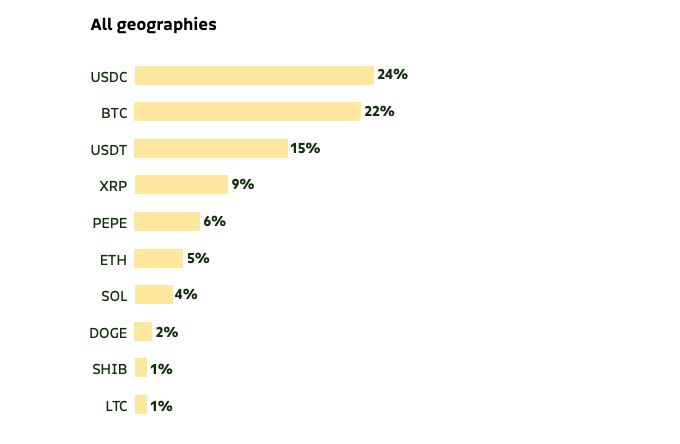
Сrypto assets by share in 2024. Source: Bitso
A recent PitchBook report indicates that the combined market capitalization of the top 10 stablecoins has nearly doubled over the past two years, now totaling around $220 billion.
Tether leads this segment with about 65% of the market, while USDC holds roughly 25%, underlining their dominance in a market that continues to attract significant investor interest.
Amid this growth, legal risks are coming to the fore. Regulators are actively drafting specific rules for stablecoins, signaling an increased focus on consumer protection and market integrity. This regulatory momentum could shape the future landscape of digital asset trading, influencing investor sentiment and market behavior.
Specifically, MiCA rules require that stablecoins comply with EU banking standards. Tether has therefore withdrawn from the European market to avoid MiCA compliance. Paolo Ardoino revealed that Tether is now helping to secure U.S. debt.
As stablecoin adoption accelerates, market participants will be watching closely to see how regulatory developments and shifting market dynamics impact the broader cryptocurrency ecosystem. This evolving landscape may redefine asset allocation strategies and enhance the role of stablecoins as a trusted means of savings.
We will remind, earlier we reported that ECB research shows Europeans have no interest in digital euro.

 Afghanistan
 Albania
 Algeria
 Angola
 Argentina
 Armenia
 Australia
 Austria
 Azerbaijan
 Bahamas
 Bahrain
 Bangladesh
 Belarus
 Belgium
 Bolivia
 Botswana
 Brazil
 Brunei
 Bulgaria
 Cambodia
 Cameroon
 Canada
 Chile
Chile
 China
China
 Colombia
 Congo
Congo
 Costa Rica
 Cote d'Ivoire
 Croatia
 Cuba
Cuba
 Cyprus
 Czechia
 DR Congo
 Denmark
 Dominican Republic
 Ecuador
 Egypt
Egypt
 El Salvador
 Estonia
 Eswatini
 Ethiopia
 Finland
 France
 Georgia
 Germany
 Ghana
Ghana
 Greece
 Haiti
Haiti
 Hong Kong
 Hungary
 India
India
 Indonesia
 Iran, Islamic republic
 Iraq
Iraq
 Ireland
 Israel
 Italy
Italy
 Jamaica
 Japan
Japan
 Jordan
 Kazakhstan
 Kenya
Kenya
 Korea
Korea
 Kuwait
 Kyrgyzstan
 Laos
Laos
 Latvia
 Lebanon
 Lesotho
 Libya
Libya
 Lithuania
 Luxembourg
 Madagascar
 Malaysia
 Malta
Malta
 Mauritius
 Mexico
 Moldova
 Mongolia
 Montenegro
 Morocco
 Mozambique
 Myanmar
 Namibia
 Nepal
Nepal
 Netherlands
 New Zealand
 Nigeria
 North Macedonia
 Norway
 Oman
Oman
 Pakistan
 Palestine
 Panama
 Papua New Guinea
 Paraguay
 Peru
Peru
 Philippines
 Poland
 Portugal
 Puerto Rico
 Qatar
Qatar
 Reunion
 Romania
 Rwanda
 Saudi Arabia
 Serbia
 Singapore
 Slovakia
 Slovenia
 Somalia
 South Africa
 Spain
Spain
 Sri Lanka
 Sweden
 Switzerland
 Syria
Syria
 Taiwan
 Tajikistan
 Tanzania
 Thailand
 Trinidad and Tobago
 Tunisia
 Turkey
 UAE
UAE
 Uganda
 Ukraine
 United Kingdom
United States
United Kingdom
United States
 Uruguay
 Uzbekistan
 Venezuela
 Vietnam
 Yemen
Yemen
 Zambia
 Zimbabwe