
Ethereum dips after US regulators classify ETH as a digital commodity

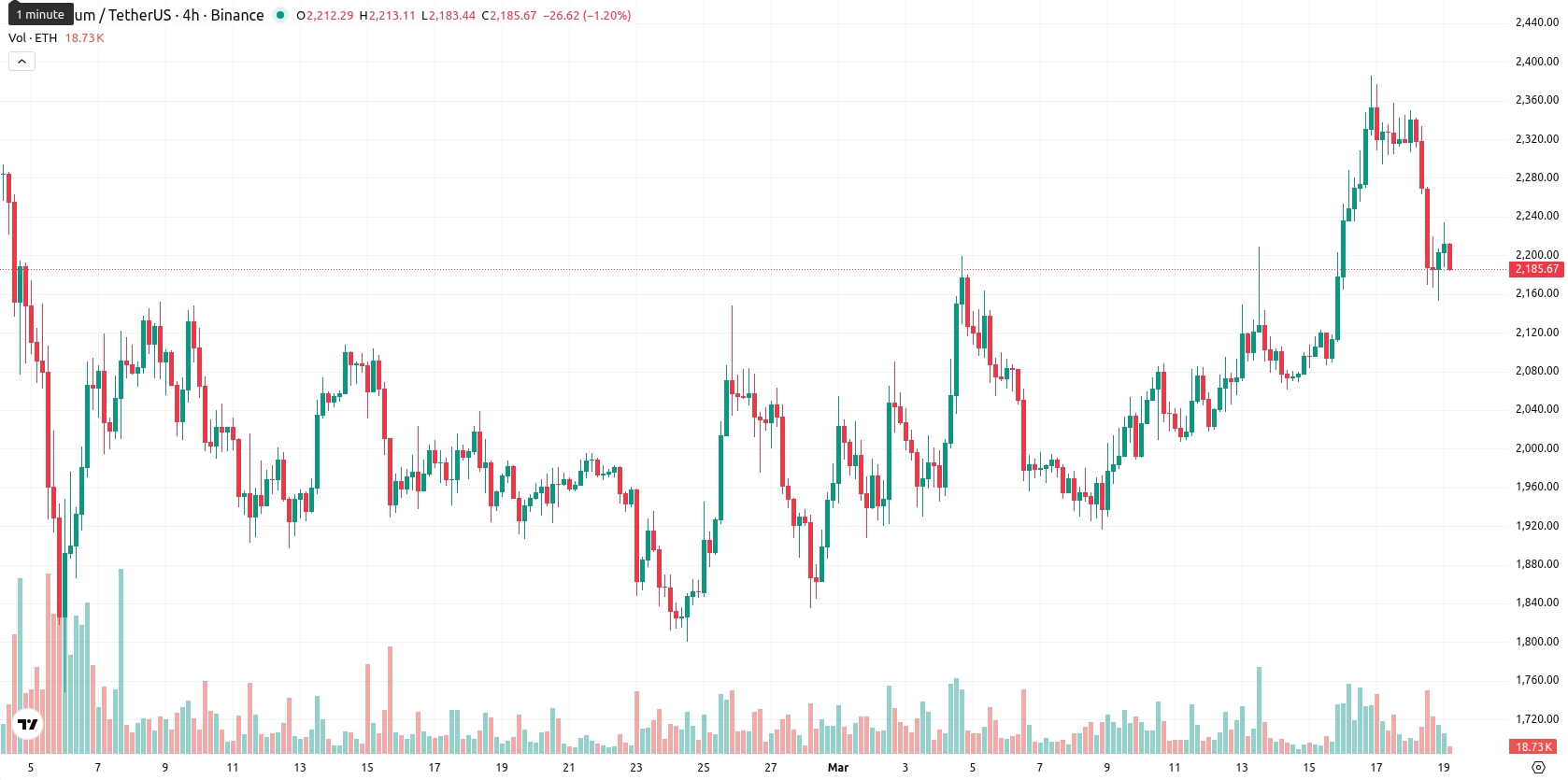
Ethereum (ETH) is trading at $2,189.80, above both the SMA-20 at $2,065.89 and SMA-50 at $2,101.67, but sharply below the SMA-200 at $3,204.73, indicating that short- and medium-term momentum remains constructive while long-term trend pressure persists from above. The Ichimoku Kijun value at $2,093.01 sits below the current price and serves as immediate support.
 1931.2
1946.52
1931.2
1946.52
Highlights
- U.S. regulators now classify Ethereum as a digital commodity, strengthening federal oversight on staking, mining, and airdrops and raising institutional uncertainty.
- With over 66% of ETH locked in the Beacon Deposit Contract and concentrated staked holdings, synchronized outflows pose liquidity risks during adverse events.
- ETH trades above key short-term averages but remains in a downtrend, with a weekly range of $2,085 to $2,203 and a higher likelihood of further downside amid mixed momentum signals.
Institutional caution rises as regulatory shifts and liquidity concentration weigh
U.S. regulators have classified Ethereum (ETHUSD) as a digital commodity, establishing federal rules for staking, mining, airdrops, and token wrapping, which directly alters its regulatory landscape and affects institutional participation. Ongoing disagreements in the U.S. over stablecoin rules and anti-money laundering provisions have stalled crypto legislation, resulting in a subdued risk appetite among institutional investors and restraining inflows from advisory channels. Recent Federal Reserve decisions to hold interest rates steady amid persistent Middle East geopolitical tensions and oil price increases have exerted downward macro pressure on Ethereum markets. Large-scale ETH liquidity remains constrained, with over 66% of total supply locked in the Beacon Deposit Contract and top holdings concentrated among major exchanges and staking entities, raising the risk of synchronized capital outflows in response to adverse geopolitical or regulatory triggers. U.S. political events, including midterm elections and the potential fate of the CLARITY Act, introduce additional uncertainty regarding Ethereum's near-term regulatory outlook.
Bullish momentum faces overbought signals amid elevated intraday volatility
Momentum signals on the daily timeframe present a mixed picture: the MACD and ADX both tilt positive, showing buy signals, while overbought conditions are seen in CCI and BBP, and the RSI remains slightly bullish. Stoch RSI and multiple oscillators present neutral or oversold conditions, indicating a divergence between upward momentum and short-term exhaustion. AO supports the buy direction. The price declined 5.58% today, opening with a gap down and settling near the lower edge of its daily range, signaling high intraday volatility and persistent selling pressure since the open.
Downside risk elevated as weekly indicators maintain bearish bias
For the coming week, the expected price range is $2,085 to $2,203, reflecting typical weekly volatility and keeping the range relative to the current price. The probability of further price declines is more likely, with a very low probability (less than 20%) for a sustained upward move, given the uniformly bearish signals from W1 indicators. The baseline scenario sees ETH consolidating in a sideways band around current levels. In a bullish scenario, a rebound above the $2,203 resistance could trigger additional buying. Conversely, a break below $2,085 would open the way for deeper losses toward lower support levels.
Earlier, analysts noted that macroeconomic headwinds and ongoing regulatory uncertainty were creating a tug-of-war between institutional accumulation and short-term selling pressure in Ethereum markets. With new federal commodity classification for ETH alongside persistent high liquidity lockup and wavering institutional sentiment, traders should monitor the $2,085 support zone closely as a decisive break below this level could accelerate near-term downside risk.








-
 Afghanistan
-
 Albania
-
 Algeria
-
 Angola
-
 Argentina
-
 Armenia
-
 Australia
-
 Austria
-
 Azerbaijan
-
 Bahamas
-
 Bahrain
-
 Bangladesh
-
 Belarus
-
 Belgium
-
 Bolivia
-
 Botswana
-
 Brazil
-
 Brunei
-
 Bulgaria
-
 Cambodia
-
 Cameroon
-
 Canada
-
 Chile
Chile
-
 China
China
-
 Colombia
-
 Congo
Congo
-
 Costa Rica
-
 Cote d'Ivoire
-
 Croatia
-
 Cuba
Cuba
-
 Cyprus
-
 Czechia
-
 DR Congo
-
 Denmark
-
 Dominican Republic
-
 Ecuador
-
 Egypt
Egypt
-
 El Salvador
-
 Estonia
-
 Eswatini
-
 Ethiopia
-
 Finland
-
 France
-
 Georgia
-
 Germany
-
 Ghana
Ghana
-
 Greece
-
 Haiti
Haiti
-
 Hong Kong
-
 Hungary
-
 India
India
-
 Indonesia
-
 Iran, Islamic republic
-
 Iraq
Iraq
-
 Ireland
-
 Israel
-
 Italy
Italy
-
 Jamaica
-
 Japan
Japan
-
 Jordan
-
 Kazakhstan
-
 Kenya
Kenya
-
 Korea
Korea
-
 Kuwait
-
 Kyrgyzstan
-
 Laos
Laos
-
 Latvia
-
 Lebanon
-
 Lesotho
-
 Libya
Libya
-
 Lithuania
-
 Luxembourg
-
 Madagascar
-
 Malaysia
-
 Malta
Malta
-
 Mauritius
-
 Mexico
-
 Moldova
-
 Mongolia
-
 Montenegro
-
 Morocco
-
 Mozambique
-
 Myanmar
-
 Namibia
-
 Nepal
Nepal
-
 Netherlands
-
 New Zealand
-
 Nigeria
-
 North Macedonia
-
 Norway
-
 Oman
Oman
-
 Pakistan
-
 Palestine
-
 Panama
-
 Papua New Guinea
-
 Paraguay
-
 Peru
Peru
-
 Philippines
-
 Poland
-
 Portugal
-
 Puerto Rico
-
 Qatar
Qatar
-
 Reunion
-
 Romania
-
 Rwanda
-
 Saudi Arabia
-
 Serbia
-
 Singapore
-
 Slovakia
-
 Slovenia
-
 Somalia
-
 South Africa
-
 Spain
Spain
-
 Sri Lanka
-
 Sweden
-
 Switzerland
-
 Syria
Syria
-
 Taiwan
-
 Tajikistan
-
 Tanzania
-
 Thailand
-
 Trinidad and Tobago
-
 Tunisia
-
 Turkey
-
 UAE
UAE
-
 Uganda
-
 Ukraine
-
 United Kingdom
-
United States
-
 Uruguay
-
 Uzbekistan
-
 Venezuela
-
 Vietnam
-
 Yemen
Yemen
-
 Zambia
-
 Zimbabwe
- Forex
- Crypto











