

Raydium falls as price remains well below its long-term average

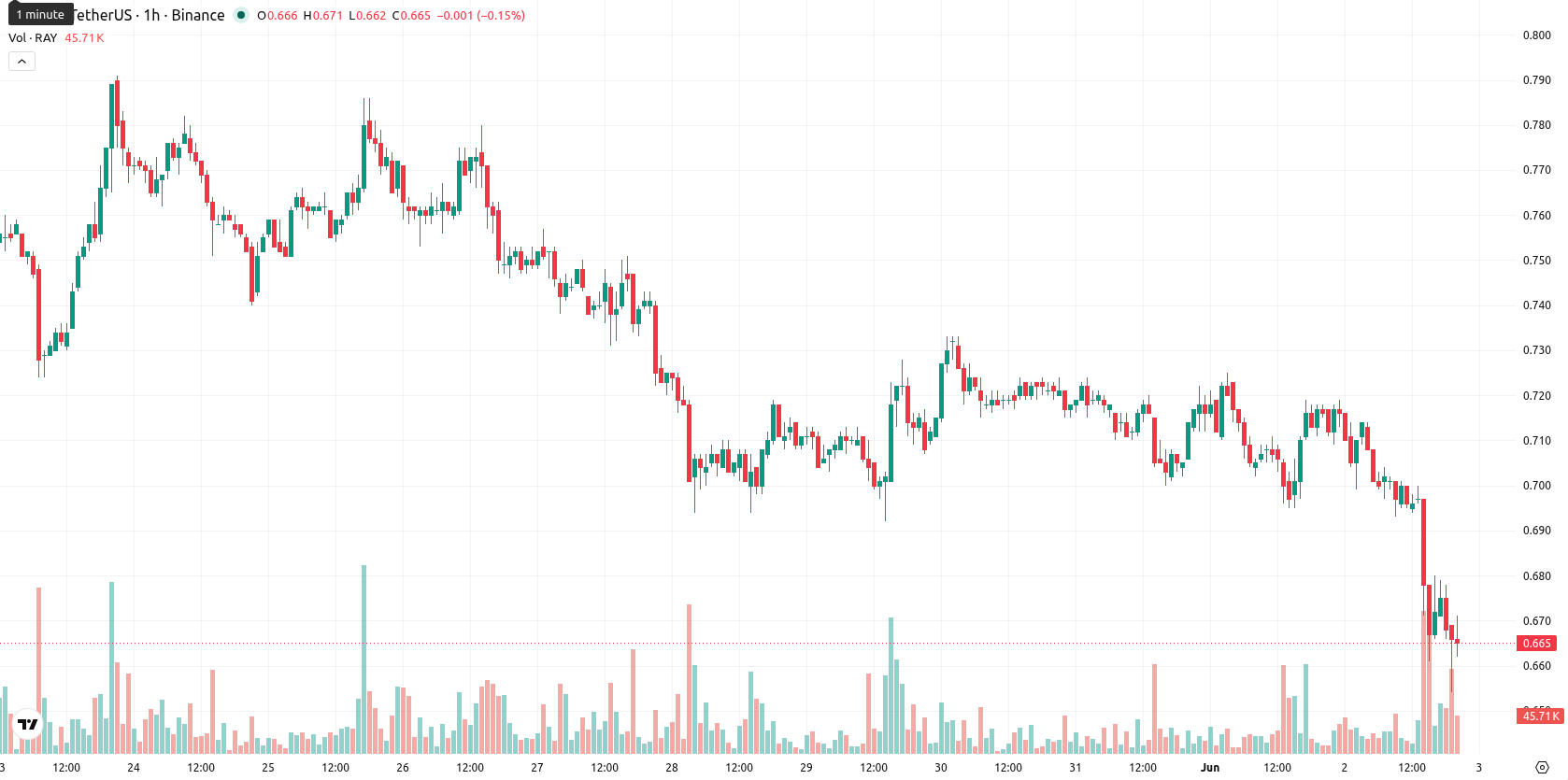
Raydium (RAY) is trading at $0.665, down 7.25% for the session and registering a sharp single-day decline. The current level leaves the asset positioned below its key moving averages, reflecting pronounced, persistent pressure over multiple time horizons.
 2.0868
2.5300
2.0868
2.5300
Highlights
- RAY trades below key moving averages, reflecting sustained bearish sentiment across all time frames.
- Momentum and volatility indicators indicate an oversold condition, reinforcing sellers' dominance and weak prospects for reversal.
- Near-term price action is expected in the $0.64–$0.71 range, with sub-$0.64 lows likely to trigger renewed downside.
Bearish momentum prevails as oversold signals and resistance converge
The 20-, 50-, and 200-day simple moving averages are situated at $0.7401, $0.7450, and $0.8258, respectively, all above the current price, while the Ichimoku Kijun level at $0.7910 serves as immediate resistance. Weak structure is confirmed by bearish momentum on both the MACD and ADX; RSI, Stoch RSI, and CCI reflect an oversold condition, and negative BBP alongside confirmation from the Awesome Oscillator highlight sustained intraday seller dominance.
Sideways drift expected as upside risks hinge on resistance break
Over the next five trading days, the anticipated volatility band ranges from $0.64 to $0.71, with a very low probability (less than 20%) of a meaningful upward move. The most likely scenario is sideways action within this corridor, with upside potential only if RAY decisively breaches resistance at $0.79. A close below $0.64 could open the door to renewed selling pressure and further declines, while signals of a broader trend reversal remain weak at present.
Earlier, analysts noted that Raydium was facing ongoing seller dominance with only tentative signs of medium-term support and limited breakout potential. The latest developments reinforce this bearish trend, and with volatility now compressing near key supports, traders should monitor for a decisive move below $0.64 as a signal of escalating downside risk.





Latest Raydium News





-
 Afghanistan
-
 Albania
-
 Algeria
-
 Angola
-
 Argentina
-
 Armenia
-
 Australia
-
 Austria
-
 Azerbaijan
-
 Bahamas
-
 Bahrain
-
 Bangladesh
-
 Belarus
-
 Belgium
-
 Bolivia
-
 Botswana
-
 Brazil
-
 Brunei
-
 Bulgaria
-
 Cambodia
-
 Cameroon
-
 Canada
-
 Chile
Chile
-
 China
China
-
 Colombia
-
 Congo
Congo
-
 Costa Rica
-
 Cote d'Ivoire
-
 Croatia
-
 Cuba
Cuba
-
 Cyprus
-
 Czechia
-
 DR Congo
-
 Denmark
-
 Dominican Republic
-
 Ecuador
-
 Egypt
Egypt
-
 El Salvador
-
 Estonia
-
 Eswatini
-
 Ethiopia
-
 Finland
-
 France
-
 Georgia
-
 Germany
-
 Ghana
Ghana
-
 Greece
-
 Haiti
Haiti
-
 Hong Kong
-
 Hungary
-
 India
India
-
 Indonesia
-
 Iran, Islamic republic
-
 Iraq
Iraq
-
 Ireland
-
 Israel
-
 Italy
Italy
-
 Jamaica
-
 Japan
Japan
-
 Jordan
-
 Kazakhstan
-
 Kenya
Kenya
-
 Korea
Korea
-
 Kuwait
-
 Kyrgyzstan
-
 Laos
Laos
-
 Latvia
-
 Lebanon
-
 Lesotho
-
 Libya
Libya
-
 Lithuania
-
 Luxembourg
-
 Madagascar
-
 Malaysia
-
 Malta
Malta
-
 Mauritius
-
 Mexico
-
 Moldova
-
 Mongolia
-
 Montenegro
-
 Morocco
-
 Mozambique
-
 Myanmar
-
 Namibia
-
 Nepal
Nepal
-
 Netherlands
-
 New Zealand
-
 Nigeria
-
 North Macedonia
-
 Norway
-
 Oman
Oman
-
 Pakistan
-
 Palestine
-
 Panama
-
 Papua New Guinea
-
 Paraguay
-
 Peru
Peru
-
 Philippines
-
 Poland
-
 Portugal
-
 Puerto Rico
-
 Qatar
Qatar
-
 Reunion
-
 Romania
-
 Rwanda
-
 Saudi Arabia
-
 Serbia
-
 Singapore
-
 Slovakia
-
 Slovenia
-
 Somalia
-
 South Africa
-
 Spain
Spain
-
 Sri Lanka
-
 Sweden
-
 Switzerland
-
 Syria
Syria
-
 Taiwan
-
 Tajikistan
-
 Tanzania
-
 Thailand
-
 Trinidad and Tobago
-
 Tunisia
-
 Turkey
-
 UAE
UAE
-
 Uganda
-
 Ukraine
-
 United Kingdom
-
United States
-
 Uruguay
-
 Uzbekistan
-
 Venezuela
-
 Vietnam
-
 Yemen
Yemen
-
 Zambia
-
 Zimbabwe
- Forex
- Crypto












