
Ethereum awaits biggest upgrade in years as demand remains weak

Ethereum's largest network upgrade in years has entered its final stage of development. The key question now is whether the cryptocurrency can finally break its ongoing downtrend.
Ethereum developers have moved the Glamsterdam upgrade into its final testing phase. According to representatives of the Ethereum Foundation, this could become the most significant network fork since The Merge.
The primary goal of the upgrade is to improve scalability, accelerate transaction processing, and reduce centralization risks. One of the most important changes is the implementation of ePBS (Enshrined Proposer-Builder Separation), which is designed to make block production more transparent and reduce the influence of MEV-related strategies on the network.
The upgrade also includes Block-level Access Lists, a technology intended to improve data processing efficiency and prepare Ethereum for further scaling.
Additionally, developers plan to modify the fee structure. Complex computations are expected to become cheaper, while on-chain data storage will become more expensive.
However, institutional investors remain cautious. Although outflows from spot ETH ETFs have stopped, capital inflows remain relatively modest. According to recent data, ETH ETFs recorded inflows of just $9.59 million on June 16, suggesting that sustained institutional demand has yet to return.
The breakout attempt begins to fade
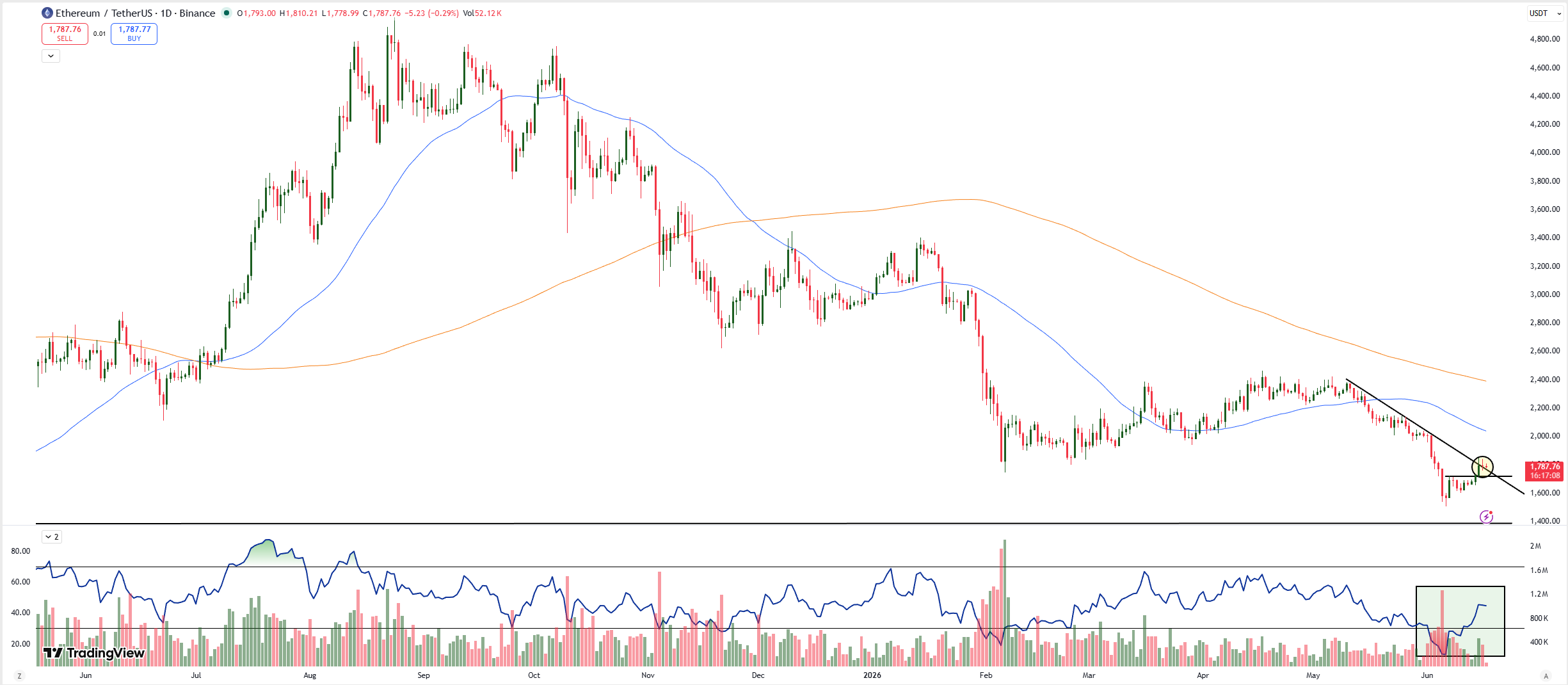
ETH tested the local resistance level at $1,850 but failed to establish itself above it, causing bullish momentum to weaken.
The cryptocurrency managed to break above its short-term descending trendline. However, a move back below that trendline remains a realistic possibility.
For now, the key level to watch is $1,770, which coincides with trendline support. A break below this level could open the door for a decline toward $1,700.
Meanwhile, the RSI (14) has exited oversold territory, which historically adds momentum to the prevailing medium-term downtrend.
Institutional demand remains limited
Despite the recent improvement in ETH ETF flows, institutional demand remains relatively weak.
After a prolonged period of outflows, ETFs have begun recording modest inflows. However, these figures remain far below the levels typically associated with the beginning of a sustainable bullish trend.
This suggests that investors are gradually becoming less willing to sell Ethereum, but they are not yet prepared to aggressively increase their exposure.
Given the historically lower trading activity during the summer months, a significant increase in liquidity appears unlikely in the near term.


Latest Ethereum News





-
 Afghanistan
-
 Albania
-
 Algeria
-
 Angola
-
 Argentina
-
 Armenia
-
 Australia
-
 Austria
-
 Azerbaijan
-
 Bahamas
-
 Bahrain
-
 Bangladesh
-
 Belarus
-
 Belgium
-
 Bolivia
-
 Botswana
-
 Brazil
-
 Brunei
-
 Bulgaria
-
 Cambodia
-
 Cameroon
-
 Canada
-
 Chile
Chile
-
 China
China
-
 Colombia
-
 Congo
Congo
-
 Costa Rica
-
 Cote d'Ivoire
-
 Croatia
-
 Cuba
Cuba
-
 Cyprus
-
 Czechia
-
 DR Congo
-
 Denmark
-
 Dominican Republic
-
 Ecuador
-
 Egypt
Egypt
-
 El Salvador
-
 Estonia
-
 Eswatini
-
 Ethiopia
-
 Finland
-
 France
-
 Georgia
-
 Germany
-
 Ghana
Ghana
-
 Greece
-
 Haiti
Haiti
-
 Hong Kong
-
 Hungary
-
 India
India
-
 Indonesia
-
 Iran, Islamic republic
-
 Iraq
Iraq
-
 Ireland
-
 Israel
-
 Italy
Italy
-
 Jamaica
-
 Japan
Japan
-
 Jordan
-
 Kazakhstan
-
 Kenya
Kenya
-
 Korea
Korea
-
 Kuwait
-
 Kyrgyzstan
-
 Laos
Laos
-
 Latvia
-
 Lebanon
-
 Lesotho
-
 Libya
Libya
-
 Lithuania
-
 Luxembourg
-
 Madagascar
-
 Malaysia
-
 Malta
Malta
-
 Mauritius
-
 Mexico
-
 Moldova
-
 Mongolia
-
 Montenegro
-
 Morocco
-
 Mozambique
-
 Myanmar
-
 Namibia
-
 Nepal
Nepal
-
 Netherlands
-
 New Zealand
-
 Nigeria
-
 North Macedonia
-
 Norway
-
 Oman
Oman
-
 Pakistan
-
 Palestine
-
 Panama
-
 Papua New Guinea
-
 Paraguay
-
 Peru
Peru
-
 Philippines
-
 Poland
-
 Portugal
-
 Puerto Rico
-
 Qatar
Qatar
-
 Reunion
-
 Romania
-
 Rwanda
-
 Saudi Arabia
-
 Serbia
-
 Singapore
-
 Slovakia
-
 Slovenia
-
 Somalia
-
 South Africa
-
 Spain
Spain
-
 Sri Lanka
-
 Sweden
-
 Switzerland
-
 Syria
Syria
-
 Taiwan
-
 Tajikistan
-
 Tanzania
-
 Thailand
-
 Trinidad and Tobago
-
 Tunisia
-
 Turkey
-
 UAE
UAE
-
 Uganda
-
 Ukraine
-
 United Kingdom
-
United States
-
 Uruguay
-
 Uzbekistan
-
 Venezuela
-
 Vietnam
-
 Yemen
Yemen
-
 Zambia
-
 Zimbabwe
- Forex
- Crypto











