The tweet was deleted by the author.
But we saved everything 🙂.


XRP (XRP) is trading at $1.4711, marking a decline of $0.0463 or 3.05% versus the previous close. Since the open, the price has moved near the lower end of today's volatile $1.4611 – $1.5505 range, reflecting visible intraday selling pressure. The pullback follows a strong, overbought rally and signals near-term reversion risk as bullish momentum diverges from exhausted oscillators. The market correction is largely driven by technical overextension and profit-taking, overshadowing recent positive developments related to the XRP Ledger ecosystem.
 1.3534
1.4300
1.3534
1.4300
Ripple highlighted that RLUSD crossed $2 billion in market cap last week, with nearly $1 billion issued on the XRP Ledger, emphasizing its real-world utility and enterprise focus. This tweet signals increasing adoption and enterprise penetration on the XRP Ledger, a factor that can drive demand and long-term value for the network. However, despite these positive signals, the market is reacting more strongly to profit-taking after last week's rally and overbought technical conditions. Meanwhile, XRP has benefited from strong inflows into US spot XRP ETFs, regulatory optimism following high-profile policy summits, and continued institutional growth in its ecosystem.
View post on X Loading...
XRP is firmly above its MA-20 at $1.1488, MA-50 at $1.1148, and MA-200 at $1.2769, confirming a bullish structure across all major timeframes. Immediate support is set at $1.4275, with resistance near $1.5500. The MACD remains in buy territory, but an overbought RSI at 81.63 and high volatility warn of a likely pullback. For the next five days, XRP is expected to consolidate in the $1.4275 – $1.5500 range, with the tweet's positive signal yet to be reflected in near-term price action, adding caution to the outlook.
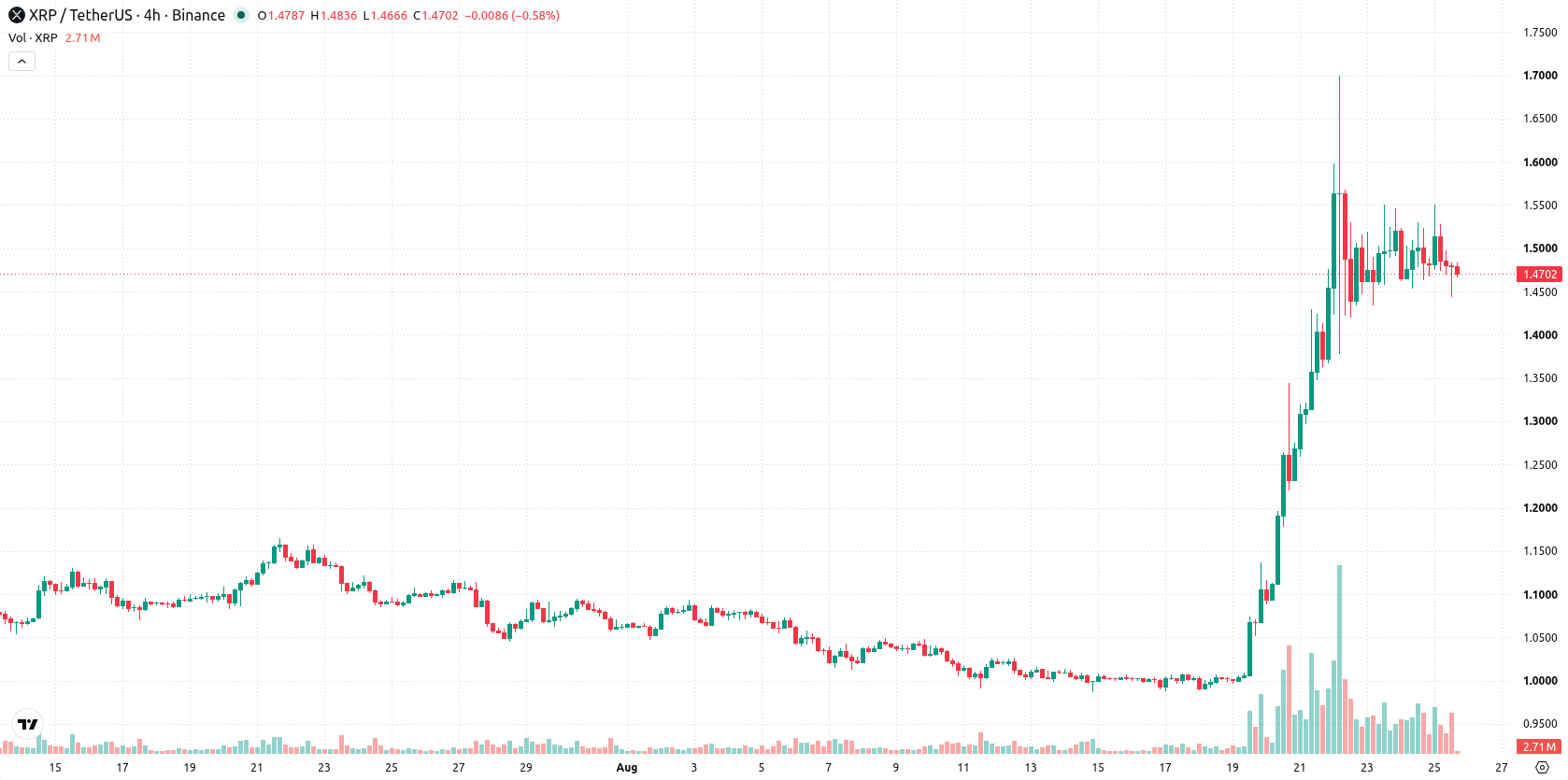
Previously it was reported that XRP showed resilient momentum, underpinned by network upgrades and significant institutional ETF inflows, which contributed to short-term price stability despite heightened volatility. This article offers an updated assessment, highlighting a shift in technical signals that makes monitoring the current consolidation zone crucial for traders considering new positions.


 Afghanistan
 Albania
 Algeria
 Angola
 Argentina
 Armenia
 Australia
 Austria
 Azerbaijan
 Bahamas
 Bahrain
 Bangladesh
 Belarus
 Belgium
 Bolivia
 Botswana
 Brazil
 Brunei
 Bulgaria
 Cambodia
 Cameroon
 Canada
 Chile
Chile
 China
China
 Colombia
 Congo
Congo
 Costa Rica
 Cote d'Ivoire
 Croatia
 Cuba
Cuba
 Cyprus
 Czechia
 DR Congo
 Denmark
 Dominican Republic
 Ecuador
 Egypt
Egypt
 El Salvador
 Estonia
 Eswatini
 Ethiopia
 Finland
 France
 Georgia
 Germany
 Ghana
Ghana
 Greece
 Haiti
Haiti
 Hong Kong
 Hungary
 India
India
 Indonesia
 Iran, Islamic republic
 Iraq
Iraq
 Ireland
 Israel
 Italy
Italy
 Jamaica
 Japan
Japan
 Jordan
 Kazakhstan
 Kenya
Kenya
 Korea
Korea
 Kuwait
 Kyrgyzstan
 Laos
Laos
 Latvia
 Lebanon
 Lesotho
 Libya
Libya
 Lithuania
 Luxembourg
 Madagascar
 Malaysia
 Malta
Malta
 Mauritius
 Mexico
 Moldova
 Mongolia
 Montenegro
 Morocco
 Mozambique
 Myanmar
 Namibia
 Nepal
Nepal
 Netherlands
 New Zealand
 Nigeria
 North Macedonia
 Norway
 Oman
Oman
 Pakistan
 Palestine
 Panama
 Papua New Guinea
 Paraguay
 Peru
Peru
 Philippines
 Poland
 Portugal
 Puerto Rico
 Qatar
Qatar
 Reunion
 Romania
 Rwanda
 Saudi Arabia
 Serbia
 Singapore
 Slovakia
 Slovenia
 Somalia
 South Africa
 Spain
Spain
 Sri Lanka
 Sweden
 Switzerland
 Syria
Syria
 Taiwan
 Tajikistan
 Tanzania
 Thailand
 Trinidad and Tobago
 Tunisia
 Turkey
 UAE
UAE
 Uganda
 Ukraine
 United Kingdom
United States
United Kingdom
United States
 Uruguay
 Uzbekistan
 Venezuela
 Vietnam
 Yemen
Yemen
 Zambia
 Zimbabwe