The tweet was deleted by the author.
But we saved everything 🙂.


Uniswap (UNI) is currently trading at $7.08, which represents a $0.06 increase or +0.81% from the previous close of $7.02. Since the market open at $7.01, the price has remained within a moderate intraday range of $6.98 to $7.30, settling near the midpoint with largely sideways action. Daily momentum and technical signals remain bearish, with ongoing seller pressure dominating trading. The gain is best explained by minor mean reversion and moderate oscillation within a weak technical structure, as opposed to external sentiment shifts.
 4.937
5.3190
Hayden Adams compared Uniswap’s USDC to ETH trade execution with that of Matcha, highlighting Uniswap's slight advantage in output for large transactions. This matters for Uniswap because even marginal routing efficiency can drive increased on-chain swap volume, which enhances fee generation and token burns, influencing revenue and circulating supply trends. The news background supports this, with Uniswap launching Aggregator Hooks across multiple chains, now enabling direct protocol fee flows to UNI token burns and creating additional deflationary support as part of broader governance initiatives. Recent approval for regulated UNI futures on CME Group also signals growing institutional recognition.
View post on X Loading...
UNI is trading below both its MA-20 ($7.68) and MA-50 ($7.79), indicating short- and medium-term pressure, while still positioned well above the long-term MA-200 at $4.54 for structural support. The nearest resistance is seen at $8.47, with support around $6.70, and momentum indicators such as MACD and RSI remain bearish. Over the next five sessions, the anticipated trading range is $6.70 to $7.80, with a high probability for a rebound based on supportive weekly trend signals. However, as the tweet's fundamental message has not been confirmed by price action, this adds some caution to the near-term forecast.
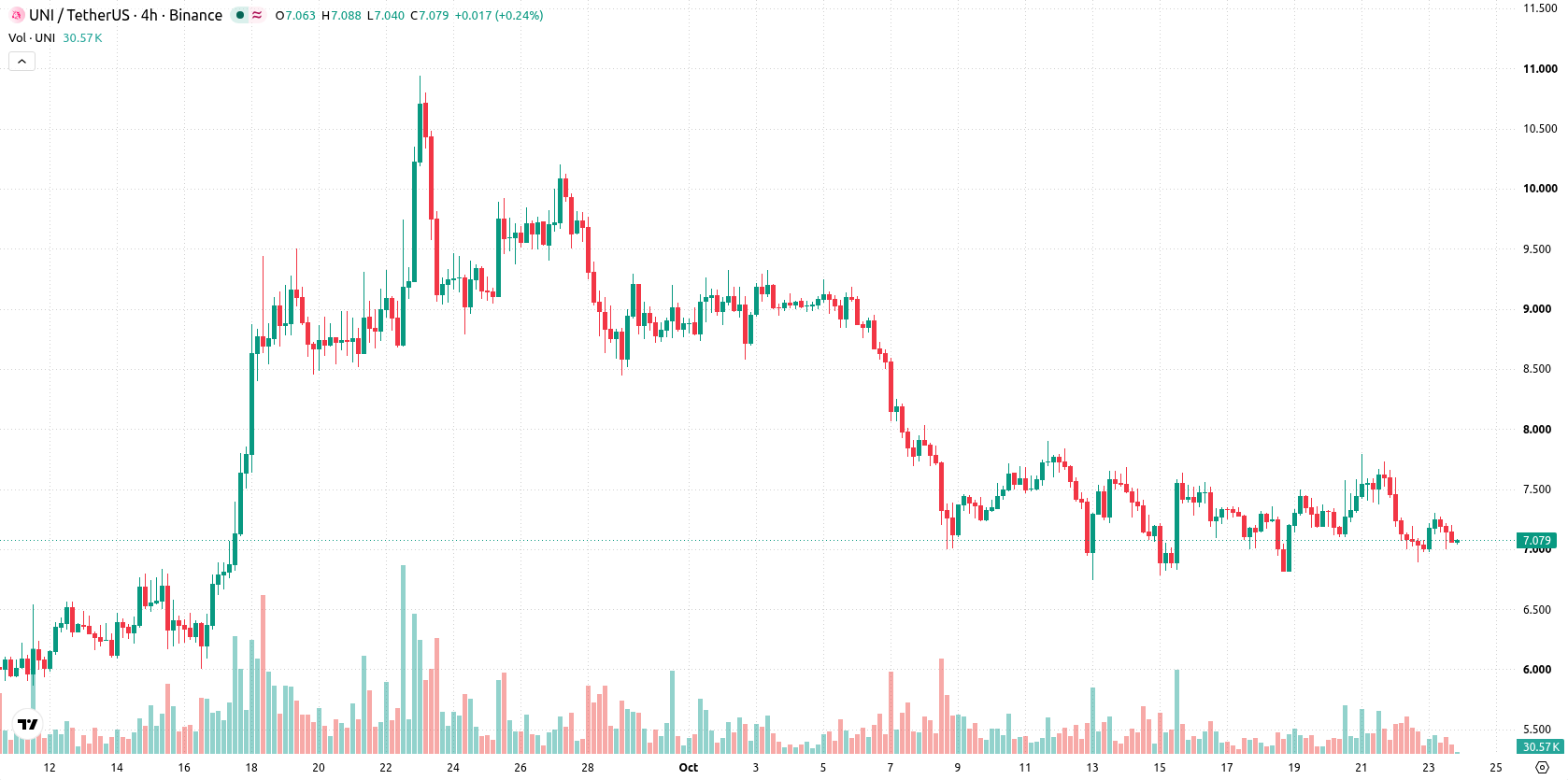
Earlier, analysts noted that Uniswap was under persistent selling pressure despite recent technical upgrades and institutional listings, with price action reflecting a choppy and consolidative environment. The current analysis signals a notable shift, highlighting that traders should watch for a decisive breakout from the prevailing range to determine the next directional move.



 Afghanistan
 Albania
 Algeria
 Angola
 Argentina
 Armenia
 Australia
 Austria
 Azerbaijan
 Bahamas
 Bahrain
 Bangladesh
 Belarus
 Belgium
 Bolivia
 Botswana
 Brazil
 Brunei
 Bulgaria
 Cambodia
 Cameroon
 Canada
 Chile
 China
 Colombia
 Congo
 Costa Rica
 Cote d'Ivoire
 Croatia
 Cuba
 Cyprus
 Czechia
 DR Congo
 Denmark
 Dominican Republic
 Ecuador
 Egypt
 El Salvador
 Estonia
 Eswatini
 Ethiopia
 Finland
 France
 Georgia
 Germany
 Ghana
 Greece
 Haiti
 Hong Kong
 Hungary
 India
 Indonesia
 Iran, Islamic republic
 Iraq
 Ireland
 Israel
 Italy
 Jamaica
 Japan
 Jordan
 Kazakhstan
 Kenya
 Korea
 Kuwait
 Kyrgyzstan
 Laos
 Latvia
 Lebanon
 Lesotho
 Libya
 Lithuania
 Luxembourg
 Madagascar
 Malaysia
 Malta
 Mauritius
 Mexico
 Moldova
 Mongolia
 Montenegro
 Morocco
 Mozambique
 Myanmar
 Namibia
 Nepal
 Netherlands
 New Zealand
 Nigeria
 North Macedonia
 Norway
 Oman
 Pakistan
 Palestine
 Panama
 Papua New Guinea
 Paraguay
 Peru
 Philippines
 Poland
 Portugal
 Puerto Rico
 Qatar
 Reunion
 Romania
 Rwanda
 Saudi Arabia
 Serbia
 Singapore
 Slovakia
 Slovenia
 Somalia
 South Africa
 Spain
 Sri Lanka
 Sweden
 Switzerland
 Syria
 Taiwan
 Tajikistan
 Tanzania
 Thailand
 Trinidad and Tobago
 Tunisia
 Turkey
 UAE
 Uganda
 Ukraine
 United Kingdom
United States
 Uruguay
 Uzbekistan
 Venezuela
 Vietnam
 Yemen
 Zambia
 Zimbabwe