


Saros (SAROS) rallied 25.66% today as weak technical momentum and oversold oscillators may have prompted short-term buying interest in the absence of fresh catalysts. The rebound looks limited, with SAROS still trading well below all its major moving averages and locked within a tightly rangebound, bearish setup.
 0.0001
28
Highlights
- SAROS/USD trades well below key moving averages, indicating sustained downward pressure across all timeframes.
- Bearish momentum dominates as MACD, ADX, and multiple overbought-oversold indicators register weak trend signals.
- SAROS/USD remains locked in a flat, extremely tight $0.0001 to $0.0001 range with high probability of further decline.
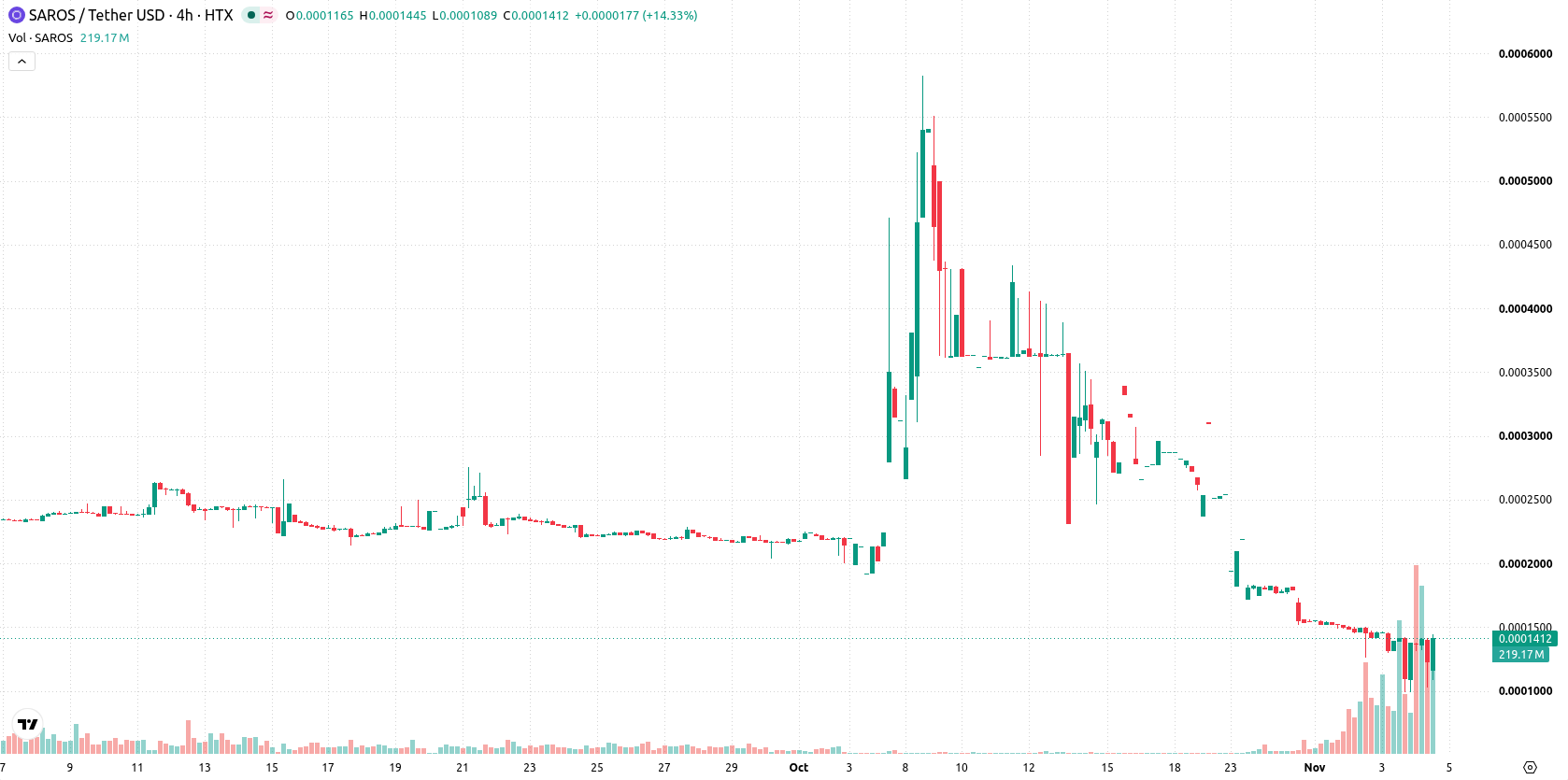
Bearish alignment persists as SAROS holds below major averages
SAROS/USD is trading notably below its 20-day, 50-day, and 200-day moving averages at $0.0002, $0.0002, and $0.0004, respectively, indicating sustained pressure from sellers across all timeframes. The near-term ceiling and floor remain fixed at $0.0001, confirming a tightly rangebound setup and persistent bearish alignment, further emphasized by a bearish 50-day versus 200-day moving average configuration. Momentum signals are weak, with the MACD and ADX both confirming a bearish trend. The RSI, Stochastic RSI, and CCI are each in their respective oversold zones, highlighting rebound potential without yet confirming it. Sellers continue to dominate intraday momentum, as reflected by a zero-value Bull/Bear Power (BBP), and the Awesome Oscillator supports the prevailing negative trend. Intraday price action is unchanged at $0.0001, showing no volatility or directional intent.
Earlier, analysts noted that Saros was experiencing mixed technical momentum within a broadly bearish setup, cautioning that clear directional signals would depend on a decisive move outside its established trading corridor. The current analysis reinforces this outlook by highlighting ongoing rangebound price action and sustained downward pressure, with the key scenario for traders now being to monitor for a confirmed break below the $0.0001 support as the next potential trigger for downside risk.






Latest Saros News




-
 Afghanistan
-
 Albania
-
 Algeria
-
 Angola
-
 Argentina
-
 Armenia
-
 Australia
-
 Austria
-
 Azerbaijan
-
 Bahamas
-
 Bahrain
-
 Bangladesh
-
 Belarus
-
 Belgium
-
 Bolivia
-
 Botswana
-
 Brazil
-
 Brunei
-
 Bulgaria
-
 Cambodia
-
 Cameroon
-
 Canada
-
 Chile
-
 China
-
 Colombia
-
 Congo
-
 Costa Rica
-
 Cote d'Ivoire
-
 Croatia
-
 Cuba
-
 Cyprus
-
 Czechia
-
 DR Congo
-
 Denmark
-
 Dominican Republic
-
 Ecuador
-
 Egypt
-
 El Salvador
-
 Estonia
-
 Eswatini
-
 Ethiopia
-
 Finland
-
 France
-
 Georgia
-
 Germany
-
 Ghana
-
 Greece
-
 Haiti
-
 Hong Kong
-
 Hungary
-
 India
-
 Indonesia
-
 Iran, Islamic republic
-
 Iraq
-
 Ireland
-
 Israel
-
 Italy
-
 Jamaica
-
 Japan
-
 Jordan
-
 Kazakhstan
-
 Kenya
-
 Korea
-
 Kuwait
-
 Kyrgyzstan
-
 Laos
-
 Latvia
-
 Lebanon
-
 Lesotho
-
 Libya
-
 Lithuania
-
 Luxembourg
-
 Madagascar
-
 Malaysia
-
 Malta
-
 Mauritius
-
 Mexico
-
 Moldova
-
 Mongolia
-
 Montenegro
-
 Morocco
-
 Mozambique
-
 Myanmar
-
 Namibia
-
 Nepal
-
 Netherlands
-
 New Zealand
-
 Nigeria
-
 North Macedonia
-
 Norway
-
 Oman
-
 Pakistan
-
 Palestine
-
 Panama
-
 Papua New Guinea
-
 Paraguay
-
 Peru
-
 Philippines
-
 Poland
-
 Portugal
-
 Puerto Rico
-
 Qatar
-
 Reunion
-
 Romania
-
 Rwanda
-
 Saudi Arabia
-
 Serbia
-
 Singapore
-
 Slovakia
-
 Slovenia
-
 Somalia
-
 South Africa
-
 Spain
-
 Sri Lanka
-
 Sweden
-
 Switzerland
-
 Syria
-
 Taiwan
-
 Tajikistan
-
 Tanzania
-
 Thailand
-
 Trinidad and Tobago
-
 Tunisia
-
 Turkey
-
 UAE
-
 Uganda
-
 Ukraine
-
 United Kingdom
-
United States
-
 Uruguay
-
 Uzbekistan
-
 Venezuela
-
 Vietnam
-
 Yemen
-
 Zambia
-
 Zimbabwe
- Forex
- Crypto












