

Recent Fed meeting minutes worsen monetary conditions for Bitcoin, signaling potential for further stress

Bitcoin (BTC) is trading lower, quoted at $59,156 as of November 20, 2026, after a daily drop of 6.24%. The asset remains under pressure following signals of tighter US monetary policy after the Federal Reserve's latest meeting. Market participants are watching for further central bank actions and US inflation data as drivers of crypto liquidity and risk sentiment.
 62639.52
68446.21
Highlights
- Federal Reserve officials discussed the possibility of additional rate increases at the October 2026 meeting and warned of persistent inflation.
- Ongoing tight monetary policy reduces dollar liquidity and curbs institutional demand for BTC and other cryptocurrencies.
- BTC trades below key technical benchmarks with multiple bearish signals, facing downside risk unless US monetary policy turns more accommodative.
Federal Reserve's hawkish stance weighs on Bitcoin demand
According to FXStreet, the Federal Reserve's October 2026 meeting minutes, released on November 18, 2026, showed that most officials considered the possibility of additional interest rate increases and continued to warn about persistent inflation.
These signals of a hawkish policy stance point to a reduction in dollar liquidity, making speculative assets like BTC less attractive to institutional buyers. Tighter monetary conditions limit the flow of funds into riskier markets and may further temper demand for cryptocurrencies.
This persistent macroeconomic pressure acts as a limiting factor for BTC, which remains sensitive to shifts in global risk appetite and central bank actions. Broader institutional participation could remain subdued while restrictive policy signals persist.
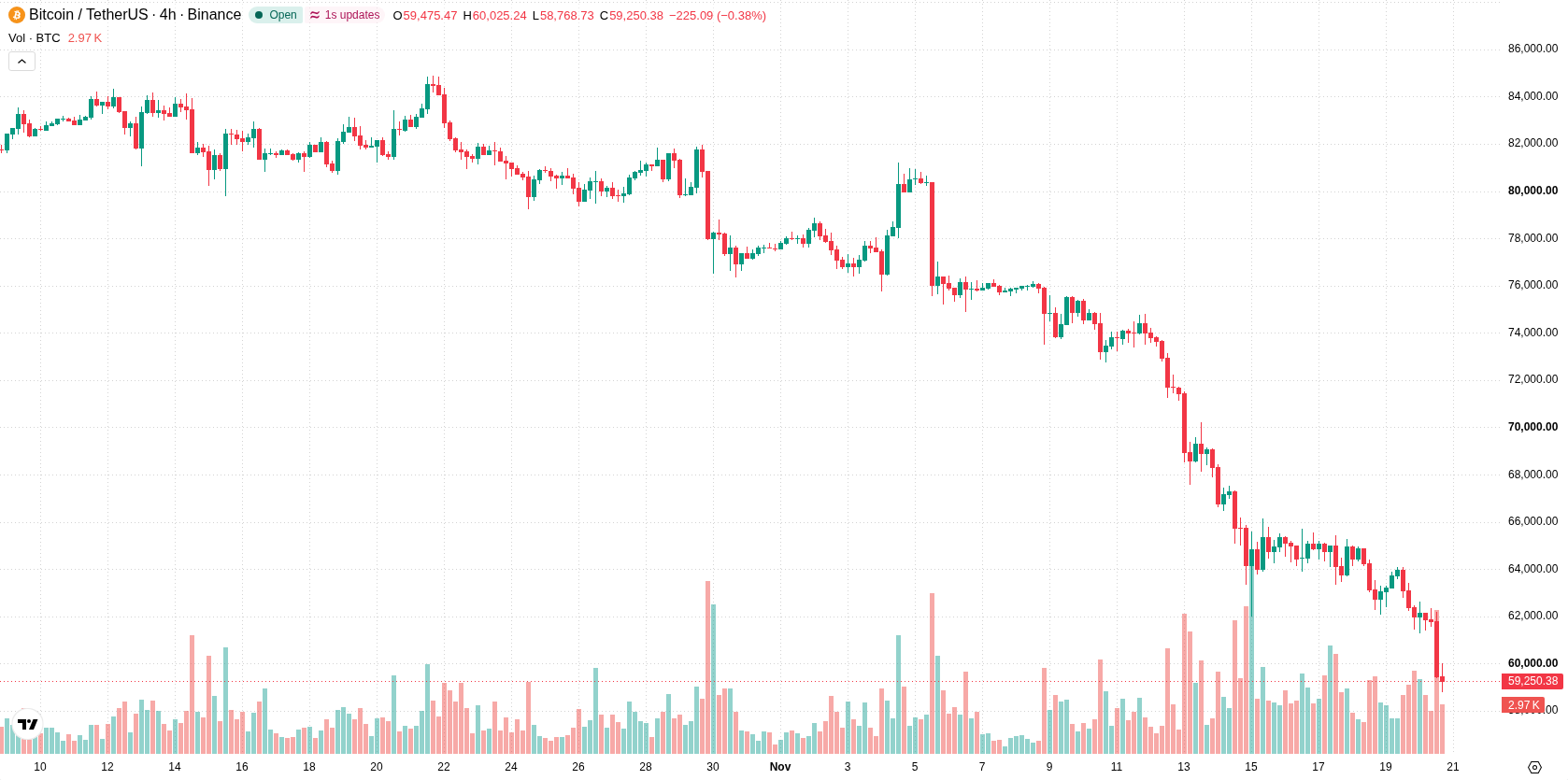
BTC remains below key H4 moving averages amid sell signals
BTC continues to trade well below key trend levels, with the H4 SMA-50 at $65,436 and H4 SMA-200 at $75,437. The MACD on the 4H chart remains in sell territory, indicating ongoing downward momentum as liquidity conditions tighten.
The H4 Kijun sits at $63,463, acting as a resistance level for any short-term recovery attempts. The technical setup features alignment with the prevailing bearish macro environment, with the ADX also pointing to a selling trend.
Fed monetary policy as primary risk to Bitcoin stabilization
BTC is exposed to continued downside risk while uncertainty over the Federal Reserve's next move dominates sentiment. Stabilization above the H4 Kijun around $63,463 could signal the start of recovery, but sustained restrictive policy would keep demand and price under pressure. A confirmed dovish shift by the Fed or a meaningful inflation slowdown would be needed to alter the risk balance. Until then, monitoring central bank commentary and US data releases remains critical.
Earlier, analysts noted that Bitcoin's role as a safe haven asset had come under scrutiny amid significant declines and increased correlation with broader risk markets. The current environment of restrictive US monetary policy continues to reinforce this dynamic, with upcoming Federal Reserve communications and inflation data remaining pivotal for the asset's outlook.






Latest Bitcoin News





-
 Afghanistan
-
 Albania
-
 Algeria
-
 Angola
-
 Argentina
-
 Armenia
-
 Australia
-
 Austria
-
 Azerbaijan
-
 Bahamas
-
 Bahrain
-
 Bangladesh
-
 Belarus
-
 Belgium
-
 Bolivia
-
 Botswana
-
 Brazil
-
 Brunei
-
 Bulgaria
-
 Cambodia
-
 Cameroon
-
 Canada
-
 Chile
-
 China
-
 Colombia
-
 Congo
-
 Costa Rica
-
 Cote d'Ivoire
-
 Croatia
-
 Cuba
-
 Cyprus
-
 Czechia
-
 DR Congo
-
 Denmark
-
 Dominican Republic
-
 Ecuador
-
 Egypt
-
 El Salvador
-
 Estonia
-
 Eswatini
-
 Ethiopia
-
 Finland
-
 France
-
 Georgia
-
 Germany
-
 Ghana
-
 Greece
-
 Haiti
-
 Hong Kong
-
 Hungary
-
 India
-
 Indonesia
-
 Iran, Islamic republic
-
 Iraq
-
 Ireland
-
 Israel
-
 Italy
-
 Jamaica
-
 Japan
-
 Jordan
-
 Kazakhstan
-
 Kenya
-
 Korea
-
 Kuwait
-
 Kyrgyzstan
-
 Laos
-
 Latvia
-
 Lebanon
-
 Lesotho
-
 Libya
-
 Lithuania
-
 Luxembourg
-
 Madagascar
-
 Malaysia
-
 Malta
-
 Mauritius
-
 Mexico
-
 Moldova
-
 Mongolia
-
 Montenegro
-
 Morocco
-
 Mozambique
-
 Myanmar
-
 Namibia
-
 Nepal
-
 Netherlands
-
 New Zealand
-
 Nigeria
-
 North Macedonia
-
 Norway
-
 Oman
-
 Pakistan
-
 Palestine
-
 Panama
-
 Papua New Guinea
-
 Paraguay
-
 Peru
-
 Philippines
-
 Poland
-
 Portugal
-
 Puerto Rico
-
 Qatar
-
 Reunion
-
 Romania
-
 Rwanda
-
 Saudi Arabia
-
 Serbia
-
 Singapore
-
 Slovakia
-
 Slovenia
-
 Somalia
-
 South Africa
-
 Spain
-
 Sri Lanka
-
 Sweden
-
 Switzerland
-
 Syria
-
 Taiwan
-
 Tajikistan
-
 Tanzania
-
 Thailand
-
 Trinidad and Tobago
-
 Tunisia
-
 Turkey
-
 UAE
-
 Uganda
-
 Ukraine
-
 United Kingdom
-
United States
-
 Uruguay
-
 Uzbekistan
-
 Venezuela
-
 Vietnam
-
 Yemen
-
 Zambia
-
 Zimbabwe
- Forex
- Crypto












