
WTI crude oil slides toward $56 as Venezuela supply shift revives oversupply fears

WTI crude oil is under renewed pressure, ensuring near $56 a barrel on Wednesday as early-year optimism fades and markets reprice geopolitical headlines through a supply lens. Prices extended weekly losses after President Donald Trump said Venezuela would deliver 30-50 million barrels of crude to the United States, a development traders see as adding barrels to an already heavy global market rather than tightening it.
Highlights
- WTI trades near $56 as Venezuelan supply headlines weigh on sentiment
- Key moving averages continue to cap upside momentum
- Oversupply expectations dominate despite intermittent geopolitical risks
The announcement reversed a short-lived geopolitical risk premium and reinforced concerns that 2026 could shape up as another year of oversupply, leaving crude struggling to regain traction despite periodic relief rallies.
Downtrend intact as rallies fail near key resistance
On the daily chart, WTI’s technical bias remains firmly bearish. Price continues to trade below all major EMAs, reinforcing the broader downtrend that has been in place since late summer. The 20-day EMA near $57.6 has turned into immediate resistance, repeatedly rejecting rebound attempts. Above that, the 50-day EMA around $58.6 and the 100-day EMA near $60.2 form a dense supply band where sellers have consistently reasserted control.
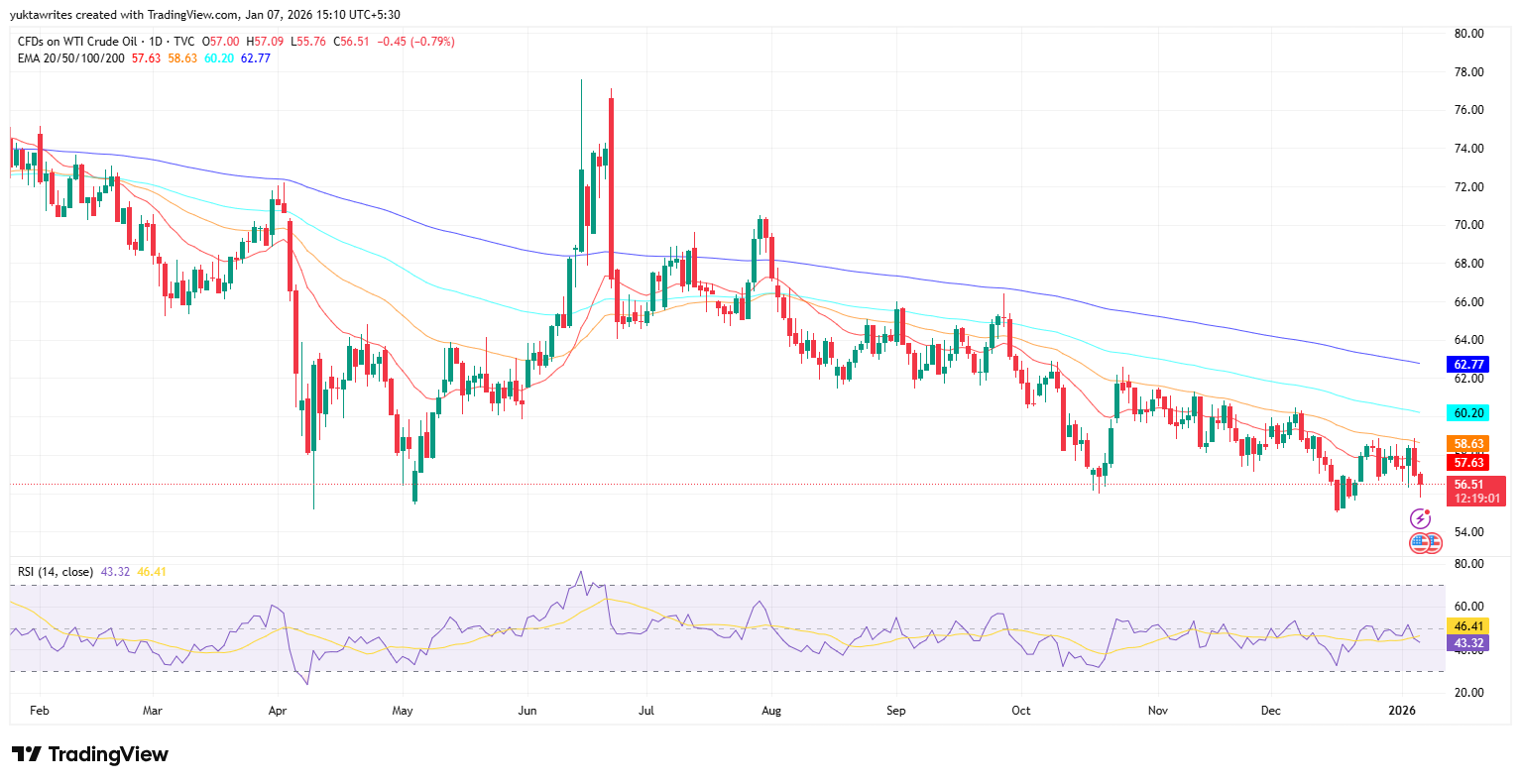
WTI crude oil Price dynamics (Source: TradingView)
The 200-day EMA, a key long-term trend reference, sits higher near $62.8, underscoring how far crude remains from regaining bullish credibility. Momentum indicators align with this view. Daily RSI continues to oscillate below the midpoint, signaling persistent selling pressure punctuated only by brief oversold bounces rather than sustained recoveries. This pattern is typical of markets correcting within a broader downtrend rather than preparing for a durable base.
Intraday structure reinforces the caution. On the 30-minute chart, Supertrend remains tilted bearish, and parabolic SAR dots are positioned above price, confirming downside momentum. Attempts to rebound toward the $57-$57.2 area have stalled quickly, suggesting that traders are fading strength rather than positioning for upside continuation. These shallow, failing bounces point to a market still digesting bearish catalysts rather than one building accumulation.
Supply narrative overtakes geopolitics
The shift in price action is closely tied to evolving geopolitical interpretation. Trump’s plan to redirect Venezuelan crude toward the U.S. market, either through direct shipments or renewed engagement by American companies, has reframed Venezuela from a disruption risk into a potential supply source. Analysts note that Venezuelan barrels are historically bound for China could now add pressure to Atlantic Basin balances, particularly for heavier crude grades.
This development dovetails with broader forecasts pointing to ample global supply in the year ahead. Banks and energy agencies have warned that rising non-OPEC output, steady U.S. production, and potential easing of sanctions could exacerbate oversupply conditions into 2026. While U.S. inventory data has been mixed, including occasional drawdowns that offer short-lived support, overall OECD stockpiles and production trends continue to tilt the balance toward excess supply.
Key levels define bullish and bearish paths
From a bullish perspective, oil would need a material shift in narrative to regain momentum. OPEC+ could respond to sustained price weakness by tightening output further, particularly if inventories continue to build and prices threaten fiscal breakevens. A resurgence of geopolitical risk, whether in the Middle East or key shipping routes, could also inject a renewed risk premium.
Technically, a more constructive outlook would require weekly closes above $58.5, followed by a decisive break through $60. That would open the door toward the $62-$63 zone, where the 200-day EMA resides. Without such confirmation, upside moves are likely to remain corrective.
The bearish scenario is clearer. Failure to reclaim the 20-day EMA, followed by a break below recent lows near $55.8, would expose the $53-$52 area, levels not seen since mid-2025. Such a move would align with oversupply forecasts and could accelerate liquidation among leveraged longs. Below $50, sentiment would deteriorate sharply and refocus attention on longer-term support zones.
For traders, the message remains defensive. Lower highs and lower lows favor selling rallies rather than chasing rebounds. Swing participants may wait for either a confirmed reclaim above $58.5 or a clean break below $55.8 to engage with clearer directional bias. Long-term investors should treat current levels tactically, not strategically, until global demand dynamics improve.
As discussed previously, crude’s recent rallies have struggled to gain traction because they lack confirmation from tightening inventories or demand acceleration. Instead, each bounce has been met with selling as traders position for a prolonged period of imbalance, especially if Venezuelan production gradually recovers.





Latest WTI News










-
 Afghanistan
-
 Albania
-
 Algeria
-
 Angola
-
 Argentina
-
 Armenia
-
 Australia
-
 Austria
-
 Azerbaijan
-
 Bahamas
-
 Bahrain
-
 Bangladesh
-
 Belarus
-
 Belgium
-
 Bolivia
-
 Botswana
-
 Brazil
-
 Brunei
-
 Bulgaria
-
 Cambodia
-
 Cameroon
-
 Canada
-
 Chile
Chile
-
 China
China
-
 Colombia
-
 Congo
Congo
-
 Costa Rica
-
 Cote d'Ivoire
-
 Croatia
-
 Cuba
Cuba
-
 Cyprus
-
 Czechia
-
 DR Congo
-
 Denmark
-
 Dominican Republic
-
 Ecuador
-
 Egypt
Egypt
-
 El Salvador
-
 Estonia
-
 Eswatini
-
 Ethiopia
-
 Finland
-
 France
-
 Georgia
-
 Germany
-
 Ghana
Ghana
-
 Greece
-
 Haiti
Haiti
-
 Hong Kong
-
 Hungary
-
 India
India
-
 Indonesia
-
 Iran, Islamic republic
-
 Iraq
Iraq
-
 Ireland
-
 Israel
-
 Italy
Italy
-
 Jamaica
-
 Japan
Japan
-
 Jordan
-
 Kazakhstan
-
 Kenya
Kenya
-
 Korea
Korea
-
 Kuwait
-
 Kyrgyzstan
-
 Laos
Laos
-
 Latvia
-
 Lebanon
-
 Lesotho
-
 Libya
Libya
-
 Lithuania
-
 Luxembourg
-
 Madagascar
-
 Malaysia
-
 Malta
Malta
-
 Mauritius
-
 Mexico
-
 Moldova
-
 Mongolia
-
 Montenegro
-
 Morocco
-
 Mozambique
-
 Myanmar
-
 Namibia
-
 Nepal
Nepal
-
 Netherlands
-
 New Zealand
-
 Nigeria
-
 North Macedonia
-
 Norway
-
 Oman
Oman
-
 Pakistan
-
 Palestine
-
 Panama
-
 Papua New Guinea
-
 Paraguay
-
 Peru
Peru
-
 Philippines
-
 Poland
-
 Portugal
-
 Puerto Rico
-
 Qatar
Qatar
-
 Reunion
-
 Romania
-
 Rwanda
-
 Saudi Arabia
-
 Serbia
-
 Singapore
-
 Slovakia
-
 Slovenia
-
 Somalia
-
 South Africa
-
 Spain
Spain
-
 Sri Lanka
-
 Sweden
-
 Switzerland
-
 Syria
Syria
-
 Taiwan
-
 Tajikistan
-
 Tanzania
-
 Thailand
-
 Trinidad and Tobago
-
 Tunisia
-
 Turkey
-
 UAE
UAE
-
 Uganda
-
 Ukraine
-
 United Kingdom
-
United States
-
 Uruguay
-
 Uzbekistan
-
 Venezuela
-
 Vietnam
-
 Yemen
Yemen
-
 Zambia
-
 Zimbabwe
- Forex
- Crypto












