

Tesla stock holds at $432 as Germany sales tumble nearly 50% in December

As of January 8, Tesla stock is trading at $431.88, down 0.3% in the last 24 hours, with a market cap of approximately $1.37 trillion. The price remains elevated compared to 2025 lows but has stalled below the critical $450–$480 resistance zone.
Highlights
- Tesla’s vehicle deliveries in Germany fell 48.4% in 2025, sharply underperforming the broader EV market.
- The stock is holding near $432 but facing resistance amid growing competitive and political headwinds in Europe.
- Technical indicators suggest potential consolidation unless a new catalyst emerges.
The 50-day moving average stands at $422.67, while the 200-day moving average is at $270.42—a wide divergence that reflects the steep rally from May through November 2025. Despite recent weakness, the stock is still up over 30% in the past six months. However, the RSI (Relative Strength Index) has declined from overbought territory above 70 to around 57, suggesting fading momentum but not yet a full reversal.
Volume data also indicates decreasing bullish conviction, with daily trading volume falling below the 20-day average. While there is no immediate breakdown signal, the technical picture suggests that Tesla needs a fresh fundamental catalyst to break decisively above $450 and retest the $480–$500 range. Failure to do so could send the price back to the $385–$400 support zone, where buyers previously stepped in.
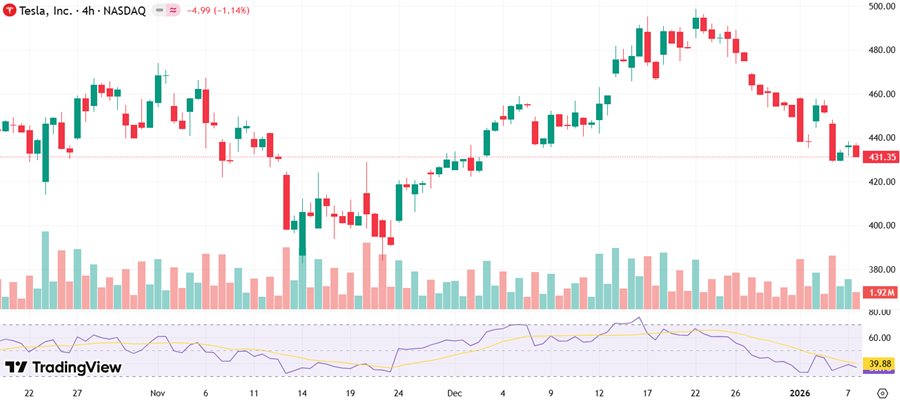
Tesla stock price dynamics (November 2025 - January 2025). Source: TradingView
Short interest remains relatively low at under 3%, but options data indicates a growing number of puts concentrated around the $400 strike, hinting at institutional hedging as macro uncertainty rises. This trend suggests that large investors are positioning for potential downside protection ahead of the upcoming earnings report. Additionally, the skew in implied volatility toward put options reinforces caution in the market, with traders pricing in elevated near-term risk despite the stock’s recent resilience.
German sales crash underscores weakness in European demand
Tesla’s position in Europe—once a pillar of its global expansion—is increasingly under threat. December 2025 figures from Germany, one of Tesla's largest European markets, showed a 48% year-over-year collapse in registrations, with only 2,032 vehicles sold. That marks one of Tesla’s worst monthly performances in the region in the last three years.
Even more troubling, the broader German EV market expanded by +42% during the same period, highlighting Tesla's relative underperformance and shrinking market share. Cumulatively, Tesla’s deliveries in Germany fell 48.4% in 2025, despite broader electrification trends and government subsidies aimed at accelerating EV adoption.
Several factors are contributing to this divergence. First, Tesla is facing increased pressure from Chinese manufacturers like BYD, which offer more affordable EVs with competitive range and technology. Second, European automakers such as Volkswagen, Mercedes-Benz, and Renault have caught up in both production scale and consumer EV perception, eroding Tesla’s first-mover advantage. Third, there are growing reports that political backlash toward Elon Musk’s public persona—particularly in Europe—may be affecting consumer sentiment.
Consolidation likely before directional move
Given the combination of technical resistance, deteriorating European fundamentals, and high valuation multiples, Tesla’s share price is likely to remain range-bound in the near term. The stock could trade between $400 and $450 over the next 2–4 weeks, with a possible retest of the $385 support level if broader tech sentiment weakens or earnings guidance in January disappoints.
To the upside, a break above $450 would require either a positive surprise in January’s earnings report or a fresh catalyst from Tesla’s AI, FSD, or energy storage business lines. However, current valuations remain stretched at a P/E ratio above 300, pricing in high expectations for future growth in non-automotive segments like robotics and autonomous driving.
Tesla’s decline followed Nvidia’s CES 2026 launch of its Alpamayo platform, an open-source AI stack that could erode Tesla’s lead in autonomous driving by empowering rivals. Elon Musk downplayed the threat, but markets reacted negatively amid concerns that Tesla’s technological edge is narrowing.








-
 Afghanistan
-
 Albania
-
 Algeria
-
 Angola
-
 Argentina
-
 Armenia
-
 Australia
-
 Austria
-
 Azerbaijan
-
 Bahamas
-
 Bahrain
-
 Bangladesh
-
 Belarus
-
 Belgium
-
 Bolivia
-
 Botswana
-
 Brazil
-
 Brunei
-
 Bulgaria
-
 Cambodia
-
 Cameroon
-
 Canada
-
 Chile
Chile
-
 China
China
-
 Colombia
-
 Congo
Congo
-
 Costa Rica
-
 Cote d'Ivoire
-
 Croatia
-
 Cuba
Cuba
-
 Cyprus
-
 Czechia
-
 DR Congo
-
 Denmark
-
 Dominican Republic
-
 Ecuador
-
 Egypt
Egypt
-
 El Salvador
-
 Estonia
-
 Eswatini
-
 Ethiopia
-
 Finland
-
 France
-
 Georgia
-
 Germany
-
 Ghana
Ghana
-
 Greece
-
 Haiti
Haiti
-
 Hong Kong
-
 Hungary
-
 India
India
-
 Indonesia
-
 Iran, Islamic republic
-
 Iraq
Iraq
-
 Ireland
-
 Israel
-
 Italy
Italy
-
 Jamaica
-
 Japan
Japan
-
 Jordan
-
 Kazakhstan
-
 Kenya
Kenya
-
 Korea
Korea
-
 Kuwait
-
 Kyrgyzstan
-
 Laos
Laos
-
 Latvia
-
 Lebanon
-
 Lesotho
-
 Libya
Libya
-
 Lithuania
-
 Luxembourg
-
 Madagascar
-
 Malaysia
-
 Malta
Malta
-
 Mauritius
-
 Mexico
-
 Moldova
-
 Mongolia
-
 Montenegro
-
 Morocco
-
 Mozambique
-
 Myanmar
-
 Namibia
-
 Nepal
Nepal
-
 Netherlands
-
 New Zealand
-
 Nigeria
-
 North Macedonia
-
 Norway
-
 Oman
Oman
-
 Pakistan
-
 Palestine
-
 Panama
-
 Papua New Guinea
-
 Paraguay
-
 Peru
Peru
-
 Philippines
-
 Poland
-
 Portugal
-
 Puerto Rico
-
 Qatar
Qatar
-
 Reunion
-
 Romania
-
 Rwanda
-
 Saudi Arabia
-
 Serbia
-
 Singapore
-
 Slovakia
-
 Slovenia
-
 Somalia
-
 South Africa
-
 Spain
Spain
-
 Sri Lanka
-
 Sweden
-
 Switzerland
-
 Syria
Syria
-
 Taiwan
-
 Tajikistan
-
 Tanzania
-
 Thailand
-
 Trinidad and Tobago
-
 Tunisia
-
 Turkey
-
 UAE
UAE
-
 Uganda
-
 Ukraine
-
 United Kingdom
-
United States
-
 Uruguay
-
 Uzbekistan
-
 Venezuela
-
 Vietnam
-
 Yemen
Yemen
-
 Zambia
-
 Zimbabwe
- Forex
- Crypto












