
Nikkei 225 holds near 51,940 with uptrend structure still intact
The Nikkei 225 has moved back onto the front foot after a volatile start to the year, reclaiming the 52,000 area on Friday and snapping a brief two-session slide. Friday’s 1.61% advance to just under 51,940 was not a technical fluke or thin holiday rebound.
Highlights
- Nikkei 225 jumps 1.61% to near 51,940 as China eases export control concerns
- Fast Retailing’s outlook upgrade fuels renewed buying in exporters and retailers
- Index holds above key moving averages, keeping the broader uptrend intact
The immediate catalyst was a shift in sentiment. China clarified that its export controls on dual-use items would not disrupt civilian trade with Japan, cooling a headline risk that had briefly pressured exporters and industrial names. That reassurance arrived alongside stronger-than-expected Japanese household spending data and a sharp earnings upgrade from Fast Retailing, prompting investors to rotate back into risk. The result was a broad rebound rather than a narrow trade, with gains spreading beyond technology into retail, financials, and industrials.
Uptrend structure remains intact despite early-year volatility
From a technical perspective, the daily chart continues to reflect a market consolidating gains rather than rolling over. The Nikkei remains comfortably above all major moving averages, reinforcing the strength of the primary uptrend that has been in place since last year’s spring washout. The 20-day EMA is rising near the 50,800 area, while the 50-day sits closer to 49,800. Longer-term support remains well below, with the 100-day near 47,800 and the 200-day closer to 44,800.
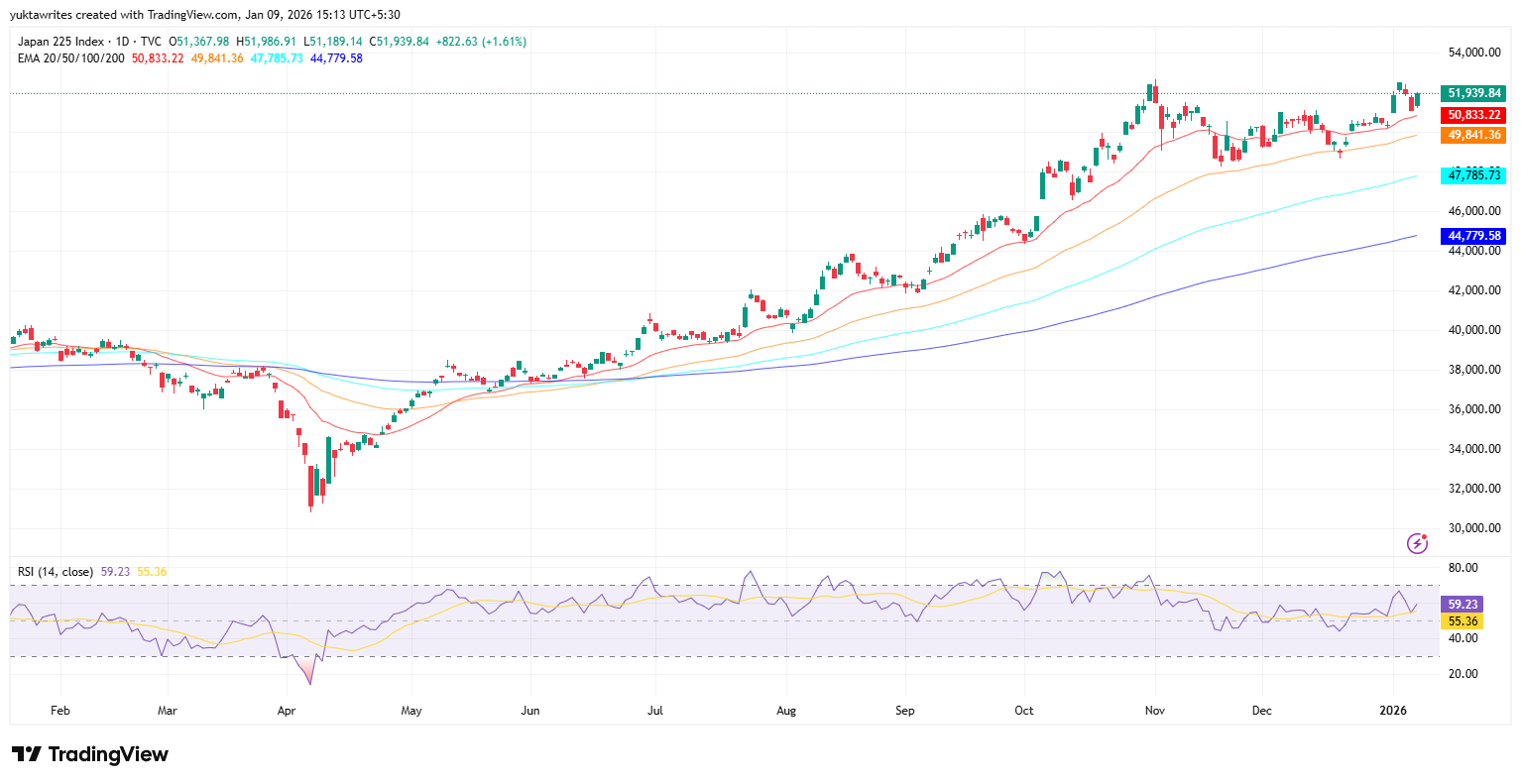
Nikkei 225 price dynamics (Source: TradingView)
That spacing matters. It shows that recent pullbacks have been shallow and corrective, not impulsive or trend-breaking. Even December’s choppier trade failed to damage the broader structure, and buyers have consistently stepped in ahead of deeper retracement levels. Momentum indicators support that read. The daily RSI has pushed back toward the high-50 after cooling late last year, a profile more consistent with trend continuation than exhaustion.
The November peak near 52,500 remains the key upside reference. A sustained daily close above that level would confirm that the market has absorbed residual supply from late-2025 distribution and open the door toward the mid-53,000s, where extension targets cluster based on the prior leg higher.
Short-term dynamics favor buyers as risk appetite stabilizes
Lower-timeframe action reinforces the constructive tone for active traders. On the 30-minute chart, early-January weakness found demand just above the 51,000 area, where short-term trend indicators flipped back into support. Since then, the index has been grinding higher through a series of higher lows rather than accelerating vertically, signaling controlled accumulation rather than late-cycle chasing.
Intraday structure now shows layered support between 51,500 and 51,600, with price holding above that band into the close. As long as this zone holds on a closing basis, pullbacks are more likely to attract buyers than trigger fast liquidation. Volume patterns align with this view. Rebound sessions have drawn broader participation than the late-December drift lower, suggesting institutional re-engagement after year-end rebalancing.
Macro conditions remain broadly supportive. The yen has stayed relatively contained, easing pressure on exporters, while moderating domestic inflation gives the Bank of Japan room to maintain a patient stance. That backdrop continues to favor equities, particularly companies with overseas revenue exposure.
Fundamentals also help explain why downside attempts have struggled to gain traction. Corporate earnings momentum remains a central pillar of the rally. Fast Retailing’s double-digit surge after lifting guidance highlighted the strength of Japanese multinationals benefiting from demand in Europe and North America. Gains in automakers, megabanks, and semiconductor-linked names have broadened participation, reducing the risk of a sudden air pocket driven by narrow leadership.
Levels that separate continuation from correction
Clear technical thresholds still matter. On the downside, a decisive break below 51,500 would signal that short-term momentum is stalling. Below that, attention would shift to the 50,800 to 51,000 zone. A loss of that area would likely draw price toward the 50-day moving average near 49,800. Such a move would not break the broader trend, but it would shift the near-term trade from buy-the-dip to wait-for-support.
On the upside, the path is more straightforward. Holding above 51,600 and pushing through 52,000 increases pressure on the November high near 52,500. A clean break and hold above that level would confirm trend resumption and expose the 53,500 to 54,000 region over the coming weeks, assuming global risk sentiment remains constructive.
As previously discussed, the Nikkei’s longer-term advance has been supported by corporate governance reforms, improved capital returns, and stronger earnings visibility among globally diversified Japanese firms. The latest rebound reinforces that narrative, suggesting recent weakness was driven by transient headline risk rather than deterioration in fundamentals or structure.





Latest Nikkei 225 News









-
 Afghanistan
-
 Albania
-
 Algeria
-
 Angola
-
 Argentina
-
 Armenia
-
 Australia
-
 Austria
-
 Azerbaijan
-
 Bahamas
-
 Bahrain
-
 Bangladesh
-
 Belarus
-
 Belgium
-
 Bolivia
-
 Botswana
-
 Brazil
-
 Brunei
-
 Bulgaria
-
 Cambodia
-
 Cameroon
-
 Canada
-
 Chile
Chile
-
 China
China
-
 Colombia
-
 Congo
Congo
-
 Costa Rica
-
 Cote d'Ivoire
-
 Croatia
-
 Cuba
Cuba
-
 Cyprus
-
 Czechia
-
 DR Congo
-
 Denmark
-
 Dominican Republic
-
 Ecuador
-
 Egypt
Egypt
-
 El Salvador
-
 Estonia
-
 Eswatini
-
 Ethiopia
-
 Finland
-
 France
-
 Georgia
-
 Germany
-
 Ghana
Ghana
-
 Greece
-
 Haiti
Haiti
-
 Hong Kong
-
 Hungary
-
 India
India
-
 Indonesia
-
 Iran, Islamic republic
-
 Iraq
Iraq
-
 Ireland
-
 Israel
-
 Italy
Italy
-
 Jamaica
-
 Japan
Japan
-
 Jordan
-
 Kazakhstan
-
 Kenya
Kenya
-
 Korea
Korea
-
 Kuwait
-
 Kyrgyzstan
-
 Laos
Laos
-
 Latvia
-
 Lebanon
-
 Lesotho
-
 Libya
Libya
-
 Lithuania
-
 Luxembourg
-
 Madagascar
-
 Malaysia
-
 Malta
Malta
-
 Mauritius
-
 Mexico
-
 Moldova
-
 Mongolia
-
 Montenegro
-
 Morocco
-
 Mozambique
-
 Myanmar
-
 Namibia
-
 Nepal
Nepal
-
 Netherlands
-
 New Zealand
-
 Nigeria
-
 North Macedonia
-
 Norway
-
 Oman
Oman
-
 Pakistan
-
 Palestine
-
 Panama
-
 Papua New Guinea
-
 Paraguay
-
 Peru
Peru
-
 Philippines
-
 Poland
-
 Portugal
-
 Puerto Rico
-
 Qatar
Qatar
-
 Reunion
-
 Romania
-
 Rwanda
-
 Saudi Arabia
-
 Serbia
-
 Singapore
-
 Slovakia
-
 Slovenia
-
 Somalia
-
 South Africa
-
 Spain
Spain
-
 Sri Lanka
-
 Sweden
-
 Switzerland
-
 Syria
Syria
-
 Taiwan
-
 Tajikistan
-
 Tanzania
-
 Thailand
-
 Trinidad and Tobago
-
 Tunisia
-
 Turkey
-
 UAE
UAE
-
 Uganda
-
 Ukraine
-
 United Kingdom
-
United States
-
 Uruguay
-
 Uzbekistan
-
 Venezuela
-
 Vietnam
-
 Yemen
Yemen
-
 Zambia
-
 Zimbabwe
- Forex
- Crypto












