
Tesla stock drops below $447 as Musk ends FSD sales, shifts to subscription-only model
As of January 14, Tesla stock is trading at $446.85, down 0.5% over the last 24 hours. The price action has moderated after the sharp rebound seen in November, with the stock now consolidating in a narrow range between $440 and $450.
Highlights
- Tesla will stop offering one-time purchases of its Full Self-Driving software and switch exclusively to a subscription model starting February 14, 2026.
- The change is intended to increase recurring revenue but raises concerns about user adoption and regulatory pressure.
- Investors are watching closely as the shift could impact margins, customer behavior, and long-term autonomy strategy.
Technical indicators present a mixed picture. Tesla is currently hovering just above the 20-day moving average, which has been providing minor support in recent sessions. The 50-day MA, which converges near the $455–460 level, is acting as near-term resistance. Meanwhile, the 200-day moving average is situated closer to $235, a long way below current levels.
The Relative Strength Index (RSI) sits around 53, indicating neutral momentum and no clear directional bias. MACD momentum has flattened, suggesting a period of consolidation. From a volume perspective, recent trading has been lighter than average, reinforcing the view that neither bulls nor bears are in control at this juncture.
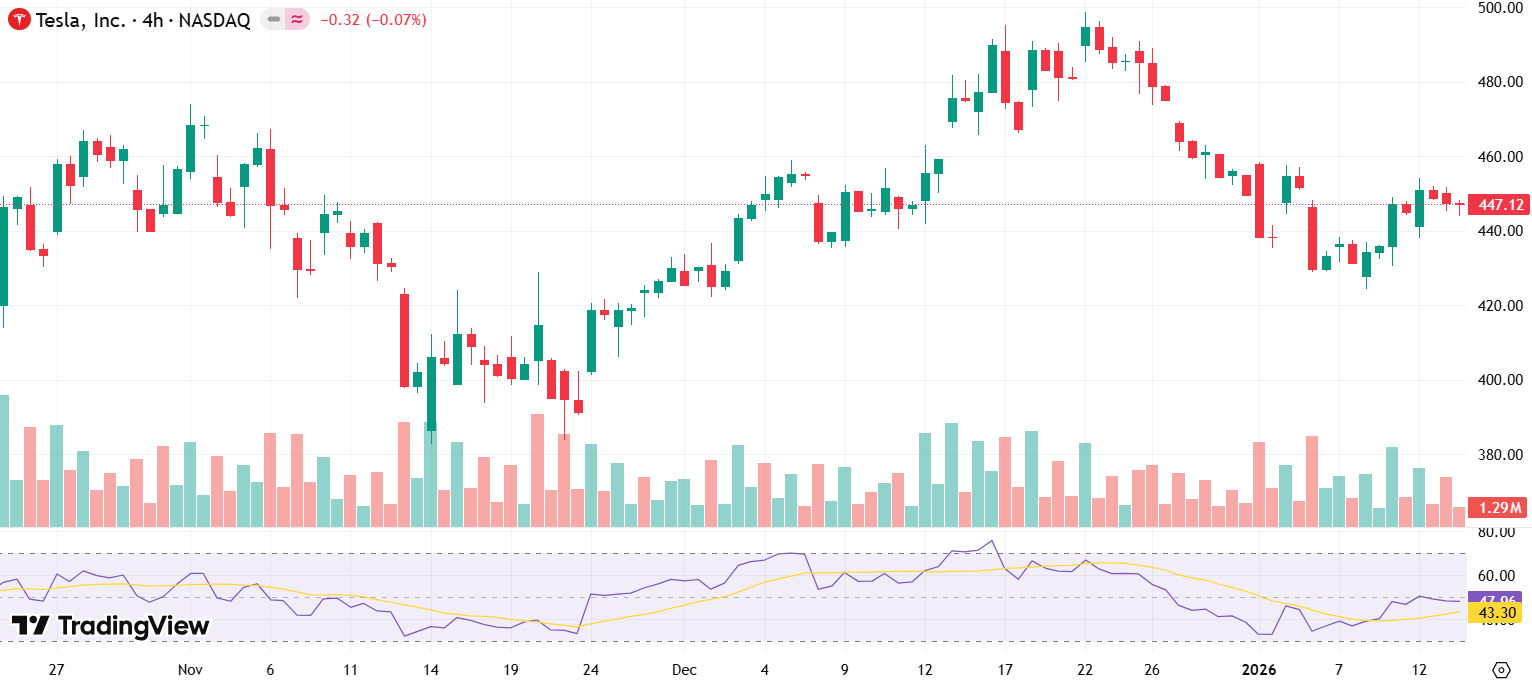
Tesla stock price dynamics (November 2025 - January 2025). Source: TradingView
Critical support lies at $420, a level tested multiple times in the last quarter. A decisive breakdown below this floor could trigger a steeper correction toward $390. On the upside, the stock must clear the $470–475 range to re-engage bullish momentum and attempt a test of the $500 psychological resistance.
FSD subscription-only strategy adds recurring revenue but faces adoption risk
The most significant recent development is Tesla CEO Elon Musk’s announcement that the company will end one-time purchases of its Full Self-Driving software beginning February 14, 2026. Instead, FSD will only be offered as a monthly subscription, with U.S. pricing currently set around $99. Musk claims this shift will better reflect the product’s ongoing improvements and encourage broader adoption. However, the move is also widely interpreted as a response to the low upfront take rates on FSD packages, as well as to regulatory headwinds.
The change comes amid growing scrutiny of Tesla’s autonomous driving claims. The U.S. National Highway Traffic Safety Administration (NHTSA) is currently investigating nearly 2.9 million Teslas equipped with FSD after reports of multiple crashes. This investigation raises serious concerns about the readiness and safety of the software and could result in reputational damage or operational constraints. Furthermore, Musk’s long-standing assertion that other automakers would license Tesla’s FSD stack has yet to materialize, with recent comments confirming that no automaker has expressed interest in adopting the technology.
While the shift to a subscription model could drive more consistent, high-margin software revenue, there’s risk that uptake will remain tepid if the value proposition remains unclear. The long delay in delivering full autonomy — initially promised years ago — continues to erode investor confidence in FSD’s commercial viability. Tesla’s growing reliance on this platform as a revenue lever makes adoption metrics in 2026 a key risk factor.
Consolidation expected, catalyst needed for breakout
In a bullish scenario, strong Q4 numbers and clear guidance on FSD adoption could drive a breakout above $470, opening a path to the $500 mark. If software gross margins expand materially, it could revive bullish sentiment and push valuation multiples higher. Positive commentary from management on future FSD enhancements or new licensing opportunities could further fuel investor optimism and lift the stock in the short term.
In a bearish scenario, if regulatory action escalates or the subscription model underwhelms, the stock could lose its $420 support, with a pullback toward $390 likely. Delivery softness or weaker-than-expected margins may also trigger multiple compression. A prolonged NHTSA investigation or additional safety-related headlines could deepen investor concerns and increase volatility around Tesla’s autonomous driving roadmap.
Top investor James Foord sees Nvidia, not traditional automakers, as Tesla’s biggest existential threat due to its advanced autonomous driving platform, DRIVE. He argues that Nvidia’s full-stack AI ecosystem could undermine Tesla’s lead in self-driving technology and challenge its competitive edge.








-
 Afghanistan
-
 Albania
-
 Algeria
-
 Angola
-
 Argentina
-
 Armenia
-
 Australia
-
 Austria
-
 Azerbaijan
-
 Bahamas
-
 Bahrain
-
 Bangladesh
-
 Belarus
-
 Belgium
-
 Bolivia
-
 Botswana
-
 Brazil
-
 Brunei
-
 Bulgaria
-
 Cambodia
-
 Cameroon
-
 Canada
-
 Chile
Chile
-
 China
China
-
 Colombia
-
 Congo
Congo
-
 Costa Rica
-
 Cote d'Ivoire
-
 Croatia
-
 Cuba
Cuba
-
 Cyprus
-
 Czechia
-
 DR Congo
-
 Denmark
-
 Dominican Republic
-
 Ecuador
-
 Egypt
Egypt
-
 El Salvador
-
 Estonia
-
 Eswatini
-
 Ethiopia
-
 Finland
-
 France
-
 Georgia
-
 Germany
-
 Ghana
Ghana
-
 Greece
-
 Haiti
Haiti
-
 Hong Kong
-
 Hungary
-
 India
India
-
 Indonesia
-
 Iran, Islamic republic
-
 Iraq
Iraq
-
 Ireland
-
 Israel
-
 Italy
Italy
-
 Jamaica
-
 Japan
Japan
-
 Jordan
-
 Kazakhstan
-
 Kenya
Kenya
-
 Korea
Korea
-
 Kuwait
-
 Kyrgyzstan
-
 Laos
Laos
-
 Latvia
-
 Lebanon
-
 Lesotho
-
 Libya
Libya
-
 Lithuania
-
 Luxembourg
-
 Madagascar
-
 Malaysia
-
 Malta
Malta
-
 Mauritius
-
 Mexico
-
 Moldova
-
 Mongolia
-
 Montenegro
-
 Morocco
-
 Mozambique
-
 Myanmar
-
 Namibia
-
 Nepal
Nepal
-
 Netherlands
-
 New Zealand
-
 Nigeria
-
 North Macedonia
-
 Norway
-
 Oman
Oman
-
 Pakistan
-
 Palestine
-
 Panama
-
 Papua New Guinea
-
 Paraguay
-
 Peru
Peru
-
 Philippines
-
 Poland
-
 Portugal
-
 Puerto Rico
-
 Qatar
Qatar
-
 Reunion
-
 Romania
-
 Rwanda
-
 Saudi Arabia
-
 Serbia
-
 Singapore
-
 Slovakia
-
 Slovenia
-
 Somalia
-
 South Africa
-
 Spain
Spain
-
 Sri Lanka
-
 Sweden
-
 Switzerland
-
 Syria
Syria
-
 Taiwan
-
 Tajikistan
-
 Tanzania
-
 Thailand
-
 Trinidad and Tobago
-
 Tunisia
-
 Turkey
-
 UAE
UAE
-
 Uganda
-
 Ukraine
-
 United Kingdom
-
United States
-
 Uruguay
-
 Uzbekistan
-
 Venezuela
-
 Vietnam
-
 Yemen
Yemen
-
 Zambia
-
 Zimbabwe
- Forex
- Crypto











