

Microsoft stock ticks up after energy market swings linked to Iran uncertainty

Microsoft Corporation (MSFT) is trading at $401.00, sitting slightly above the SMA-20 ($400.25) but remains well below the SMA-50 ($427.68) and SMA-200 ($482.96), signaling short-term stabilization but continued medium- and long-term pressure from sellers. The Ichimoku Kijun at $402.70 sits above the current price, indicating immediate resistance.
 542.67
542.67
542.67
Highlights
- Microsoft faces heightened geopolitical risk due to its concentrated investment in the UAE amid ongoing Middle East conflict, raising concerns over regional exposure.
- Increasing energy market volatility and intensified regulatory scrutiny of AI-driven carbon credit purchases add persistent operational and reputational risks globally.
- MSFT is likely to consolidate between $398 and $411 as technical momentum remains bearish with low probability of a near-term rebound.
Geopolitical risk and energy volatility weigh on Microsoft’s outlook
War in the Middle East has introduced significant headwinds for Microsoft due to its concentrated investment in the United Arab Emirates, exposing operations and growth plans to regional geopolitical risk. Ongoing tensions and volatility in the region, particularly involving Iran, have fueled investor fears and driven short-term declines in technology stocks. Global energy market fluctuations, heightened by geopolitical exogenous shocks, are influencing demand and operating costs for large-scale AI and cloud infrastructure. Structural risks remain as government and institutional scrutiny around carbon credit purchases intensifies amid rapidly rising energy demand from AI, leading to growing regulatory and reputational risks globally.
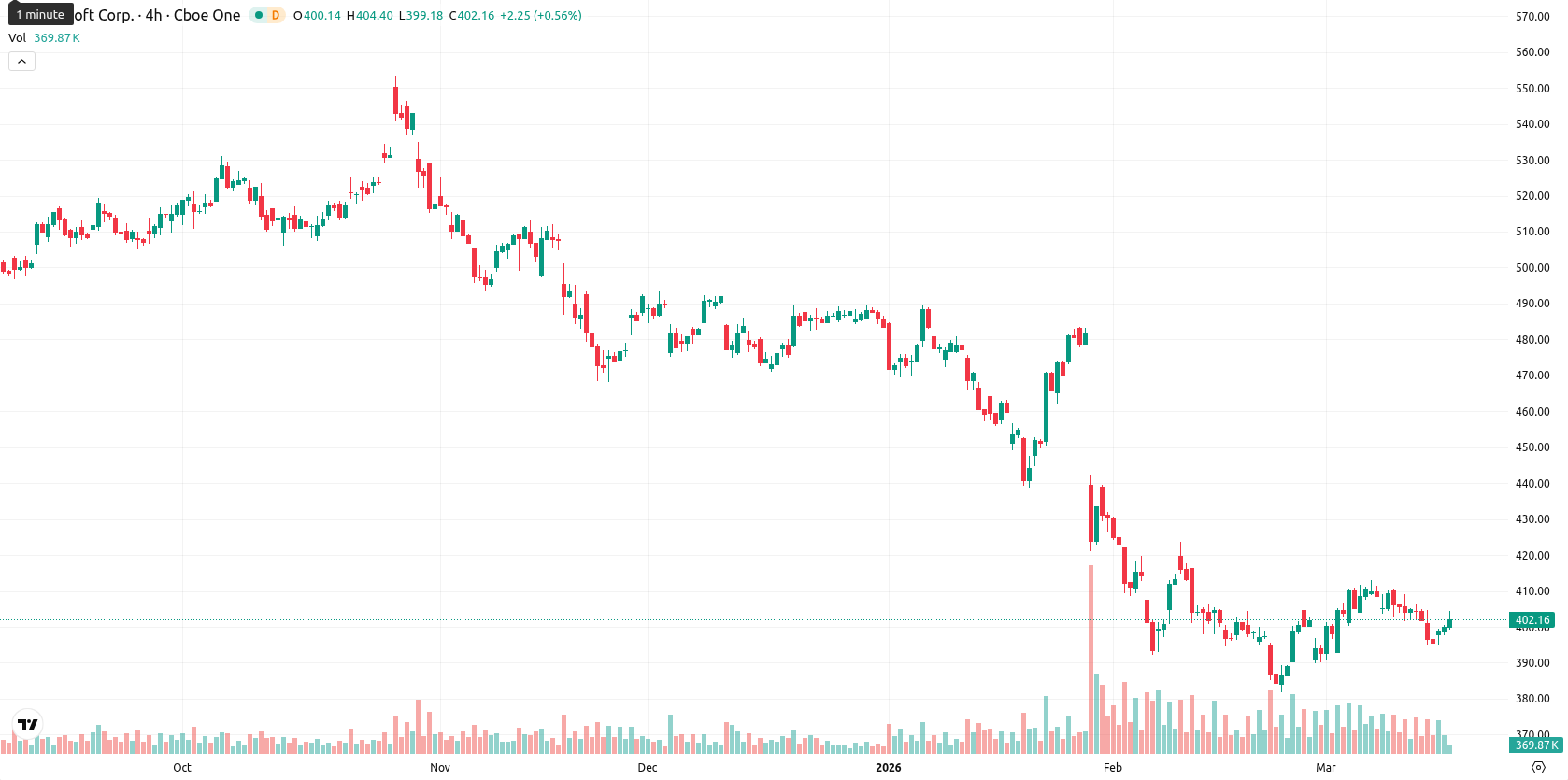
Intraday price divergence as momentum signals reinforce downside bias
Momentum indicators on D1 show a bearish bias, with MACD and ADX supporting a prevailing downside trend. RSI, Stoch RSI, and CCI signal a lack of oversold extremes but maintain a bearish-to-neutral stance, while BBP at -2.04 suggests intraday seller dominance. The daily session opened with almost no gap, and the price currently stands near the lower half of the day’s range ($399.98 — $404.28), reflecting moderate volatility and a mild upward move of 0.27% from yesterday but with no clear momentum follow-through. A divergence is present: while some short-term oscillators remain neutral or fluctuate, overall momentum indicators still point down, so intraday price action is somewhat at odds with dominant momentum signals.
Downside consolidation likely as rebound faces persistent resistance
Looking ahead, the expected range for the next five trading days is $398.00 to $411.00. The probability of a price rebound is very low (less than 20%), making a further decline much more likely. The baseline scenario is for MSFT to consolidate sideways between $398 and $411 as short-term stabilization battles longer-term downward pressure. A bullish scenario would see the price break above $403, targeting the upper end of the volatility band relative to current levels, but this faces strong resistance and is unlikely without a change in momentum. Conversely, a bearish scenario opens if support below $399 is lost, which could accelerate downside toward the lower band of the range.
Earlier, analysts noted that Microsoft's resilient growth trajectory is underpinned by its dominant position in cloud computing and artificial intelligence integration, setting the stage for steady long-term expansion. Against the backdrop of heightened geopolitical risk and regulatory scrutiny, immediate focus should be on the $399 support and $403 resistance levels, as a decisive move beyond this band could indicate the next directional shift for MSFT in the near term.





Latest Microsoft News





-
 Afghanistan
-
 Albania
-
 Algeria
-
 Angola
-
 Argentina
-
 Armenia
-
 Australia
-
 Austria
-
 Azerbaijan
-
 Bahamas
-
 Bahrain
-
 Bangladesh
-
 Belarus
-
 Belgium
-
 Bolivia
-
 Botswana
-
 Brazil
-
 Brunei
-
 Bulgaria
-
 Cambodia
-
 Cameroon
-
 Canada
-
 Chile
Chile
-
 China
China
-
 Colombia
-
 Congo
Congo
-
 Costa Rica
-
 Cote d'Ivoire
-
 Croatia
-
 Cuba
Cuba
-
 Cyprus
-
 Czechia
-
 DR Congo
-
 Denmark
-
 Dominican Republic
-
 Ecuador
-
 Egypt
Egypt
-
 El Salvador
-
 Estonia
-
 Eswatini
-
 Ethiopia
-
 Finland
-
 France
-
 Georgia
-
 Germany
-
 Ghana
Ghana
-
 Greece
-
 Haiti
Haiti
-
 Hong Kong
-
 Hungary
-
 India
India
-
 Indonesia
-
 Iran, Islamic republic
-
 Iraq
Iraq
-
 Ireland
-
 Israel
-
 Italy
Italy
-
 Jamaica
-
 Japan
Japan
-
 Jordan
-
 Kazakhstan
-
 Kenya
Kenya
-
 Korea
Korea
-
 Kuwait
-
 Kyrgyzstan
-
 Laos
Laos
-
 Latvia
-
 Lebanon
-
 Lesotho
-
 Libya
Libya
-
 Lithuania
-
 Luxembourg
-
 Madagascar
-
 Malaysia
-
 Malta
Malta
-
 Mauritius
-
 Mexico
-
 Moldova
-
 Mongolia
-
 Montenegro
-
 Morocco
-
 Mozambique
-
 Myanmar
-
 Namibia
-
 Nepal
Nepal
-
 Netherlands
-
 New Zealand
-
 Nigeria
-
 North Macedonia
-
 Norway
-
 Oman
Oman
-
 Pakistan
-
 Palestine
-
 Panama
-
 Papua New Guinea
-
 Paraguay
-
 Peru
Peru
-
 Philippines
-
 Poland
-
 Portugal
-
 Puerto Rico
-
 Qatar
Qatar
-
 Reunion
-
 Romania
-
 Rwanda
-
 Saudi Arabia
-
 Serbia
-
 Singapore
-
 Slovakia
-
 Slovenia
-
 Somalia
-
 South Africa
-
 Spain
Spain
-
 Sri Lanka
-
 Sweden
-
 Switzerland
-
 Syria
Syria
-
 Taiwan
-
 Tajikistan
-
 Tanzania
-
 Thailand
-
 Trinidad and Tobago
-
 Tunisia
-
 Turkey
-
 UAE
UAE
-
 Uganda
-
 Ukraine
-
 United Kingdom
-
United States
-
 Uruguay
-
 Uzbekistan
-
 Venezuela
-
 Vietnam
-
 Yemen
Yemen
-
 Zambia
-
 Zimbabwe
- Forex
- Crypto












