

Despite the recent pullback in Microsoft, the company's fundamental outlook remains strong. The latest earnings report showed Azure revenue growth accelerating to 40% year-over-year, while the annualized revenue run rate of its AI business reached approximately $37 billion.
This confirms that enterprise demand for generative AI and cloud infrastructure continues to expand, while investments in Copilot, Azure OpenAI, and AI agent solutions are beginning to generate meaningful commercial returns.
Why the stock is declining
The recent correction is driven less by any deterioration in Microsoft's business and more by investor concerns over the scale of the company's AI-related capital expenditures. Markets remain focused on the payback period for the tens of billions of dollars being invested in data centers and computing infrastructure. Additional pressure has come from the reduced exclusivity of Microsoft's partnership with OpenAI, as well as a broader sell-off across large-cap technology stocks amid macroeconomic uncertainty and higher bond yields.
New initiatives strengthen the long-term outlook
At Build 2026, Microsoft unveiled several major developments, including its MAI-Thinking-1 model, new security tools designed for AI workloads, and further expansion of the Azure ecosystem. The company is also aggressively increasing data center capacity to meet demand that still exceeds available infrastructure. Many analysts believe the market continues to underestimate the long-term revenue potential of Azure AI and its contribution to Microsoft's future growth.
What investors should watch
In the near term, Microsoft shares could remain volatile due to elevated AI spending and continued pressure on the broader Big Tech sector. However, key business metrics continue to improve: cloud growth is accelerating, AI monetization is expanding, and enterprise demand remains robust. For investors, the key question is no longer whether demand for AI exists, but how quickly Microsoft can convert its record investments into sustainable earnings growth and stronger free cash flow generation.
Near-term outlook
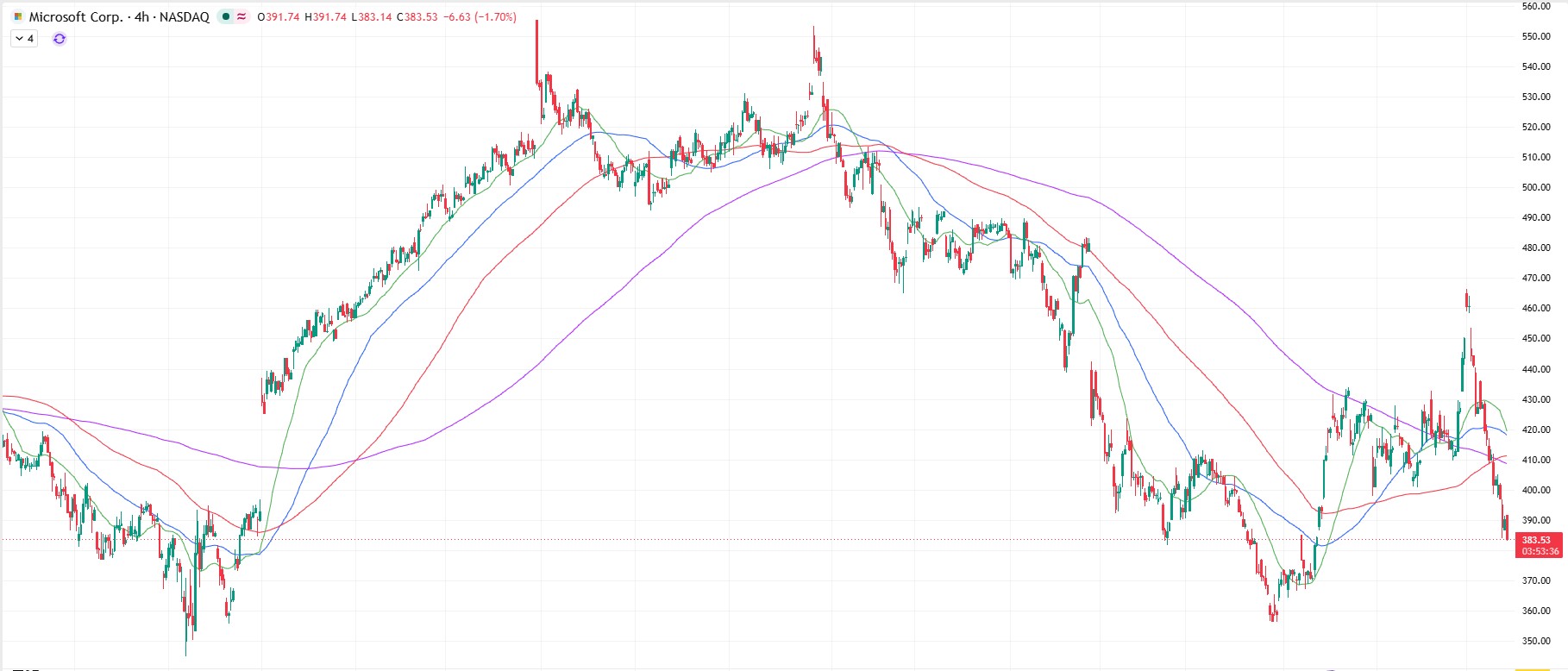
Microsoft's inability to hold above the $430 level and the subsequent loss of that area as support increases the risk of a decline back toward the $360-$350 range, where buyers may re-emerge. A decisive break below that zone, as discussed previously in Microsoft breaks support as pressure on shares intensifies, could open the door for a deeper move toward the $340-$320 area.


Latest Microsoft News







-
 Afghanistan
-
 Albania
-
 Algeria
-
 Angola
-
 Argentina
-
 Armenia
-
 Australia
-
 Austria
-
 Azerbaijan
-
 Bahamas
-
 Bahrain
-
 Bangladesh
-
 Belarus
-
 Belgium
-
 Bolivia
-
 Botswana
-
 Brazil
-
 Brunei
-
 Bulgaria
-
 Cambodia
-
 Cameroon
-
 Canada
-
 Chile
Chile
-
 China
China
-
 Colombia
-
 Congo
Congo
-
 Costa Rica
-
 Cote d'Ivoire
-
 Croatia
-
 Cuba
Cuba
-
 Cyprus
-
 Czechia
-
 DR Congo
-
 Denmark
-
 Dominican Republic
-
 Ecuador
-
 Egypt
Egypt
-
 El Salvador
-
 Estonia
-
 Eswatini
-
 Ethiopia
-
 Finland
-
 France
-
 Georgia
-
 Germany
-
 Ghana
Ghana
-
 Greece
-
 Haiti
Haiti
-
 Hong Kong
-
 Hungary
-
 India
India
-
 Indonesia
-
 Iran, Islamic republic
-
 Iraq
Iraq
-
 Ireland
-
 Israel
-
 Italy
Italy
-
 Jamaica
-
 Japan
Japan
-
 Jordan
-
 Kazakhstan
-
 Kenya
Kenya
-
 Korea
Korea
-
 Kuwait
-
 Kyrgyzstan
-
 Laos
Laos
-
 Latvia
-
 Lebanon
-
 Lesotho
-
 Libya
Libya
-
 Lithuania
-
 Luxembourg
-
 Madagascar
-
 Malaysia
-
 Malta
Malta
-
 Mauritius
-
 Mexico
-
 Moldova
-
 Mongolia
-
 Montenegro
-
 Morocco
-
 Mozambique
-
 Myanmar
-
 Namibia
-
 Nepal
Nepal
-
 Netherlands
-
 New Zealand
-
 Nigeria
-
 North Macedonia
-
 Norway
-
 Oman
Oman
-
 Pakistan
-
 Palestine
-
 Panama
-
 Papua New Guinea
-
 Paraguay
-
 Peru
Peru
-
 Philippines
-
 Poland
-
 Portugal
-
 Puerto Rico
-
 Qatar
Qatar
-
 Reunion
-
 Romania
-
 Rwanda
-
 Saudi Arabia
-
 Serbia
-
 Singapore
-
 Slovakia
-
 Slovenia
-
 Somalia
-
 South Africa
-
 Spain
Spain
-
 Sri Lanka
-
 Sweden
-
 Switzerland
-
 Syria
Syria
-
 Taiwan
-
 Tajikistan
-
 Tanzania
-
 Thailand
-
 Trinidad and Tobago
-
 Tunisia
-
 Turkey
-
 UAE
UAE
-
 Uganda
-
 Ukraine
-
 United Kingdom
-
United States
-
 Uruguay
-
 Uzbekistan
-
 Venezuela
-
 Vietnam
-
 Yemen
Yemen
-
 Zambia
-
 Zimbabwe
- Forex
- Crypto











