
S&P 500 holds near record highs despite Fed and geopolitical risks

The S&P 500 continues to trade near its recent highs, although the market remains sensitive to macroeconomic data, Federal Reserve policy, and geopolitical developments.
At its latest FOMC meeting, the Federal Reserve kept interest rates unchanged within the 3.5%–3.75% range. However, the tone of the statement became more hawkish. The Fed removed its previous easing bias, limiting the upside potential for the S&P 500 and reducing the attractiveness of risk assets for some investors.
The labor market remains another important factor. Recent data showed that 172,000 jobs were added in May, while the unemployment rate stood at 4.3%. These figures continue to confirm the resilience of the U.S. economy, but they also give the Federal Reserve more room to maintain a restrictive monetary policy stance.
Geopolitical risks should not be overlooked either. The memorandum between the United States and Iran represents only an intermediate step toward a final agreement. The process could still break down at any moment, potentially leading to higher oil prices, renewed inflationary pressures, and deteriorating market sentiment.
In such a scenario, investors could shift toward defensive assets, which would likely weigh on the S&P 500.
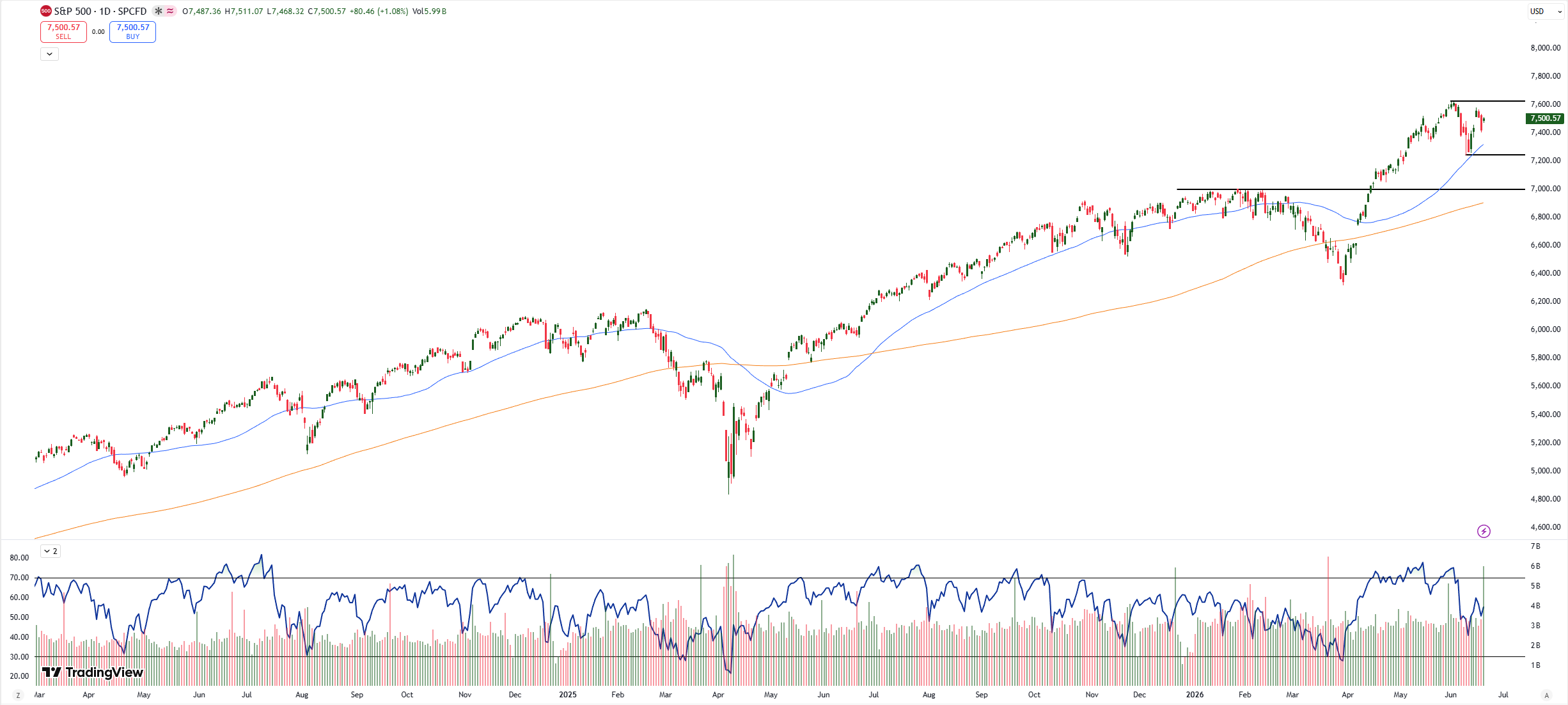
Technical structure remains bullish despite geopolitical risks
From a technical perspective, the S&P 500 continues to maintain a bullish structure on the daily chart.The 50-day SMA and 200-day SMA remain the primary reference points. As long as the index stays above the 50-day moving average, medium-term momentum remains in favor of buyers. Meanwhile, the 200-day SMA continues to serve as the key indicator of the long-term trend.
The nearest resistance level is located around the all-time high near 7,620 points, where the index previously encountered profit-taking pressure. A successful breakout above this level could open the door to further gains, a scenario partially supported by the outlook of several major investment banks.
For example, Citi recently raised its year-end target for the S&P 500 from 7,100 to 8,100 points, citing continued upside potential for the broader market.
The key support zone is located near recent swing lows and the 50-day SMA, between 7,320 and 7,250 points. If the index loses this area and geopolitical instability persists, the probability of a decline toward 7,000 points would increase significantly.
Index concentration increases market vulnerability
Another important risk remains the growing concentration of the index within the technology sector, which now accounts for approximately 36.9% of the S&P 500.
This makes the index increasingly dependent on the performance of the largest technology companies and continued demand for AI infrastructure.
The trend is being reinforced by the June index rebalancing. Marvell Technology and Flex will join the S&P 500, while Pool Corp and Campbell's will be removed before the market opens on June 22.
The next major catalyst will be the upcoming earnings season, which traditionally begins with the banking sector. JPMorgan's earnings report, scheduled for July 14, could set the tone for investor sentiment throughout the reporting season.



Latest S&P 500 News







-
 Afghanistan
-
 Albania
-
 Algeria
-
 Angola
-
 Argentina
-
 Armenia
-
 Australia
-
 Austria
-
 Azerbaijan
-
 Bahamas
-
 Bahrain
-
 Bangladesh
-
 Belarus
-
 Belgium
-
 Bolivia
-
 Botswana
-
 Brazil
-
 Brunei
-
 Bulgaria
-
 Cambodia
-
 Cameroon
-
 Canada
-
 Chile
Chile
-
 China
China
-
 Colombia
-
 Congo
Congo
-
 Costa Rica
-
 Cote d'Ivoire
-
 Croatia
-
 Cuba
Cuba
-
 Cyprus
-
 Czechia
-
 DR Congo
-
 Denmark
-
 Dominican Republic
-
 Ecuador
-
 Egypt
Egypt
-
 El Salvador
-
 Estonia
-
 Eswatini
-
 Ethiopia
-
 Finland
-
 France
-
 Georgia
-
 Germany
-
 Ghana
Ghana
-
 Greece
-
 Haiti
Haiti
-
 Hong Kong
-
 Hungary
-
 India
India
-
 Indonesia
-
 Iran, Islamic republic
-
 Iraq
Iraq
-
 Ireland
-
 Israel
-
 Italy
Italy
-
 Jamaica
-
 Japan
Japan
-
 Jordan
-
 Kazakhstan
-
 Kenya
Kenya
-
 Korea
Korea
-
 Kuwait
-
 Kyrgyzstan
-
 Laos
Laos
-
 Latvia
-
 Lebanon
-
 Lesotho
-
 Libya
Libya
-
 Lithuania
-
 Luxembourg
-
 Madagascar
-
 Malaysia
-
 Malta
Malta
-
 Mauritius
-
 Mexico
-
 Moldova
-
 Mongolia
-
 Montenegro
-
 Morocco
-
 Mozambique
-
 Myanmar
-
 Namibia
-
 Nepal
Nepal
-
 Netherlands
-
 New Zealand
-
 Nigeria
-
 North Macedonia
-
 Norway
-
 Oman
Oman
-
 Pakistan
-
 Palestine
-
 Panama
-
 Papua New Guinea
-
 Paraguay
-
 Peru
Peru
-
 Philippines
-
 Poland
-
 Portugal
-
 Puerto Rico
-
 Qatar
Qatar
-
 Reunion
-
 Romania
-
 Rwanda
-
 Saudi Arabia
-
 Serbia
-
 Singapore
-
 Slovakia
-
 Slovenia
-
 Somalia
-
 South Africa
-
 Spain
Spain
-
 Sri Lanka
-
 Sweden
-
 Switzerland
-
 Syria
Syria
-
 Taiwan
-
 Tajikistan
-
 Tanzania
-
 Thailand
-
 Trinidad and Tobago
-
 Tunisia
-
 Turkey
-
 UAE
UAE
-
 Uganda
-
 Ukraine
-
 United Kingdom
-
United States
-
 Uruguay
-
 Uzbekistan
-
 Venezuela
-
 Vietnam
-
 Yemen
Yemen
-
 Zambia
-
 Zimbabwe
- Forex
- Crypto











