
Unilever faces downside risks after losing key support
Despite large-scale marketing initiatives and solid financial performance, Unilever shares continue to lag behind the broader market. Investors are increasingly questioning whether the company can return to meaningful growth or if the current period of stagnation will persist for several more quarters.
One of Unilever's largest recent initiatives is its marketing campaign surrounding the 2026 FIFA World Cup. The company has activated more than 35 brands through its global partnership with FIFA, aiming to strengthen sales across its consumer goods portfolio.
However, the market's reaction has remained muted. Investors view the tournament primarily as a tool for supporting existing sales rather than a catalyst capable of significantly accelerating business growth.
The core challenge is that Unilever continues to face slowing organic growth in key markets, while intense competition limits the company's ability to generate stronger revenue growth.
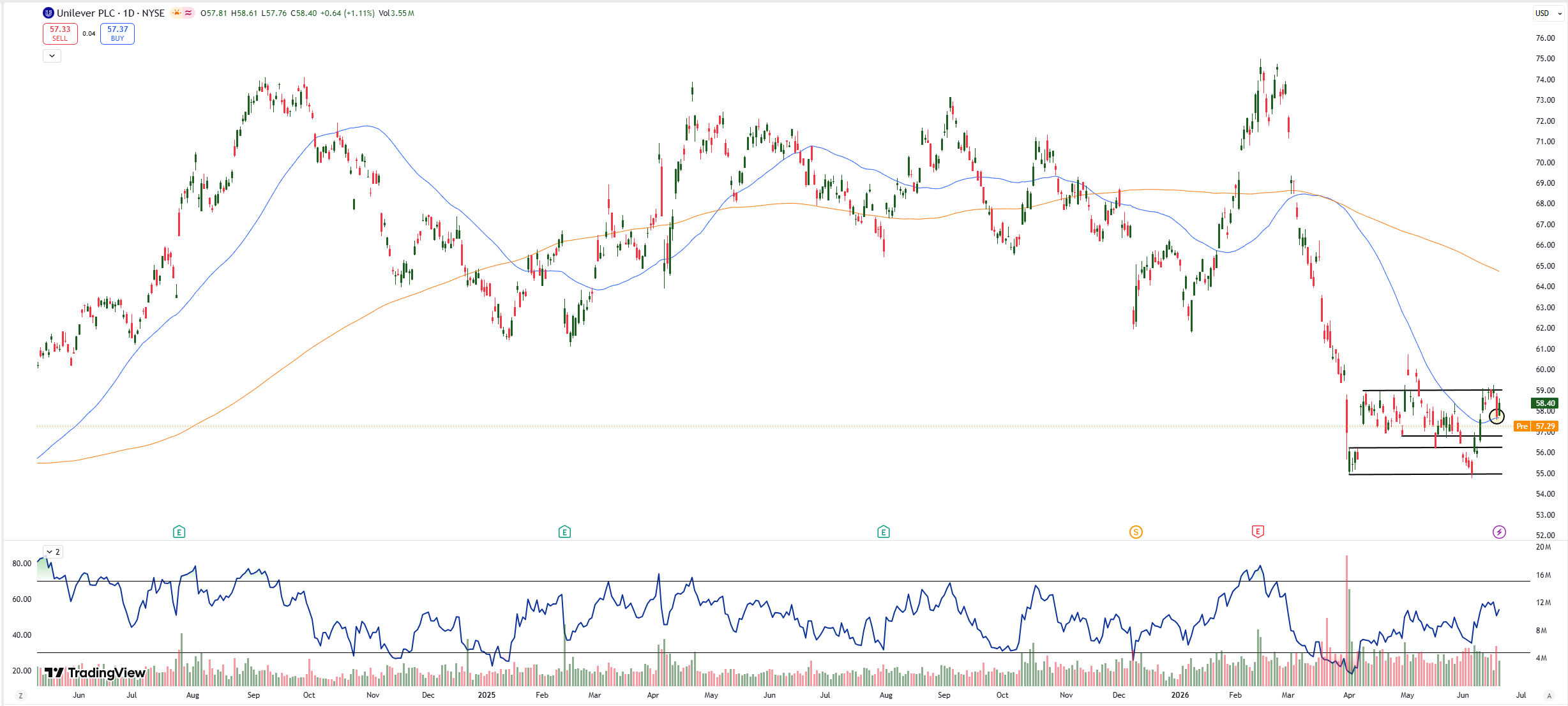
50 SMA breakdown puts Unilever under pressure
As mentioned in our previous analysis, UL failed to break through the local resistance level at $59, and the stock subsequently tested its 50-day simple moving average (SMA) near $57.63.
During pre-market trading, the stock fell by more than 1.8%. The 50-day SMA had served as an important support level, and its breakdown increases the risk of a move toward $56.79, which becomes the primary downside target for today's session.
If $56.79 is breached, the probability of a further decline toward $56.24 increases significantly. This level corresponds to an unfilled Gap Up created on April 7.
Such price gaps often act as magnets during corrective phases and tend to attract additional trading activity.
For the bullish scenario to regain credibility, buyers must at minimum push the stock back above the 50-day SMA and reclaim the $59 level. Until that happens, the risk of continued downside remains elevated.
Weak sales growth continues to weigh on Unilever
The company continues to generate a strong 32.7% return on equity (ROE), offers a dividend yield of approximately 3.9%, and trades at a relatively moderate forward P/E ratio of 14.9.
However, pressure continues to come from declining revenue. Over the past twelve months, revenue has fallen by 13.8%, while average annual sales growth over the past three years has remained negative.
Until investors see a sustained acceleration in revenue growth and organic sales, Unilever shares may continue trading near local lows despite the company's strong profitability and stable dividend profile.








-
 Afghanistan
-
 Albania
-
 Algeria
-
 Angola
-
 Argentina
-
 Armenia
-
 Australia
-
 Austria
-
 Azerbaijan
-
 Bahamas
-
 Bahrain
-
 Bangladesh
-
 Belarus
-
 Belgium
-
 Bolivia
-
 Botswana
-
 Brazil
-
 Brunei
-
 Bulgaria
-
 Cambodia
-
 Cameroon
-
 Canada
-
 Chile
Chile
-
 China
China
-
 Colombia
-
 Congo
Congo
-
 Costa Rica
-
 Cote d'Ivoire
-
 Croatia
-
 Cuba
Cuba
-
 Cyprus
-
 Czechia
-
 DR Congo
-
 Denmark
-
 Dominican Republic
-
 Ecuador
-
 Egypt
Egypt
-
 El Salvador
-
 Estonia
-
 Eswatini
-
 Ethiopia
-
 Finland
-
 France
-
 Georgia
-
 Germany
-
 Ghana
Ghana
-
 Greece
-
 Haiti
Haiti
-
 Hong Kong
-
 Hungary
-
 India
India
-
 Indonesia
-
 Iran, Islamic republic
-
 Iraq
Iraq
-
 Ireland
-
 Israel
-
 Italy
Italy
-
 Jamaica
-
 Japan
Japan
-
 Jordan
-
 Kazakhstan
-
 Kenya
Kenya
-
 Korea
Korea
-
 Kuwait
-
 Kyrgyzstan
-
 Laos
Laos
-
 Latvia
-
 Lebanon
-
 Lesotho
-
 Libya
Libya
-
 Lithuania
-
 Luxembourg
-
 Madagascar
-
 Malaysia
-
 Malta
Malta
-
 Mauritius
-
 Mexico
-
 Moldova
-
 Mongolia
-
 Montenegro
-
 Morocco
-
 Mozambique
-
 Myanmar
-
 Namibia
-
 Nepal
Nepal
-
 Netherlands
-
 New Zealand
-
 Nigeria
-
 North Macedonia
-
 Norway
-
 Oman
Oman
-
 Pakistan
-
 Palestine
-
 Panama
-
 Papua New Guinea
-
 Paraguay
-
 Peru
Peru
-
 Philippines
-
 Poland
-
 Portugal
-
 Puerto Rico
-
 Qatar
Qatar
-
 Reunion
-
 Romania
-
 Rwanda
-
 Saudi Arabia
-
 Serbia
-
 Singapore
-
 Slovakia
-
 Slovenia
-
 Somalia
-
 South Africa
-
 Spain
Spain
-
 Sri Lanka
-
 Sweden
-
 Switzerland
-
 Syria
Syria
-
 Taiwan
-
 Tajikistan
-
 Tanzania
-
 Thailand
-
 Trinidad and Tobago
-
 Tunisia
-
 Turkey
-
 UAE
UAE
-
 Uganda
-
 Ukraine
-
 United Kingdom
-
United States
-
 Uruguay
-
 Uzbekistan
-
 Venezuela
-
 Vietnam
-
 Yemen
Yemen
-
 Zambia
-
 Zimbabwe
- Forex
- Crypto











