

Nvidia stock slips 1.5% after Microsoft and Meta AI boost fails to break $183 resistance

As of August 1, Nvidia stock is trading at $176.60, down 1.5% in the past 24 hours.
The stock reached an intraday high of $183.30 on July 31 before retreating under technical pressure.
Highlights
- Nvidia is consolidating below $183 resistance despite strong long-term fundamentals and robust AI infrastructure demand from Microsoft and Meta. - Short-term support is holding near $175, with the stock trading above key moving averages.
- Geopolitical risks and valuation concerns are capping further upside in the near term.
The daily trading range on July 31 was wide, between $175.64 and $183.79, underscoring elevated volatility. This price action confirms that short-term resistance lies around the $180–183 area, while key support is forming near $175. From a technical standpoint, Nvidia continues to trade above its 50-day and 200-day moving averages, indicating that the long-term bullish trend remains intact.
However, momentum indicators such as RSI and MACD are beginning to flatten, reflecting investor hesitation near record highs. With volume surging to over 220 million shares on July 31, the recent dip may represent profit-taking rather than a structural breakdown. Nevertheless, traders should closely monitor $175 as a near-term pivot. A confirmed break below could lead to a decline toward the $170 psychological level, while a bounce from here would keep the bullish pattern alive.
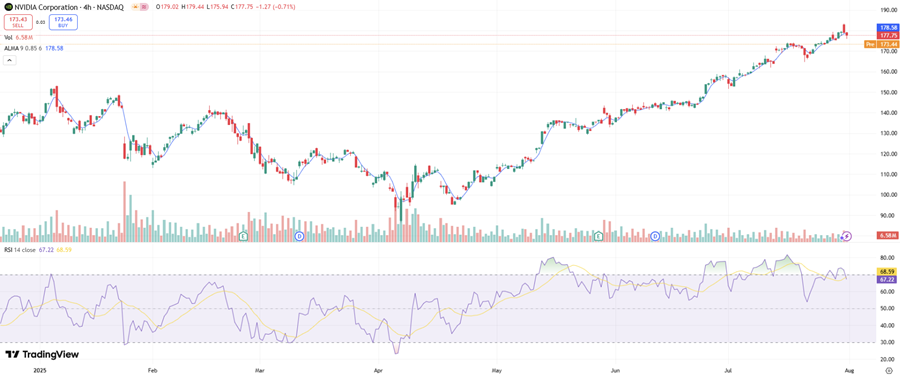
Nvidia stock price dynamics (May 2025 - July 2025). Source: TradingView
The stock’s inability to sustain levels above $180 after multiple tests suggests growing resistance among investors to chase new highs without fresh catalysts. For now, NVDA is likely to consolidate in a sideways channel between $175 and $183 before its next directional move.
Market context and sentiment
Nvidia’s recent price action reflects broader market uncertainty rather than company-specific weakness. On the positive side, big tech earnings continue to support the bullish AI narrative. Microsoft’s recent earnings revealed a massive $24 billion in quarterly capex, while Meta Platforms raised its 2025 spending outlook to $66–72 billion. Both firms reaffirmed their intention to prioritize AI infrastructure—most of which depends on Nvidia’s GPUs. These developments provide strong tailwinds for Nvidia’s long-term growth, particularly in the data center and enterprise AI sectors.
Adding to the positive backdrop, the “Stargate Norway” initiative announced last week could become a landmark project. With plans to deploy 100,000 Nvidia GPUs by late 2026, this is one of the largest AI hardware orders to date. It reinforces Nvidia’s dominant position in global AI buildouts, particularly for training and inference workloads.
However, Nvidia stock continues to face episodic drawdowns due to macro and geopolitical concerns. In early 2025, shares lost nearly $600 billion in market cap following DeepSeek’s low-cost AI model announcement. While Nvidia quickly recovered, the episode reminded investors of the fragile moat around AI hardware. Additionally, renewed fears of U.S. export restrictions on high-end AI chips to China have resurfaced. These restrictions could limit Nvidia’s growth in key emerging markets if applied broadly.
Price forecast and short-term scenarios
In the short term, Nvidia is expected to remain range-bound as the market digests mixed macro signals and awaits further catalysts. The stock is projected to trade between $170 and $185 over the next one to two weeks. The base case scenario assumes continued consolidation in the $175–178 zone. If support at $175 holds, a rebound toward $180 is possible, though sustained upward momentum would require a fresh driver, such as strong earnings or new AI partnerships.
In a bullish scenario, a clean break above $183 could lead to a quick rally toward $188–190, especially if earnings from Alphabet or Amazon show increased AI-related spending. In contrast, a bearish outcome could see NVDA break below $175, opening the door for a retreat to $168–170, particularly if U.S.–China tensions escalate or the Fed signals tighter policy.
Morgan Stanley raised its 12-month price target on Nvidia from $170 to $200, citing soaring demand for its new Blackwell chips and a sharp revenue ramp. Analyst Joseph Moore maintained an Overweight rating, emphasizing that demand continues to far exceed supply.





Latest NVIDIA News





-
 Afghanistan
-
 Albania
-
 Algeria
-
 Angola
-
 Argentina
-
 Armenia
-
 Australia
-
 Austria
-
 Azerbaijan
-
 Bahamas
-
 Bahrain
-
 Bangladesh
-
 Belarus
-
 Belgium
-
 Bolivia
-
 Botswana
-
 Brazil
-
 Brunei
-
 Bulgaria
-
 Cambodia
-
 Cameroon
-
 Canada
-
 Chile
Chile
-
 China
China
-
 Colombia
-
 Congo
Congo
-
 Costa Rica
-
 Cote d'Ivoire
-
 Croatia
-
 Cuba
Cuba
-
 Cyprus
-
 Czechia
-
 DR Congo
-
 Denmark
-
 Dominican Republic
-
 Ecuador
-
 Egypt
Egypt
-
 El Salvador
-
 Estonia
-
 Eswatini
-
 Ethiopia
-
 Finland
-
 France
-
 Georgia
-
 Germany
-
 Ghana
Ghana
-
 Greece
-
 Haiti
Haiti
-
 Hong Kong
-
 Hungary
-
 India
India
-
 Indonesia
-
 Iran, Islamic republic
-
 Iraq
Iraq
-
 Ireland
-
 Israel
-
 Italy
Italy
-
 Jamaica
-
 Japan
Japan
-
 Jordan
-
 Kazakhstan
-
 Kenya
Kenya
-
 Korea
Korea
-
 Kuwait
-
 Kyrgyzstan
-
 Laos
Laos
-
 Latvia
-
 Lebanon
-
 Lesotho
-
 Libya
Libya
-
 Lithuania
-
 Luxembourg
-
 Madagascar
-
 Malaysia
-
 Malta
Malta
-
 Mauritius
-
 Mexico
-
 Moldova
-
 Mongolia
-
 Montenegro
-
 Morocco
-
 Mozambique
-
 Myanmar
-
 Namibia
-
 Nepal
Nepal
-
 Netherlands
-
 New Zealand
-
 Nigeria
-
 North Macedonia
-
 Norway
-
 Oman
Oman
-
 Pakistan
-
 Palestine
-
 Panama
-
 Papua New Guinea
-
 Paraguay
-
 Peru
Peru
-
 Philippines
-
 Poland
-
 Portugal
-
 Puerto Rico
-
 Qatar
Qatar
-
 Reunion
-
 Romania
-
 Rwanda
-
 Saudi Arabia
-
 Serbia
-
 Singapore
-
 Slovakia
-
 Slovenia
-
 Somalia
-
 South Africa
-
 Spain
Spain
-
 Sri Lanka
-
 Sweden
-
 Switzerland
-
 Syria
Syria
-
 Taiwan
-
 Tajikistan
-
 Tanzania
-
 Thailand
-
 Trinidad and Tobago
-
 Tunisia
-
 Turkey
-
 UAE
UAE
-
 Uganda
-
 Ukraine
-
 United Kingdom
-
United States
-
 Uruguay
-
 Uzbekistan
-
 Venezuela
-
 Vietnam
-
 Yemen
Yemen
-
 Zambia
-
 Zimbabwe
- Forex
- Crypto












