

Nvidia stock rises 4% as AI chip orders surge
As of August 5, Nvidia is trading at $180.67, up 4% in the past 24 hours.
This sharp move follows renewed buying interest in AI-focused equities and a broader risk-on rally in U.S. tech markets.
Highlights
- Nvidia surged 4% to $180.67, breaking above key resistance on strong AI chip demand.
-Technical indicators point to continued bullish momentum, with support at $175 and upside targets near $190–200.
- Analysts remain optimistic, citing robust earnings forecasts and increased chip orders, especially from China and major U.S. tech firms.
On the chart, Nvidia has broken decisively above the $175 resistance area that capped prices in late July, with this zone now acting as the first layer of support. The stock is trading comfortably above its 50-day simple moving average at $165 and the 200-day SMA at approximately $150, reinforcing a strong bullish trend. Short-term resistance is found near $183.50, which marks the July 24 intraday high. A sustained close above that level would open the path to new record highs.
Momentum indicators such as the Relative Strength Index (RSI) are signaling overbought territory, currently hovering above 70. While this reflects strong buying pressure, it also suggests the potential for a brief consolidation or technical pullback. Volume over the past three sessions has been notably higher than average, adding weight to the current breakout. The MACD is also trending positively, showing no signs of bearish divergence.
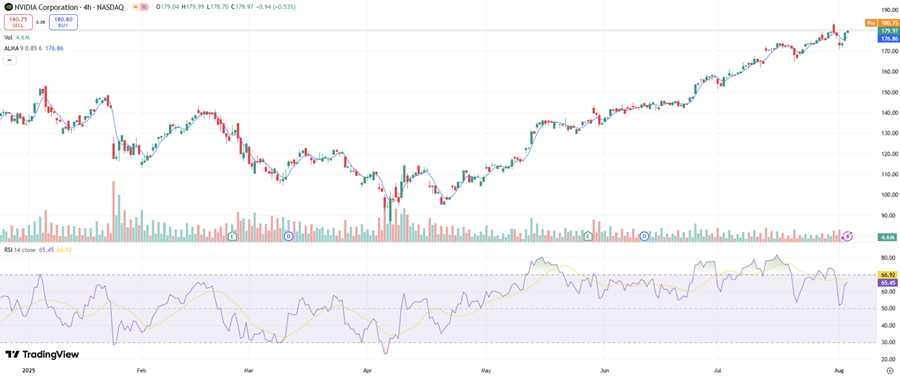
Nvidia stock price dynamics (June 2025 - August 2025). Source: TradingView
From a trend structure perspective, Nvidia is in a well-defined ascending channel that began in late April, with higher highs and higher lows forming consistently. The short-term trend remains firmly intact as long as NVDA holds above $170 on closing basis. A breakdown below $165 would weaken the bullish setup, potentially triggering a corrective move toward $160.
Market context and AI demand surge
Nvidia continues to benefit from its unparalleled position in the AI semiconductor landscape. The company’s dominance in GPU and AI accelerator markets has propelled its valuation beyond $4 trillion this summer, placing it among the most valuable public companies globally. Investor sentiment remains fueled by optimism around the Blackwell-series AI chips and H20 inferencing units, both of which are now being mass shipped to hyperscalers and cloud service providers.
Nvidia is aggressively expanding production to meet surging demand from U.S. and Chinese data center clients. In particular, new licensing rules have allowed Nvidia to resume exports of modified chips to China, a key market that had been under pressure from export controls earlier in 2024. The company has reportedly ordered 300,000 H20 units from TSMC, underscoring both its production capacity and customer demand.
Investment banks remain broadly bullish. Morgan Stanley recently reiterated its Overweight rating and raised its price target from $170 to $200, citing Nvidia’s forward P/E ratio of 33x 2026 earnings estimates as reasonable for a high-growth AI leader. Alphabet, Amazon, and Microsoft have all ramped up their AI infrastructure spending in Q2, directly benefiting Nvidia’s top-line guidance. However, some caution remains among market observers, particularly after disappointing earnings from semiconductor peers such as Intel, ASML, and Texas Instruments. These companies have warned of a cyclical slowdown in non-AI semiconductor segments, which may pose headwinds for broader chip sector valuations.
Price forecast and near-term outlook
In the short term, the base case scenario is for Nvidia to continue advancing toward the $190–195 range over the next two to three weeks, provided that it holds above $175 support. A break above $183.50 would confirm a continuation of the uptrend, likely accelerating the path toward Morgan Stanley’s $200 target before the end of Q3. This scenario assumes stable macro conditions and no negative surprises in the company’s August earnings report.
A more conservative scenario involves a consolidation phase between $175 and $183, allowing the RSI to cool down and giving the 50-day moving average time to catch up. If this consolidation fails and price breaks below $170, traders should watch the $165 level as the next support. Below that, a steeper correction toward $160 could unfold, although the broader uptrend would likely remain intact as long as the 200-day average holds.
Nvidia is reportedly participating in a new funding round for Vast Data, alongside Alphabet’s CapitalG, which could value the company at up to $30 billion. Vast, known for its AI-optimized unstructured data management, complements Nvidia’s data center GPU offerings and would become one of the most highly valued private AI infrastructure firms globally.





Latest NVIDIA News




-
 Afghanistan
-
 Albania
-
 Algeria
-
 Angola
-
 Argentina
-
 Armenia
-
 Australia
-
 Austria
-
 Azerbaijan
-
 Bahamas
-
 Bahrain
-
 Bangladesh
-
 Belarus
-
 Belgium
-
 Bolivia
-
 Botswana
-
 Brazil
-
 Brunei
-
 Bulgaria
-
 Cambodia
-
 Cameroon
-
 Canada
-
 Chile
Chile
-
 China
China
-
 Colombia
-
 Congo
Congo
-
 Costa Rica
-
 Cote d'Ivoire
-
 Croatia
-
 Cuba
Cuba
-
 Cyprus
-
 Czechia
-
 DR Congo
-
 Denmark
-
 Dominican Republic
-
 Ecuador
-
 Egypt
Egypt
-
 El Salvador
-
 Estonia
-
 Eswatini
-
 Ethiopia
-
 Finland
-
 France
-
 Georgia
-
 Germany
-
 Ghana
Ghana
-
 Greece
-
 Haiti
Haiti
-
 Hong Kong
-
 Hungary
-
 India
India
-
 Indonesia
-
 Iran, Islamic republic
-
 Iraq
Iraq
-
 Ireland
-
 Israel
-
 Italy
Italy
-
 Jamaica
-
 Japan
Japan
-
 Jordan
-
 Kazakhstan
-
 Kenya
Kenya
-
 Korea
Korea
-
 Kuwait
-
 Kyrgyzstan
-
 Laos
Laos
-
 Latvia
-
 Lebanon
-
 Lesotho
-
 Libya
Libya
-
 Lithuania
-
 Luxembourg
-
 Madagascar
-
 Malaysia
-
 Malta
Malta
-
 Mauritius
-
 Mexico
-
 Moldova
-
 Mongolia
-
 Montenegro
-
 Morocco
-
 Mozambique
-
 Myanmar
-
 Namibia
-
 Nepal
Nepal
-
 Netherlands
-
 New Zealand
-
 Nigeria
-
 North Macedonia
-
 Norway
-
 Oman
Oman
-
 Pakistan
-
 Palestine
-
 Panama
-
 Papua New Guinea
-
 Paraguay
-
 Peru
Peru
-
 Philippines
-
 Poland
-
 Portugal
-
 Puerto Rico
-
 Qatar
Qatar
-
 Reunion
-
 Romania
-
 Rwanda
-
 Saudi Arabia
-
 Serbia
-
 Singapore
-
 Slovakia
-
 Slovenia
-
 Somalia
-
 South Africa
-
 Spain
Spain
-
 Sri Lanka
-
 Sweden
-
 Switzerland
-
 Syria
Syria
-
 Taiwan
-
 Tajikistan
-
 Tanzania
-
 Thailand
-
 Trinidad and Tobago
-
 Tunisia
-
 Turkey
-
 UAE
UAE
-
 Uganda
-
 Ukraine
-
 United Kingdom
-
United States
-
 Uruguay
-
 Uzbekistan
-
 Venezuela
-
 Vietnam
-
 Yemen
Yemen
-
 Zambia
-
 Zimbabwe
- Forex
- Crypto












