
Nvidia stock falls below $182 as traders pare risks ahead of earnings report
As of August 14, Nvidia stock is trading at $181.59, down 0.86% in the past 24 hours.
The intraday range extended from a low of $179.42 to a high of $183.80, with the stock opening at $182.57.
Highlights
- Nvidia is trading at $181.59, down 0.86% as traders position cautiously ahead of Q2 earnings.
- Concerns over delays in the upcoming Rubin AI chip are weighing on sentiment despite strong ongoing demand for existing products.
- A breakout above $190 is possible if earnings and guidance exceed expectations, but a miss could send the stock toward $170.
Technically, Nvidia is hovering near short-term support in the $180–$182 range. A breakdown below this level could open the path toward $174–$175, with more solid support resting near the $170 psychological level. Resistance remains around the $188–$190 zone, where previous rallies have stalled. Nvidia remains in a long-term uptrend but is showing signs of consolidation after a sharp rally earlier this year.
Moving averages offer a slightly mixed picture. While Nvidia continues to trade above its 100-day SMA, short-term averages such as the 20-day and 50-day lines are flattening out, suggesting some loss of upward momentum. The Relative Strength Index (RSI) is near neutral territory, implying that the stock is neither overbought nor oversold. MACD has shown a bearish crossover recently, reflecting cautious sentiment ahead of key news.
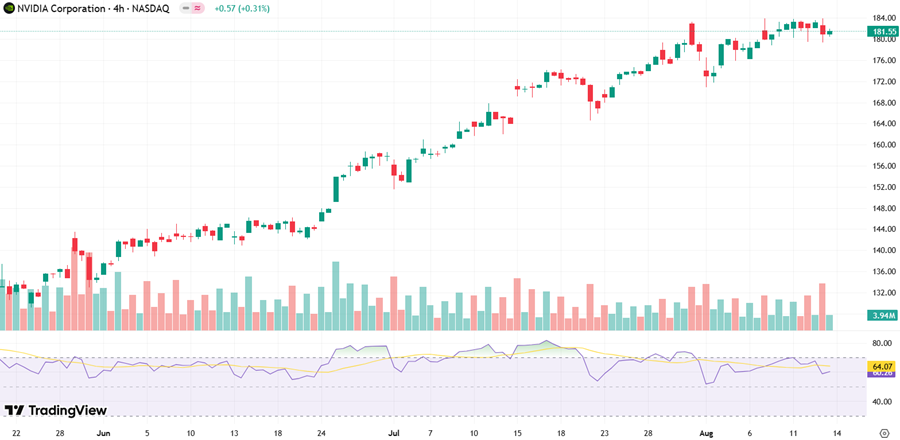
Nvidia stock price dynamics (June 2025 - August 2025). Source: TradingView
Overall, the technical setup suggests that Nvidia is at an inflection point. A strong earnings print could drive a breakout above $190, while any disappointment could trigger a correction toward the low $170s. Options activity also shows elevated implied volatility, indicating that traders are bracing for a significant post-earnings move. Volume has been trending above average, reinforcing that investors are positioning ahead of a potential shift in trend.
Earnings optimism tempered by Rubin chip risks
The broader narrative surrounding Nvidia remains centered on its leadership in AI infrastructure and data center acceleration. However, recent headlines have complicated the bullish case. A Seeking Alpha article points to valuation risks and execution challenges, warning that even a strong earnings report may not be enough to justify current pricing.
At the heart of the concern is the development of Nvidia’s Rubin AI chips, which are reportedly being redesigned to better compete with AMD’s upcoming MI450 platform. According to Fubon Research, Rubin may face production delays well into 2026. If accurate, this could hinder Nvidia’s ability to maintain its performance lead in the AI chip race, particularly as competition intensifies from AMD and custom silicon initiatives by hyperscalers.
Despite these concerns, demand for Nvidia’s current generation of products remains robust. AI infrastructure provider CoreWeave noted that demand for GB200/GB300 NVL72 systems remains extremely strong, suggesting that even with Rubin delays, Nvidia’s sales pipeline remains healthy. This demand dynamic continues to support elevated investor expectations, though supply constraints may cap upside in the short term.
All eyes on $190 breakout or $170 retest
Nvidia’s short-term outlook will be shaped by its Q2 earnings report and any fresh information regarding Rubin development. Investor sentiment remains highly reactive to both demand signals and execution timelines, with particular focus on AI chip competitiveness. The balance between strong current performance and future uncertainty will likely define near-term price direction.
In a bullish case, if earnings exceed expectations and management downplays Rubin delays, Nvidia could break above the $190 level. Such a move would likely attract momentum buyers, pushing the stock back toward its recent highs near $200–$205.
Nvidia has secured regulatory approval to resume limited GPU shipments to China, including the H20 chip developed as an export-compliant alternative to the H100. The introduction of the RTX Pro further strengthens Nvidia’s position by meeting U.S. export rules while targeting China’s expanding AI market.







-
 Afghanistan
-
 Albania
-
 Algeria
-
 Angola
-
 Argentina
-
 Armenia
-
 Australia
-
 Austria
-
 Azerbaijan
-
 Bahamas
-
 Bahrain
-
 Bangladesh
-
 Belarus
-
 Belgium
-
 Bolivia
-
 Botswana
-
 Brazil
-
 Brunei
-
 Bulgaria
-
 Cambodia
-
 Cameroon
-
 Canada
-
 Chile
Chile
-
 China
China
-
 Colombia
-
 Congo
Congo
-
 Costa Rica
-
 Cote d'Ivoire
-
 Croatia
-
 Cuba
Cuba
-
 Cyprus
-
 Czechia
-
 DR Congo
-
 Denmark
-
 Dominican Republic
-
 Ecuador
-
 Egypt
Egypt
-
 El Salvador
-
 Estonia
-
 Eswatini
-
 Ethiopia
-
 Finland
-
 France
-
 Georgia
-
 Germany
-
 Ghana
Ghana
-
 Greece
-
 Haiti
Haiti
-
 Hong Kong
-
 Hungary
-
 India
India
-
 Indonesia
-
 Iran, Islamic republic
-
 Iraq
Iraq
-
 Ireland
-
 Israel
-
 Italy
Italy
-
 Jamaica
-
 Japan
Japan
-
 Jordan
-
 Kazakhstan
-
 Kenya
Kenya
-
 Korea
Korea
-
 Kuwait
-
 Kyrgyzstan
-
 Laos
Laos
-
 Latvia
-
 Lebanon
-
 Lesotho
-
 Libya
Libya
-
 Lithuania
-
 Luxembourg
-
 Madagascar
-
 Malaysia
-
 Malta
Malta
-
 Mauritius
-
 Mexico
-
 Moldova
-
 Mongolia
-
 Montenegro
-
 Morocco
-
 Mozambique
-
 Myanmar
-
 Namibia
-
 Nepal
Nepal
-
 Netherlands
-
 New Zealand
-
 Nigeria
-
 North Macedonia
-
 Norway
-
 Oman
Oman
-
 Pakistan
-
 Palestine
-
 Panama
-
 Papua New Guinea
-
 Paraguay
-
 Peru
Peru
-
 Philippines
-
 Poland
-
 Portugal
-
 Puerto Rico
-
 Qatar
Qatar
-
 Reunion
-
 Romania
-
 Rwanda
-
 Saudi Arabia
-
 Serbia
-
 Singapore
-
 Slovakia
-
 Slovenia
-
 Somalia
-
 South Africa
-
 Spain
Spain
-
 Sri Lanka
-
 Sweden
-
 Switzerland
-
 Syria
Syria
-
 Taiwan
-
 Tajikistan
-
 Tanzania
-
 Thailand
-
 Trinidad and Tobago
-
 Tunisia
-
 Turkey
-
 UAE
UAE
-
 Uganda
-
 Ukraine
-
 United Kingdom
-
United States
-
 Uruguay
-
 Uzbekistan
-
 Venezuela
-
 Vietnam
-
 Yemen
Yemen
-
 Zambia
-
 Zimbabwe
- Forex
- Crypto












