
Mercedes-Benz sales decline 3% as demand weakens in China and Europe
Mercedes-Benz Group AG saw a 3% decline in global sales to 1.98 million vehicles, mainly due to weak demand in China and lower electric vehicle sales in Europe, reflecting ongoing challenges amid changing consumer preferences and rising competition.
Key Takeaways
- Mercedes-Benz global sales fell by 3%, mainly due to weaker demand in key markets like China.
- Sales in China dropped 7%, with local brands gaining market share over luxury imports.
- EV sales dropped nearly 25% due to reduced subsidies in Europe and increased competition.
3% decline in global sales
Mercedes-Benz’s global sales saw a 3% dip last year, marking a significant challenge for the company. The luxury carmaker, known for its premium vehicles, faced decreased demand, particularly for high-end models, which contributed to a global slowdown in sales, reports Bloomberg.
This decline was especially noticeable in major markets such as China and Europe, where shifting consumer preferences and economic factors negatively impacted the brand's performance.
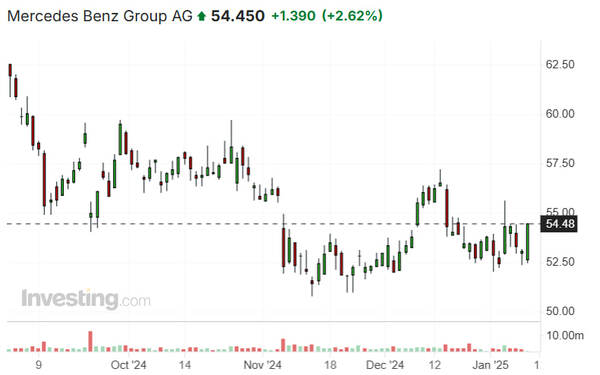
Mercedes Benz Group AG (MBGn) share price dynamics (Sep 2024 - Jan 2025) Source: Investing.com
The 3% drop translates to approximately 1.98 million vehicles sold, down from 2.04 million in the previous year. Despite strong performance in the final quarter of the year, where sales slightly improved, the overall result fell short of expectations.
Struggles in China
The most significant factor behind the sales drop was the 7% reduction in Mercedes-Benz's sales in China, its largest market. High-end models such as the S-Class and Maybach saw a sharp decline in demand, as local consumers increasingly favoured domestic brands like BYD over foreign luxury cars.
Chinese carmakers have expanded rapidly in the luxury segment, offering competitive alternatives to traditional European brands. This shift left Mercedes-Benz facing considerable challenges in retaining its market share.
China’s economic slowdown and the rising popularity of local EVs further dampened demand for Mercedes’ traditional luxury offerings. With a 7% drop in sales in China, the company was hit hard by this market shift, highlighting the need to adapt to evolving consumer preferences in the region.
Decline in EV sales
In addition to struggles in China, Mercedes-Benz also faced a significant decline in electric vehicle (EV) sales in Europe, where sales of fully electric models dropped by nearly 25%.
This downturn was largely attributed to the reduction of government subsidies in several European countries, which had previously supported the adoption of EVs. As many European governments scaled back financial incentives for electric car buyers, consumer demand for EVs softened.
Moreover, growing competition from Chinese manufacturers, who have captured an increasing share of the EV market, further hindered Mercedes-Benz’s ability to maintain its position in the European market.
Companies like BYD and NIO have gained traction with their affordable and well-equipped EVs, increasing the pressure on established carmakers like Mercedes-Benz to innovate and adapt.
Additionally, Honda Motor Co. Ltd. shares soared 13.55% in Tokyo trading on Dec. 24, their biggest one-day gain since 2008. It followed the carmaker's announcement of a massive share buyback plan and confirmation of merger talks with Nissan Motor Co. Ltd.






-
 Afghanistan
-
 Albania
-
 Algeria
-
 Angola
-
 Argentina
-
 Armenia
-
 Australia
-
 Austria
-
 Azerbaijan
-
 Bahamas
-
 Bahrain
-
 Bangladesh
-
 Belarus
-
 Belgium
-
 Bolivia
-
 Botswana
-
 Brazil
-
 Brunei
-
 Bulgaria
-
 Cambodia
-
 Cameroon
-
 Canada
-
 Chile
Chile
-
 China
China
-
 Colombia
-
 Congo
Congo
-
 Costa Rica
-
 Cote d'Ivoire
-
 Croatia
-
 Cuba
Cuba
-
 Cyprus
-
 Czechia
-
 DR Congo
-
 Denmark
-
 Dominican Republic
-
 Ecuador
-
 Egypt
Egypt
-
 El Salvador
-
 Estonia
-
 Eswatini
-
 Ethiopia
-
 Finland
-
 France
-
 Georgia
-
 Germany
-
 Ghana
Ghana
-
 Greece
-
 Haiti
Haiti
-
 Hong Kong
-
 Hungary
-
 India
India
-
 Indonesia
-
 Iran, Islamic republic
-
 Iraq
Iraq
-
 Ireland
-
 Israel
-
 Italy
Italy
-
 Jamaica
-
 Japan
Japan
-
 Jordan
-
 Kazakhstan
-
 Kenya
Kenya
-
 Korea
Korea
-
 Kuwait
-
 Kyrgyzstan
-
 Laos
Laos
-
 Latvia
-
 Lebanon
-
 Lesotho
-
 Libya
Libya
-
 Lithuania
-
 Luxembourg
-
 Madagascar
-
 Malaysia
-
 Malta
Malta
-
 Mauritius
-
 Mexico
-
 Moldova
-
 Mongolia
-
 Montenegro
-
 Morocco
-
 Mozambique
-
 Myanmar
-
 Namibia
-
 Nepal
Nepal
-
 Netherlands
-
 New Zealand
-
 Nigeria
-
 North Macedonia
-
 Norway
-
 Oman
Oman
-
 Pakistan
-
 Palestine
-
 Panama
-
 Papua New Guinea
-
 Paraguay
-
 Peru
Peru
-
 Philippines
-
 Poland
-
 Portugal
-
 Puerto Rico
-
 Qatar
Qatar
-
 Reunion
-
 Romania
-
 Rwanda
-
 Saudi Arabia
-
 Serbia
-
 Singapore
-
 Slovakia
-
 Slovenia
-
 Somalia
-
 South Africa
-
 Spain
Spain
-
 Sri Lanka
-
 Sweden
-
 Switzerland
-
 Syria
Syria
-
 Taiwan
-
 Tajikistan
-
 Tanzania
-
 Thailand
-
 Trinidad and Tobago
-
 Tunisia
-
 Turkey
-
 UAE
UAE
-
 Uganda
-
 Ukraine
-
 United Kingdom
-
United States
-
 Uruguay
-
 Uzbekistan
-
 Venezuela
-
 Vietnam
-
 Yemen
Yemen
-
 Zambia
-
 Zimbabwe
- Forex
- Crypto











