
LVMH stock consolidates at €495 as investors question pricing power and brand relevance

As of September 8, LVMH stock is trading at €494.95, down 0.3% over the last 24 hours, continuing its volatile trend following a string of weaker-than-expected earnings reports and signs of softening global demand.
Highlights
- LVMH shares fell 0.3% to €494.95 amid growing investor concerns over brand relevance and declining pricing power.
- Fashion and leather goods sales dropped 9% in Q2, while Gen Z engagement and global demand show signs of fatigue.
- Structural issues in the Moët Hennessy division and uncertain recovery in tourism further cloud the short-term outlook.
Shares have declined nearly 29% over the past 12 months, sharply underperforming the Euro Stoxx 50 and trailing luxury peers such as Hermès and Richemont. Technical indicators remain fragile, with LVMH hovering just above key support at €488. The next strong support lies near the March 2023 low of €472, while upside resistance stands at €515, followed by a more significant ceiling at €550.
The 50-day moving average has turned downward and is currently at €504, while the 200-day average has flattened around €528, suggesting a shift from consolidation to mild downtrend. RSI (Relative Strength Index) sits near 41, indicating slightly bearish momentum without being oversold. Volume has also declined compared to earlier in the year, highlighting a lack of conviction among buyers despite the price pullback.
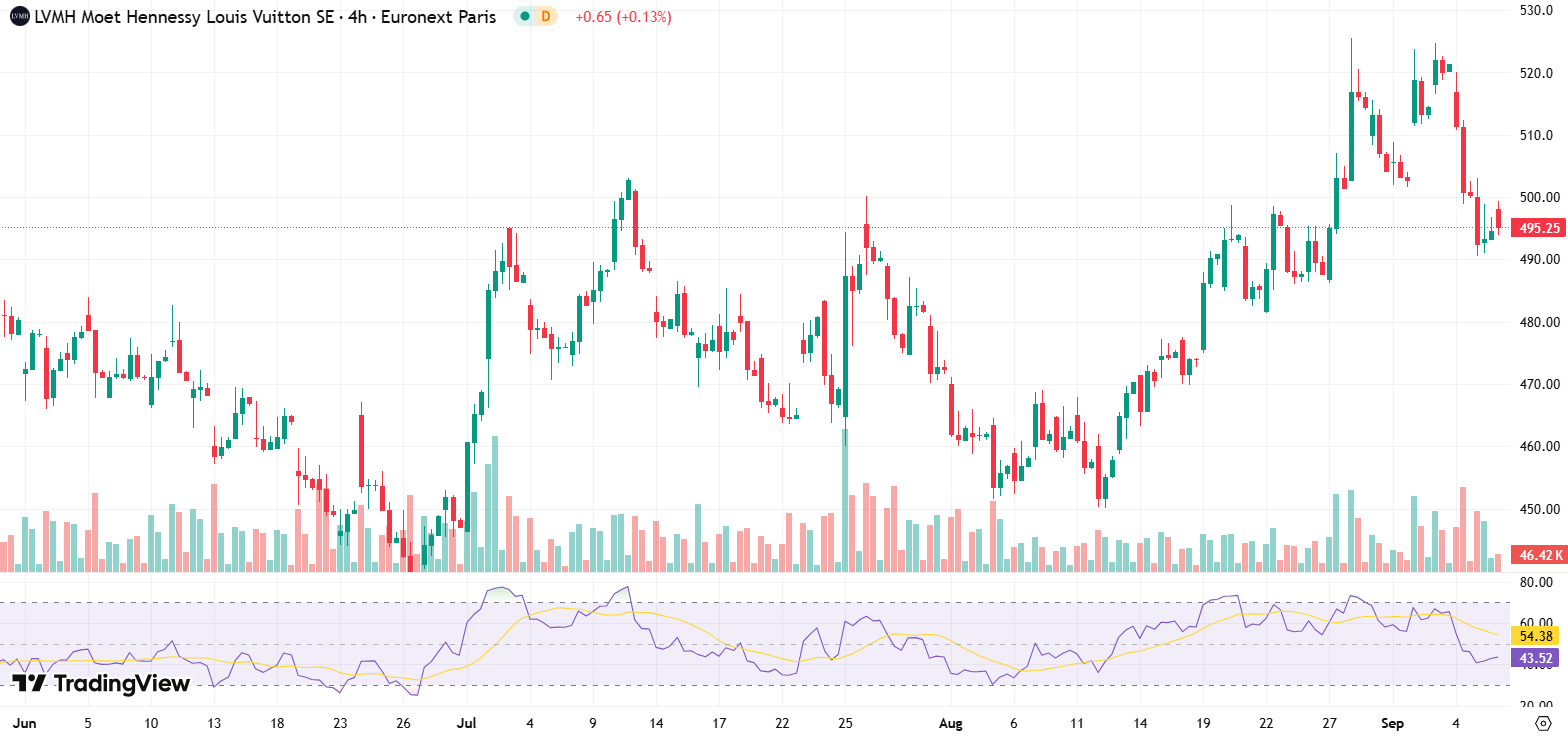
LVMH stock price dynamics (June 2025 - September 2025). Source: TradingView.
Fundamentally, LVMH’s Q2 2025 results show broad-based deceleration. Group-wide organic revenue dropped 4% to €19.5 billion, driven by a surprising 9% fall in the critical fashion and leather goods segment—its main earnings driver. Profit from recurring operations fell 15% year-on-year, to €9.01 billion. While slightly ahead of consensus, the underlying signals suggest fatigue in core brand demand, especially in the U.S. and China. Tourism recovery, which had previously boosted luxury revenues, has also lost steam, particularly in Japan and Western Europe.
Gen Z fatigue, U.S. slowdown and Moët crisis deepen
The broader macro backdrop offers little relief. Global luxury demand appears to be undergoing a cyclical and potentially structural reset. High-net-worth consumer spending is holding, but aspirational buyers in China, the U.S., and Europe are stepping back. Rising interest rates, sticky inflation, and weaker consumer sentiment have hit discretionary sectors hard, and luxury has not been spared.
A “vibe shift” has also become evident: younger consumers are showing less interest in logo-heavy heritage brands. A recent report highlights a drop in social media engagement across luxury fashion houses. Once buoyed by influencers and cultural relevance, LVMH’s brands are struggling to adapt to changing tastes and authenticity-driven consumer preferences.
Internally, the group’s Moët Hennessy unit has entered troubled waters. Once a reliable margin contributor, the wine and spirits division recorded a €1.5 billion cash outflow in 2024—its worst in over a decade—compared to a €1 billion inflow in 2019. Aggressive pricing, inventory mismanagement, and questionable acquisitions under former CEO Philippe Schaus have destabilized the unit. This comes as competitors like Pernod Ricard and Rémy Cointreau are also facing weak demand for cognac and champagne, especially in Asia.
€472 to €550 range with cautious upside bias
Looking ahead, LVMH is likely to trade within a wide band of €472 to €550 in the near term. A move below €488 would signal a retest of yearly lows, especially if broader risk appetite remains weak. However, if tourism trends recover and product innovation at Dior and Louis Vuitton gains traction, LVMH may stage a rebound toward €530–€550 by Q1 2026.
Consensus analyst targets remain mildly bullish, with a 12-month price target average of €553, representing approximately 11% upside from current levels. Among 25 analysts, 13 rate the stock a buy, 11 hold, and one a sell. The positive outlook reflects expectations of recovery in key markets and successful product launches, though sentiment remains cautious amid ongoing macroeconomic headwinds.
European equities remain range-bound as investors weigh weak German factory data and await key U.S. jobs figures that could impact Fed policy. Luxury stocks like LVMH face added pressure from softening Chinese demand, eurozone stagnation, and rising rate risks, putting high-valuation discretionary names at risk.
As we wrote, LVMH weighs sale of Marc Jacobs amid financial strains








-
 Afghanistan
-
 Albania
-
 Algeria
-
 Angola
-
 Argentina
-
 Armenia
-
 Australia
-
 Austria
-
 Azerbaijan
-
 Bahamas
-
 Bahrain
-
 Bangladesh
-
 Belarus
-
 Belgium
-
 Bolivia
-
 Botswana
-
 Brazil
-
 Brunei
-
 Bulgaria
-
 Cambodia
-
 Cameroon
-
 Canada
-
 Chile
Chile
-
 China
China
-
 Colombia
-
 Congo
Congo
-
 Costa Rica
-
 Cote d'Ivoire
-
 Croatia
-
 Cuba
Cuba
-
 Cyprus
-
 Czechia
-
 DR Congo
-
 Denmark
-
 Dominican Republic
-
 Ecuador
-
 Egypt
Egypt
-
 El Salvador
-
 Estonia
-
 Eswatini
-
 Ethiopia
-
 Finland
-
 France
-
 Georgia
-
 Germany
-
 Ghana
Ghana
-
 Greece
-
 Haiti
Haiti
-
 Hong Kong
-
 Hungary
-
 India
India
-
 Indonesia
-
 Iran, Islamic republic
-
 Iraq
Iraq
-
 Ireland
-
 Israel
-
 Italy
Italy
-
 Jamaica
-
 Japan
Japan
-
 Jordan
-
 Kazakhstan
-
 Kenya
Kenya
-
 Korea
Korea
-
 Kuwait
-
 Kyrgyzstan
-
 Laos
Laos
-
 Latvia
-
 Lebanon
-
 Lesotho
-
 Libya
Libya
-
 Lithuania
-
 Luxembourg
-
 Madagascar
-
 Malaysia
-
 Malta
Malta
-
 Mauritius
-
 Mexico
-
 Moldova
-
 Mongolia
-
 Montenegro
-
 Morocco
-
 Mozambique
-
 Myanmar
-
 Namibia
-
 Nepal
Nepal
-
 Netherlands
-
 New Zealand
-
 Nigeria
-
 North Macedonia
-
 Norway
-
 Oman
Oman
-
 Pakistan
-
 Palestine
-
 Panama
-
 Papua New Guinea
-
 Paraguay
-
 Peru
Peru
-
 Philippines
-
 Poland
-
 Portugal
-
 Puerto Rico
-
 Qatar
Qatar
-
 Reunion
-
 Romania
-
 Rwanda
-
 Saudi Arabia
-
 Serbia
-
 Singapore
-
 Slovakia
-
 Slovenia
-
 Somalia
-
 South Africa
-
 Spain
Spain
-
 Sri Lanka
-
 Sweden
-
 Switzerland
-
 Syria
Syria
-
 Taiwan
-
 Tajikistan
-
 Tanzania
-
 Thailand
-
 Trinidad and Tobago
-
 Tunisia
-
 Turkey
-
 UAE
UAE
-
 Uganda
-
 Ukraine
-
 United Kingdom
-
United States
-
 Uruguay
-
 Uzbekistan
-
 Venezuela
-
 Vietnam
-
 Yemen
Yemen
-
 Zambia
-
 Zimbabwe
- Forex
- Crypto











