


Verizon Communications Inc. (VZ) fell 2.02% after SpaceX revealed detailed plans to expand its Starlink Mobile satellite service, raising concerns about new competition in the US wireless market. The downside move is supported by Verizon trading above all key moving averages, with momentum signals still reflecting short-term resilience.
 45.16
45.16
Highlights
- SpaceX aims to expand Starlink Mobile to compete directly with established wireless providers, pressuring shares of Verizon.
- Verizon maintains a quarterly dividend of $0.7075 per share and benefits from easing Treasury yields that support telecoms.
- Verizon stock trades with a bullish technical bias, consolidating near $45.92 with a five-day projected range of $43.94 to $46.96.
Dividend support offset by muted activity amid competitive pressure
SpaceX announced its intention to expand Starlink Mobile and directly target incumbent wireless providers such as Verizon. Following remarks from SpaceX leadership, Verizon recorded lower trading activity and volume. The company recently distributed a quarterly dividend of $0.7075 per share, with the broader environment of easing Treasury yields seen as supportive for dividend-paying telecommunications companies, though price action has remained under broader selling pressure.
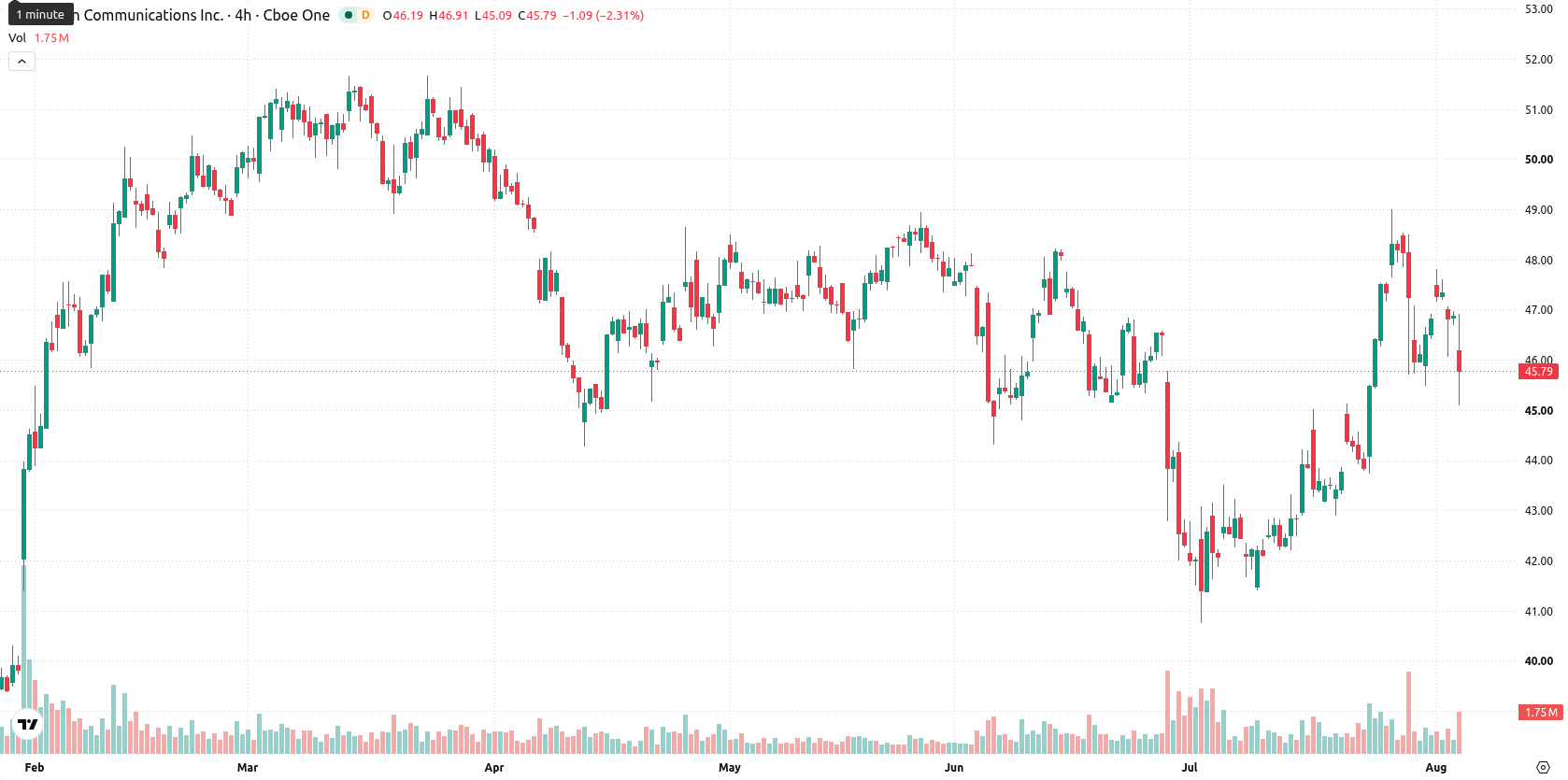
Bullish momentum persists despite oscillator divergences and overbought signals
Verizon is trading above its 20-day, 50-day, and 200-day moving averages at $44.70, $45.43, and $44.69, respectively, indicating bullish alignment across timeframes. Key technical levels include resistance at $46.33 and support at $45.73. Momentum indicators such as the MACD and ADX confirm a bullish setting, while the RSI and CCI remain in buy territory, but the Stochastic RSI signals a possible pullback. Intraday indicators such as Bull/Bear Power show an overbought state, with buyer dominance prevailing, while the Awesome Oscillator reinforces the bullish bias. Despite a 2.02% decline today, price has recovered near the daily high with volatility at 2.70%, but mixed signals remain as oscillator divergences appear alongside price momentum.
Earlier, analysts noted that Verizon had entered a period of increased downside risk amid rising competitive pressure, particularly from SpaceX's Starlink expansion. The current technical and momentum setup now suggests that traders should closely monitor support at $45.73, as a breakdown below this level could shift the outlook to renewed short-term weakness.






Latest Verizon News



-
 Afghanistan
-
 Albania
-
 Algeria
-
 Angola
-
 Argentina
-
 Armenia
-
 Australia
-
 Austria
-
 Azerbaijan
-
 Bahamas
-
 Bahrain
-
 Bangladesh
-
 Belarus
-
 Belgium
-
 Bolivia
-
 Botswana
-
 Brazil
-
 Brunei
-
 Bulgaria
-
 Cambodia
-
 Cameroon
-
 Canada
-
 Chile
-
 China
-
 Colombia
-
 Congo
-
 Costa Rica
-
 Cote d'Ivoire
-
 Croatia
-
 Cuba
-
 Cyprus
-
 Czechia
-
 DR Congo
-
 Denmark
-
 Dominican Republic
-
 Ecuador
-
 Egypt
-
 El Salvador
-
 Estonia
-
 Eswatini
-
 Ethiopia
-
 Finland
-
 France
-
 Georgia
-
 Germany
-
 Ghana
-
 Greece
-
 Haiti
-
 Hong Kong
-
 Hungary
-
 India
-
 Indonesia
-
 Iran, Islamic republic
-
 Iraq
-
 Ireland
-
 Israel
-
 Italy
-
 Jamaica
-
 Japan
-
 Jordan
-
 Kazakhstan
-
 Kenya
-
 Korea
-
 Kuwait
-
 Kyrgyzstan
-
 Laos
-
 Latvia
-
 Lebanon
-
 Lesotho
-
 Libya
-
 Lithuania
-
 Luxembourg
-
 Madagascar
-
 Malaysia
-
 Malta
-
 Mauritius
-
 Mexico
-
 Moldova
-
 Mongolia
-
 Montenegro
-
 Morocco
-
 Mozambique
-
 Myanmar
-
 Namibia
-
 Nepal
-
 Netherlands
-
 New Zealand
-
 Nigeria
-
 North Macedonia
-
 Norway
-
 Oman
-
 Pakistan
-
 Palestine
-
 Panama
-
 Papua New Guinea
-
 Paraguay
-
 Peru
-
 Philippines
-
 Poland
-
 Portugal
-
 Puerto Rico
-
 Qatar
-
 Reunion
-
 Romania
-
 Rwanda
-
 Saudi Arabia
-
 Serbia
-
 Singapore
-
 Slovakia
-
 Slovenia
-
 Somalia
-
 South Africa
-
 Spain
-
 Sri Lanka
-
 Sweden
-
 Switzerland
-
 Syria
-
 Taiwan
-
 Tajikistan
-
 Tanzania
-
 Thailand
-
 Trinidad and Tobago
-
 Tunisia
-
 Turkey
-
 UAE
-
 Uganda
-
 Ukraine
-
 United Kingdom
-
United States
-
 Uruguay
-
 Uzbekistan
-
 Venezuela
-
 Vietnam
-
 Yemen
-
 Zambia
-
 Zimbabwe
- Forex
- Crypto












