

Core Scientific shares technical analysis: Support test at $15.43 in focus

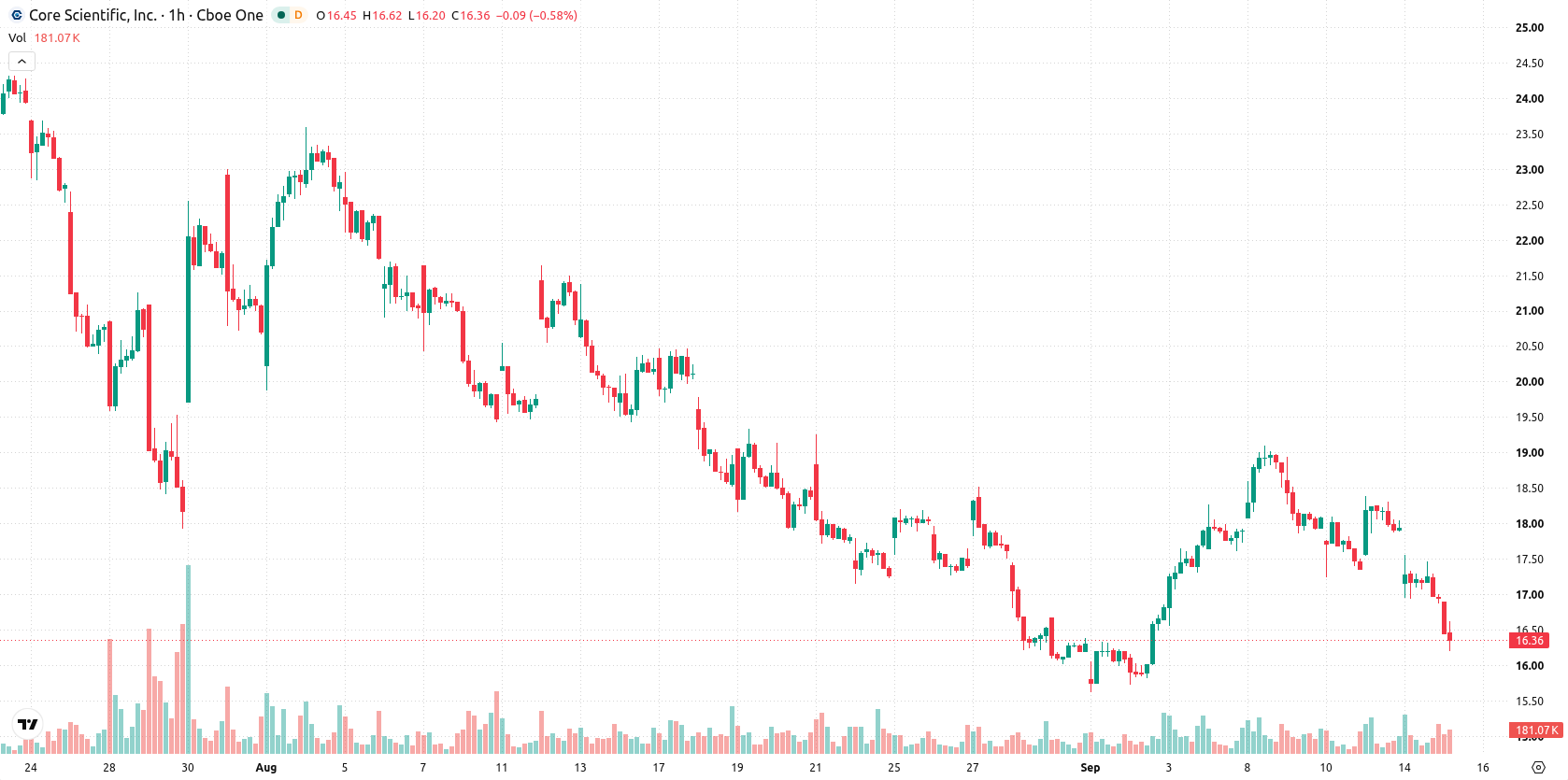
Core Scientific (CORZ) stock is trading at $16.35, marking a daily decline of 3.45%. The price remains below its key short-, medium-, and long-term moving averages, reflecting continued seller pressure.
 13.38
15.01
Highlights
- CORZ/USD trades at $16.35, below all major moving averages, showing persistent short- to long-term selling pressure.
- Momentum and oscillator indicators such as MACD, RSI and others show oversold conditions and confirm dominant short-term sellers.
- Expected near-term range is $15.43 to $17.27, with only a 22% probability of a rebound above $17.63 resistance.
Oversold momentum as technical barriers reinforce downside risk
On the hourly chart, CORZ is trading below the MA-20 at $17.62, MA-50 at $17.86, and MA-200 at $19.76, with the Ichimoku Kijun set at $17.63 as immediate resistance. Momentum indicators reinforce the downside: MACD remains on Sell, ADX is Neutral, while RSI is deeply oversold at 35.99. Additional oscillators — Stochastic RSI, CCI, and Bull/Bear Power — are all in oversold territory, highlighting strong short-term seller dominance. The Awesome Oscillator (AO) is also aligned with a Sell reading, consistent with the current negative intraday momentum.
Downside bias dominates as reversal requires resistance break
In the near term, CORZ is expected to trade within the $15.43 to $17.27 band. Probabilities favor further downside, with only a 22% chance of an upward reversal in the current setup. A move above $17.63 would be required to shift the bias to bullish, while a confirmed break below $15.43 support could trigger additional declines. The base scenario anticipates price stabilization in this volatility range.
Earlier, analysts noted that Core Scientific was experiencing persistent technical weakness and heightened volatility, with downside risks outweighing any brief periods of intraday strength. The latest data confirms and extends this negative outlook, underscoring the importance of monitoring the $15.43 support level as sustained pressure could prompt further declines.






Latest Core Scientific News




-
 Afghanistan
-
 Albania
-
 Algeria
-
 Angola
-
 Argentina
-
 Armenia
-
 Australia
-
 Austria
-
 Azerbaijan
-
 Bahamas
-
 Bahrain
-
 Bangladesh
-
 Belarus
-
 Belgium
-
 Bolivia
-
 Botswana
-
 Brazil
-
 Brunei
-
 Bulgaria
-
 Cambodia
-
 Cameroon
-
 Canada
-
 Chile
-
 China
-
 Colombia
-
 Congo
-
 Costa Rica
-
 Cote d'Ivoire
-
 Croatia
-
 Cuba
-
 Cyprus
-
 Czechia
-
 DR Congo
-
 Denmark
-
 Dominican Republic
-
 Ecuador
-
 Egypt
-
 El Salvador
-
 Estonia
-
 Eswatini
-
 Ethiopia
-
 Finland
-
 France
-
 Georgia
-
 Germany
-
 Ghana
-
 Greece
-
 Haiti
-
 Hong Kong
-
 Hungary
-
 India
-
 Indonesia
-
 Iran, Islamic republic
-
 Iraq
-
 Ireland
-
 Israel
-
 Italy
-
 Jamaica
-
 Japan
-
 Jordan
-
 Kazakhstan
-
 Kenya
-
 Korea
-
 Kuwait
-
 Kyrgyzstan
-
 Laos
-
 Latvia
-
 Lebanon
-
 Lesotho
-
 Libya
-
 Lithuania
-
 Luxembourg
-
 Madagascar
-
 Malaysia
-
 Malta
-
 Mauritius
-
 Mexico
-
 Moldova
-
 Mongolia
-
 Montenegro
-
 Morocco
-
 Mozambique
-
 Myanmar
-
 Namibia
-
 Nepal
-
 Netherlands
-
 New Zealand
-
 Nigeria
-
 North Macedonia
-
 Norway
-
 Oman
-
 Pakistan
-
 Palestine
-
 Panama
-
 Papua New Guinea
-
 Paraguay
-
 Peru
-
 Philippines
-
 Poland
-
 Portugal
-
 Puerto Rico
-
 Qatar
-
 Reunion
-
 Romania
-
 Rwanda
-
 Saudi Arabia
-
 Serbia
-
 Singapore
-
 Slovakia
-
 Slovenia
-
 Somalia
-
 South Africa
-
 Spain
-
 Sri Lanka
-
 Sweden
-
 Switzerland
-
 Syria
-
 Taiwan
-
 Tajikistan
-
 Tanzania
-
 Thailand
-
 Trinidad and Tobago
-
 Tunisia
-
 Turkey
-
 UAE
-
 Uganda
-
 Ukraine
-
 United Kingdom
-
United States
-
 Uruguay
-
 Uzbekistan
-
 Venezuela
-
 Vietnam
-
 Yemen
-
 Zambia
-
 Zimbabwe
- Forex
- Crypto












