

What's behind Oracle's latest 4.7% stock pullback?

Oracle Corporation (ORCL) fell 4.72% as mounting downside pressure persisted, even as record cloud revenue growth and an expanding contract backlog offered a supportive corporate backdrop. The steep drop is reinforced by Oracle trading well below its 20-, 50-, and 200-day moving averages, highlighting continued bearish momentum.
 133.15
144.17
Highlights
- Oracle stated that cloud revenue reached 51% of total revenue in fiscal 2026, up from 43% the previous year.
- The company reported a cloud backlog of $664 billion and $288 billion in future data center leases, with dividend yield at 1.5%.
- Oracle stock trades below key moving averages with a bearish technical setup and an expected range of $120.63 to $135.85.
Bullish cloud growth offsets heavy selling as buybacks remain paused
Oracle reported that its cloud revenue accounted for 51% of total revenue in fiscal 2026, up from 43% the previous year, reflecting stronger demand for Oracle Cloud Infrastructure and Fusion cloud applications driven by artificial intelligence adoption. The company stated its cloud backlog reached $664 billion and disclosed a quarterly dividend of $0.50 per share, with dividend yield at approximately 1.5%. Oracle also signed $288 billion in data center leases not yet commenced and continued heavy investment in data center expansion and AI infrastructure, with financial results impacted by debt financing and capital expenditures. Share buybacks remained paused and no significant changes to dividend or repurchase policies were announced, though price action has remained under broader selling pressure.
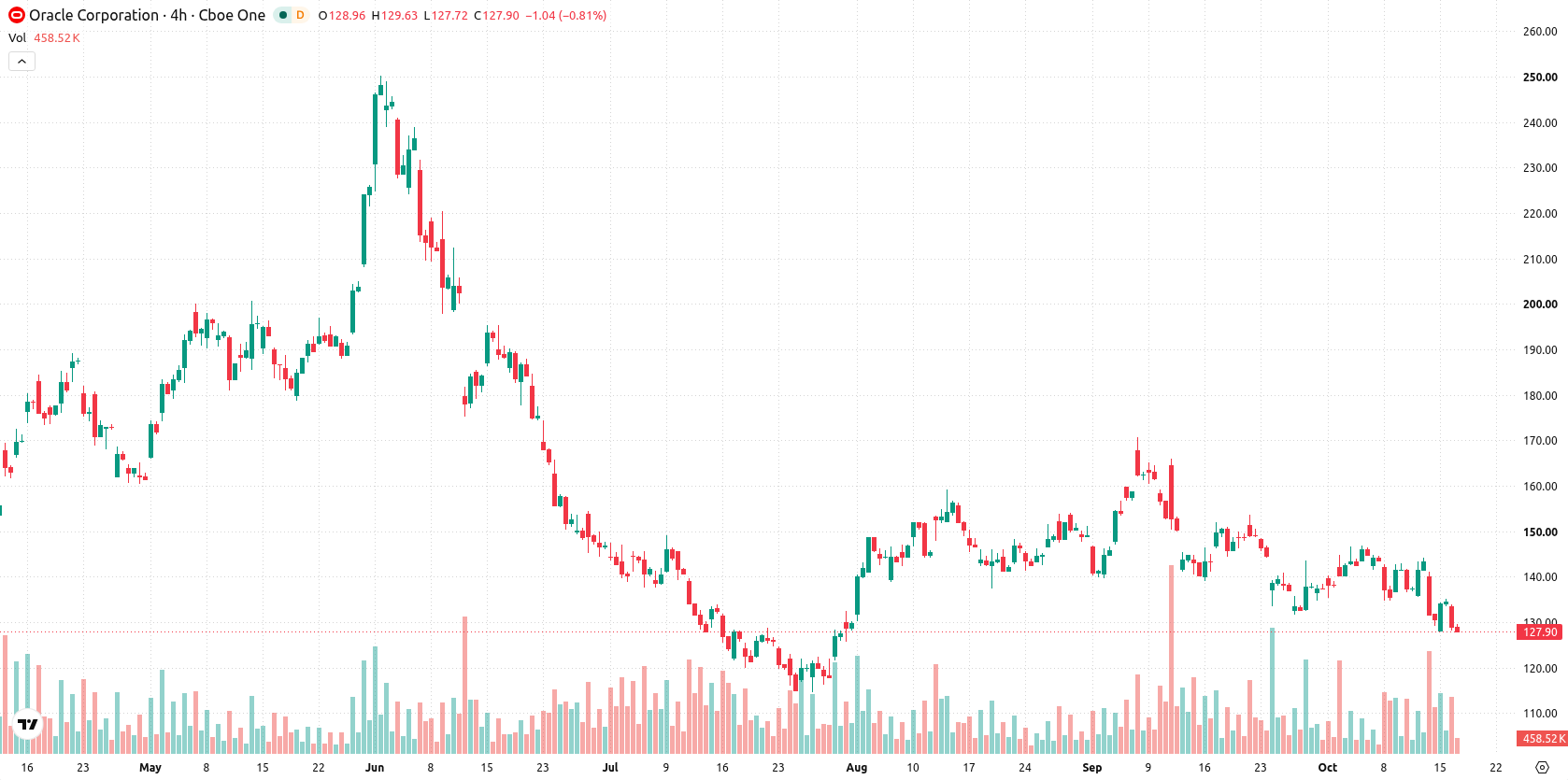
Bearish momentum and oversold signals as sellers dominate intraday action
Oracle is trading well below its 20-day ($140.43), 50-day ($145.41), and 200-day ($160.52) moving averages, indicating pronounced downside pressure in short-, medium-, and long-term trends. The stock remains capped by the near-term ceiling at $128.95, with next support at $120.63, and the overall structure is confirmed bearish by the alignment of the 50-day against the 200-day averages. Momentum signals remain negative as MACD points to continued selling pressure, and the Average Directional Index (ADX) reading is neutral, suggesting weak trend conviction. The Relative Strength Index (RSI) at 44.51 signals a sell bias. The Commodity Channel Index (CCI) at -113.42 is in oversold territory, echoed by Bull/Bear Power (BBP) at -3.96, indicating sellers dominate intraday momentum with an oversold reading. Stochastic RSI is moderately bullish, signaling some short-term buying interest, but the overall setup is pressured by the Awesome Oscillator's (AO) negative signal and daily movement, with the stock dropping $6.36 or 4.72%. Oracle opened with a downside gap of about $2.64 (1.96%) and is now trading near session lows. Intraday volatility stands at 1.97%. The intraday tone is heavy, with persistent seller control and little recovery after the open.
Earlier, analysts noted that Oracle’s technical outlook was constrained by persistent downside momentum and heightened macroeconomic and regulatory risks. The current analysis strengthens this view, as downside momentum remains dominant despite robust cloud growth, with sellers firmly in control and a decisive move below $120.63 representing the key downside risk to monitor.








-
 Afghanistan
-
 Albania
-
 Algeria
-
 Angola
-
 Argentina
-
 Armenia
-
 Australia
-
 Austria
-
 Azerbaijan
-
 Bahamas
-
 Bahrain
-
 Bangladesh
-
 Belarus
-
 Belgium
-
 Bolivia
-
 Botswana
-
 Brazil
-
 Brunei
-
 Bulgaria
-
 Cambodia
-
 Cameroon
-
 Canada
-
 Chile
-
 China
-
 Colombia
-
 Congo
-
 Costa Rica
-
 Cote d'Ivoire
-
 Croatia
-
 Cuba
-
 Cyprus
-
 Czechia
-
 DR Congo
-
 Denmark
-
 Dominican Republic
-
 Ecuador
-
 Egypt
-
 El Salvador
-
 Estonia
-
 Eswatini
-
 Ethiopia
-
 Finland
-
 France
-
 Georgia
-
 Germany
-
 Ghana
-
 Greece
-
 Haiti
-
 Hong Kong
-
 Hungary
-
 India
-
 Indonesia
-
 Iran, Islamic republic
-
 Iraq
-
 Ireland
-
 Israel
-
 Italy
-
 Jamaica
-
 Japan
-
 Jordan
-
 Kazakhstan
-
 Kenya
-
 Korea
-
 Kuwait
-
 Kyrgyzstan
-
 Laos
-
 Latvia
-
 Lebanon
-
 Lesotho
-
 Libya
-
 Lithuania
-
 Luxembourg
-
 Madagascar
-
 Malaysia
-
 Malta
-
 Mauritius
-
 Mexico
-
 Moldova
-
 Mongolia
-
 Montenegro
-
 Morocco
-
 Mozambique
-
 Myanmar
-
 Namibia
-
 Nepal
-
 Netherlands
-
 New Zealand
-
 Nigeria
-
 North Macedonia
-
 Norway
-
 Oman
-
 Pakistan
-
 Palestine
-
 Panama
-
 Papua New Guinea
-
 Paraguay
-
 Peru
-
 Philippines
-
 Poland
-
 Portugal
-
 Puerto Rico
-
 Qatar
-
 Reunion
-
 Romania
-
 Rwanda
-
 Saudi Arabia
-
 Serbia
-
 Singapore
-
 Slovakia
-
 Slovenia
-
 Somalia
-
 South Africa
-
 Spain
-
 Sri Lanka
-
 Sweden
-
 Switzerland
-
 Syria
-
 Taiwan
-
 Tajikistan
-
 Tanzania
-
 Thailand
-
 Trinidad and Tobago
-
 Tunisia
-
 Turkey
-
 UAE
-
 Uganda
-
 Ukraine
-
 United Kingdom
-
United States
-
 Uruguay
-
 Uzbekistan
-
 Venezuela
-
 Vietnam
-
 Yemen
-
 Zambia
-
 Zimbabwe
- Forex
- Crypto












