


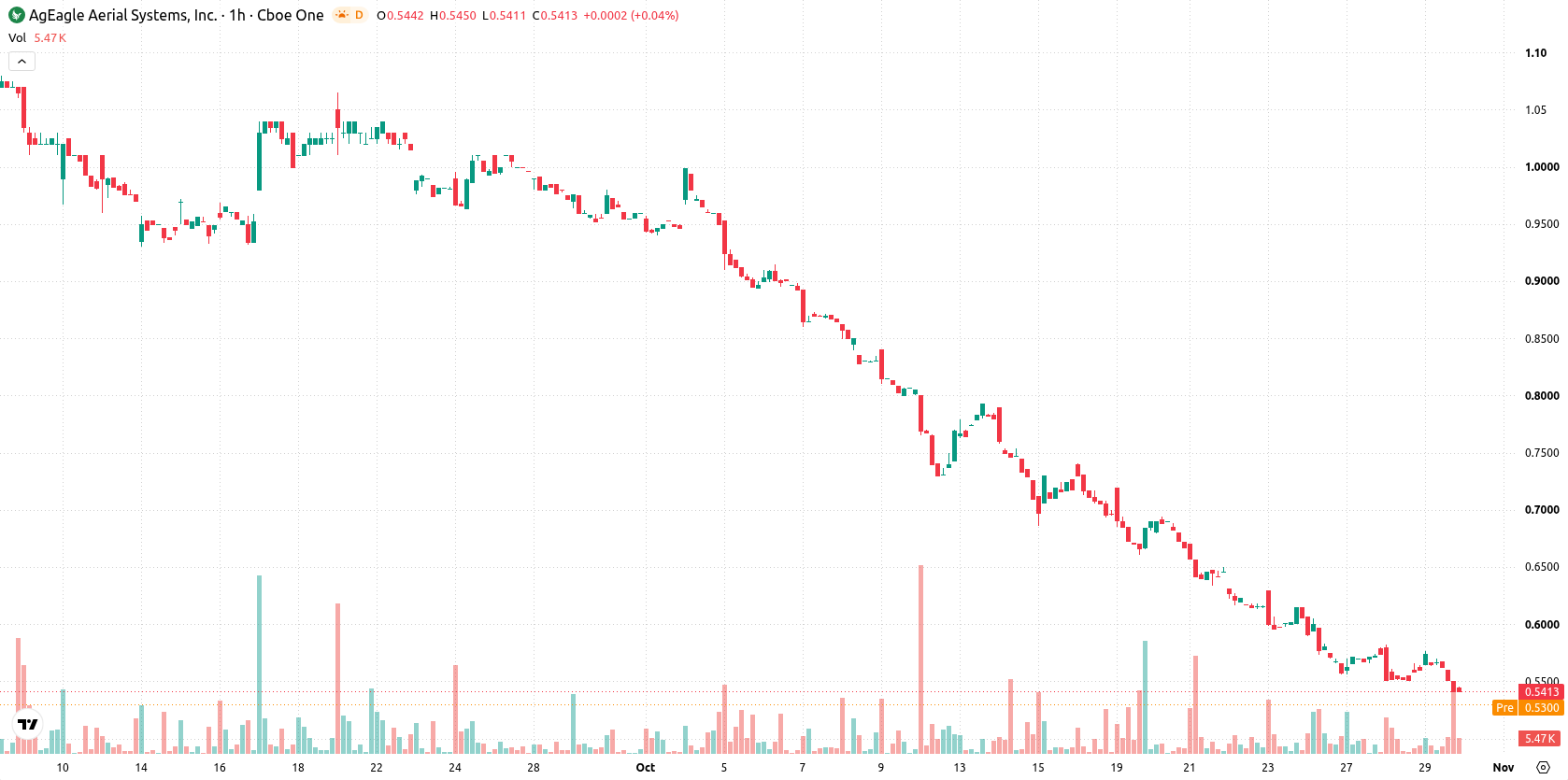
AgEagle Aerial Systems (UAVS) stock is trading at $0.54, reflecting a 3.14% decline for the day. The shares are positioned below their key moving averages, indicating ongoing downward pressure relative to recent price trends.
 0.4685
0.5874
Highlights
- UAVS stock fell 3.14% to $0.54, closing near the session low amid heightened volatility and sustained selling pressure.
- The stock trades below key short and long-term moving averages, with further downside indicated by multiple bearish momentum signals.
- UAVS is expected to move within a $0.51 to $0.58 range short-term, with a high probability of continued declines unless resistance at $0.57 is broken.
Oversold signals and bearish momentum as multiple indicators align
On the hourly chart, UAVS is situated below both the MA-20 and MA-50, while the daily chart shows the price under the MA-200. The Ichimoku Kijun level at $0.57 acts as immediate resistance. MACD remains in a strong sell configuration and ADX confirms seller dominance. RSI stands at 33.55, indicating a bias toward oversold conditions, with CCI also deep in the oversold zone. Meanwhile, Stoch RSI is neutral, Bull/Bear Power signals intraday seller control, and the Awesome Oscillator supports further downside momentum.
Further losses likely amid strong resistance and weak reversal prospects
In the short term, UAVS is likely to trade within a $0.51 to $0.58 volatility band based on current momentum and technical signals. The probability of further downside remains high, while the chances of a significant upside breakout are low. A move above the Ichimoku Kijun at $0.57 would be needed for bullish momentum to return, whereas a break below the $0.51 support could lead to accelerated selling.
Earlier, analysts noted that AgEagle Aerial Systems remained under persistent selling pressure despite its efforts to expand market presence and diversify revenue streams. The current technical setup reinforces this bearish outlook, with traders advised to monitor the $0.51 support level as a potential trigger for accelerated downside risk.






Latest EagleNXT News



-
 Afghanistan
-
 Albania
-
 Algeria
-
 Angola
-
 Argentina
-
 Armenia
-
 Australia
-
 Austria
-
 Azerbaijan
-
 Bahamas
-
 Bahrain
-
 Bangladesh
-
 Belarus
-
 Belgium
-
 Bolivia
-
 Botswana
-
 Brazil
-
 Brunei
-
 Bulgaria
-
 Cambodia
-
 Cameroon
-
 Canada
-
 Chile
-
 China
-
 Colombia
-
 Congo
-
 Costa Rica
-
 Cote d'Ivoire
-
 Croatia
-
 Cuba
-
 Cyprus
-
 Czechia
-
 DR Congo
-
 Denmark
-
 Dominican Republic
-
 Ecuador
-
 Egypt
-
 El Salvador
-
 Estonia
-
 Eswatini
-
 Ethiopia
-
 Finland
-
 France
-
 Georgia
-
 Germany
-
 Ghana
-
 Greece
-
 Haiti
-
 Hong Kong
-
 Hungary
-
 India
-
 Indonesia
-
 Iran, Islamic republic
-
 Iraq
-
 Ireland
-
 Israel
-
 Italy
-
 Jamaica
-
 Japan
-
 Jordan
-
 Kazakhstan
-
 Kenya
-
 Korea
-
 Kuwait
-
 Kyrgyzstan
-
 Laos
-
 Latvia
-
 Lebanon
-
 Lesotho
-
 Libya
-
 Lithuania
-
 Luxembourg
-
 Madagascar
-
 Malaysia
-
 Malta
-
 Mauritius
-
 Mexico
-
 Moldova
-
 Mongolia
-
 Montenegro
-
 Morocco
-
 Mozambique
-
 Myanmar
-
 Namibia
-
 Nepal
-
 Netherlands
-
 New Zealand
-
 Nigeria
-
 North Macedonia
-
 Norway
-
 Oman
-
 Pakistan
-
 Palestine
-
 Panama
-
 Papua New Guinea
-
 Paraguay
-
 Peru
-
 Philippines
-
 Poland
-
 Portugal
-
 Puerto Rico
-
 Qatar
-
 Reunion
-
 Romania
-
 Rwanda
-
 Saudi Arabia
-
 Serbia
-
 Singapore
-
 Slovakia
-
 Slovenia
-
 Somalia
-
 South Africa
-
 Spain
-
 Sri Lanka
-
 Sweden
-
 Switzerland
-
 Syria
-
 Taiwan
-
 Tajikistan
-
 Tanzania
-
 Thailand
-
 Trinidad and Tobago
-
 Tunisia
-
 Turkey
-
 UAE
-
 Uganda
-
 Ukraine
-
 United Kingdom
-
United States
-
 Uruguay
-
 Uzbekistan
-
 Venezuela
-
 Vietnam
-
 Yemen
-
 Zambia
-
 Zimbabwe
- Forex
- Crypto












