

Canopy Growth stock forecast: Bearish trend persists with $0.63 as next key support

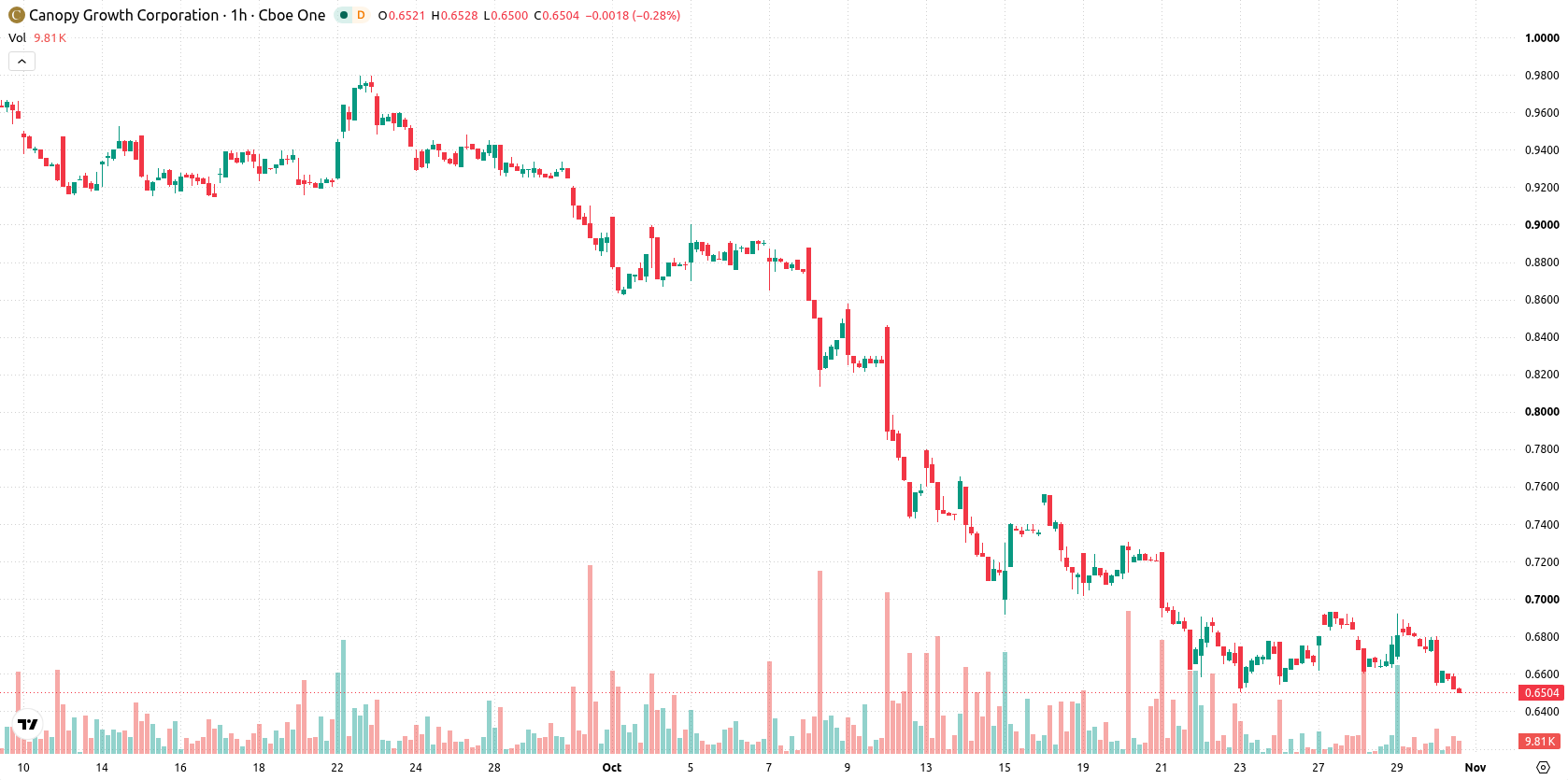
Canopy Growth (CGC) stock is trading at $0.65, marking a daily decline of 3.64%. The price sits clearly below its key moving averages, highlighting a continuation of downside momentum in the short term.
 0.6900
0.6950
Highlights
- CGC/USD trades below short- and long-term moving averages, indicating persistent seller control across all time frames.
- Momentum indicators show sustained bearish pressure with oversold short-term signals, but no reversal confirmation.
- Price is projected to remain between $0.63 and $0.67 over the next 2 to 3 days, with greater risk of further downside and resistance at $0.67.
Bearish pressure holds as oversold signals meet weak trend strength
On the technical front, CGC is trading below the MA-20 ($0.67) and MA-50 ($0.67) on the hourly chart, as well as below the long-term MA-200 ($1) on the daily timeframe. The Ichimoku Kijun at $0.67 acts as immediate resistance, while the $0.63 level outlines a nearby support zone. Among momentum indicators, MACD remains on Sell and ADX signals neutral trend strength. RSI is at 40.44 in sell territory, with Stoch RSI and CCI both flagging oversold conditions, hinting at short-term exhaustion. Bull/Bear Power favors sellers, confirming intraday bearish control, while the Awesome Oscillator direction is neutral and offers no clear trend confirmation.
Limited rebound prospects as range narrows amid downside risk
Looking ahead over the next 2–3 trading days, CGC is likely to consolidate within a $0.63–$0.67 range, reflecting recent volatility. The probability of an upside breakout above $0.67 is very low, while further downside below $0.63 has a high likelihood if selling intensifies. A bullish reversal scenario would require sustained buying to overcome immediate resistance, but current technical exhaustion suggests any rebound would be limited unless a catalyst emerges.
Earlier, analysts noted that Canopy Growth stock was entrenched in a bearish trend, with technical indicators and lack of catalysts supporting persistent downside pressure. The current analysis reinforces this view, highlighting that sustained monitoring of the $0.67 resistance remains critical for identifying any potential shift in momentum as volatility persists.






Latest Canopy Growth News




-
 Afghanistan
-
 Albania
-
 Algeria
-
 Angola
-
 Argentina
-
 Armenia
-
 Australia
-
 Austria
-
 Azerbaijan
-
 Bahamas
-
 Bahrain
-
 Bangladesh
-
 Belarus
-
 Belgium
-
 Bolivia
-
 Botswana
-
 Brazil
-
 Brunei
-
 Bulgaria
-
 Cambodia
-
 Cameroon
-
 Canada
-
 Chile
-
 China
-
 Colombia
-
 Congo
-
 Costa Rica
-
 Cote d'Ivoire
-
 Croatia
-
 Cuba
-
 Cyprus
-
 Czechia
-
 DR Congo
-
 Denmark
-
 Dominican Republic
-
 Ecuador
-
 Egypt
-
 El Salvador
-
 Estonia
-
 Eswatini
-
 Ethiopia
-
 Finland
-
 France
-
 Georgia
-
 Germany
-
 Ghana
-
 Greece
-
 Haiti
-
 Hong Kong
-
 Hungary
-
 India
-
 Indonesia
-
 Iran, Islamic republic
-
 Iraq
-
 Ireland
-
 Israel
-
 Italy
-
 Jamaica
-
 Japan
-
 Jordan
-
 Kazakhstan
-
 Kenya
-
 Korea
-
 Kuwait
-
 Kyrgyzstan
-
 Laos
-
 Latvia
-
 Lebanon
-
 Lesotho
-
 Libya
-
 Lithuania
-
 Luxembourg
-
 Madagascar
-
 Malaysia
-
 Malta
-
 Mauritius
-
 Mexico
-
 Moldova
-
 Mongolia
-
 Montenegro
-
 Morocco
-
 Mozambique
-
 Myanmar
-
 Namibia
-
 Nepal
-
 Netherlands
-
 New Zealand
-
 Nigeria
-
 North Macedonia
-
 Norway
-
 Oman
-
 Pakistan
-
 Palestine
-
 Panama
-
 Papua New Guinea
-
 Paraguay
-
 Peru
-
 Philippines
-
 Poland
-
 Portugal
-
 Puerto Rico
-
 Qatar
-
 Reunion
-
 Romania
-
 Rwanda
-
 Saudi Arabia
-
 Serbia
-
 Singapore
-
 Slovakia
-
 Slovenia
-
 Somalia
-
 South Africa
-
 Spain
-
 Sri Lanka
-
 Sweden
-
 Switzerland
-
 Syria
-
 Taiwan
-
 Tajikistan
-
 Tanzania
-
 Thailand
-
 Trinidad and Tobago
-
 Tunisia
-
 Turkey
-
 UAE
-
 Uganda
-
 Ukraine
-
 United Kingdom
-
United States
-
 Uruguay
-
 Uzbekistan
-
 Venezuela
-
 Vietnam
-
 Yemen
-
 Zambia
-
 Zimbabwe
- Forex
- Crypto












