

Can Shell weather U.S. trade restrictions and ongoing energy sector volatility?

Shell (SHEL) stock is trading lower. The key focus for the session is on elevated U.S. tariff risk, which threatens to disrupt energy market flows and increase costs into late 2026. Market participants are monitoring changes in American trade policy and energy demand implications.
 3561.50
3667.00
Highlights
- US tariffs remain in effect with duties raising import prices by 30% or more as of November 25, 2026.
- Ongoing tariffs create higher input costs and demand risk for companies like SHEL exposed to global energy supply chains.
- SHEL stock trades below key moving averages with downside momentum and resistance at GBX3,594, while support is near GBX3,359.
U.S. tariffs keep cost pressures in focus for energy stocks
According to Reuters, the U.S. administration imposed tariffs after returning to office, with duties threatening to increase import prices by 30% or more; these measures remain in place and are still seen as substantial as of November 25, 2026.
These tariffs risk pushing up input costs for companies exposed to global energy supply chains, such as SHEL, and may dampen demand for energy products by making imports more expensive. The ongoing policy uncertainty leaves SHEL directly exposed to cost pressures and shifting demand patterns.
While no additional trade actions have been confirmed since the initial tariff hikes, the standing duties continue to create an overhang for the energy sector as market participants await possible policy adjustments.
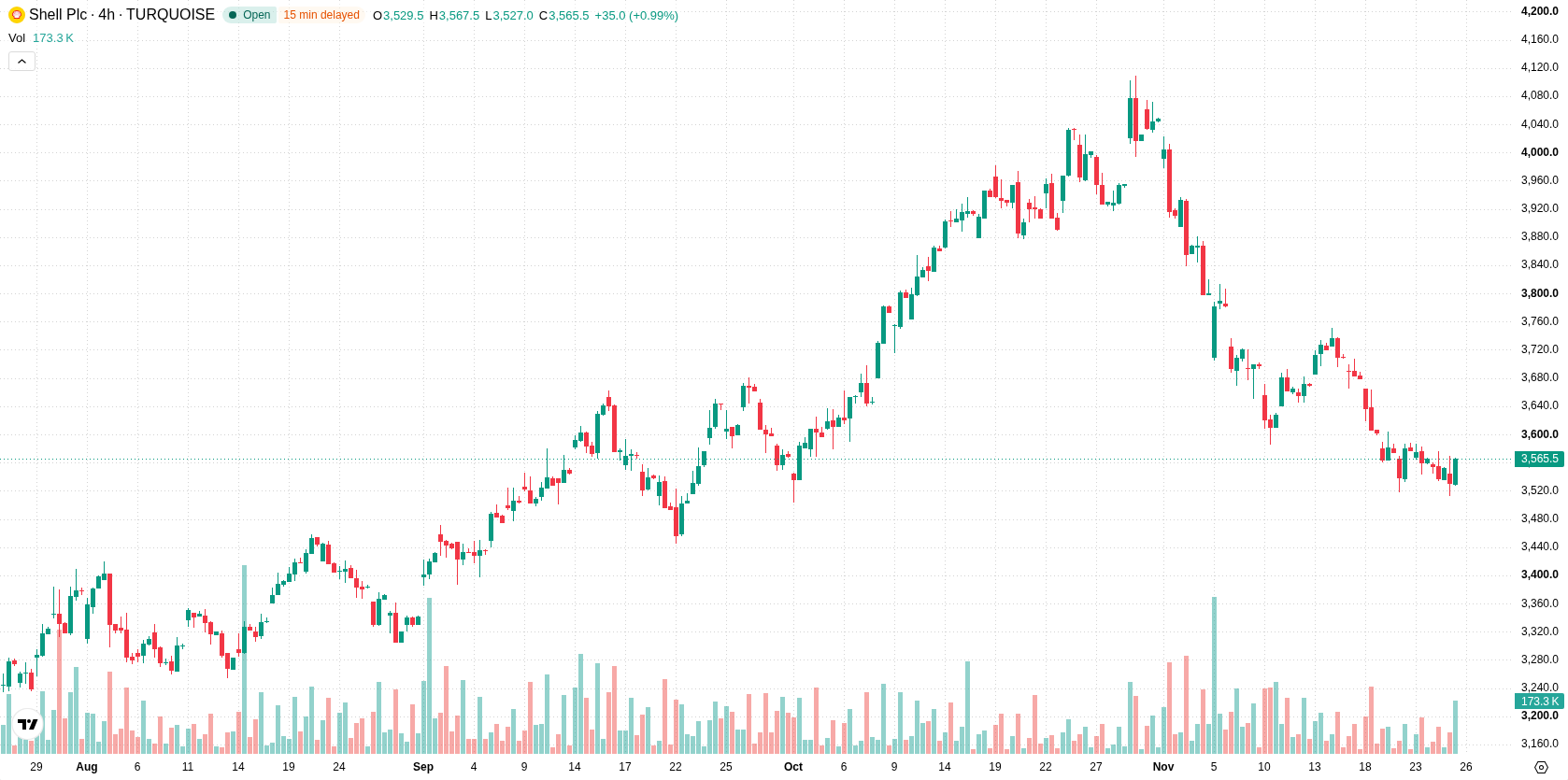
Short-term weakness alongside daily bullish structure on the 4H chart
On the 4H chart, SHEL trades between the D1 SMA-50 at GBX3,738 and the D1 SMA-200 at GBX3,358, reflecting a broader bullish alignment over the daily timeframe, but the current price sits below both the primary D1 SMA-50 and the H4 SMA-20, signaling weak short-term momentum.
Momentum indicators, including a negative MACD and a strong ADX Sell reading, confirm prevailing downside pressure as the price remains below H4 resistance around the Kijun at GBX3,593. This setup highlights that price action is under pressure despite the longer-term bullish structure.
Stability hinges on tariff policy; watch GBX3,594 resistance and GBX3,359 support
A lasting resolution of the U.S. tariff situation would be needed to help stabilize the risk backdrop for SHEL. For now, resistance around GBX3,594 continues to cap rebounds, while initial support emerges near GBX3,359. A sustained break above the resistance zone could relieve pressure, but fresh tariff news or shifts in U.S. policy remain a major risk.
Earlier, analysts noted that Shell faced persistent downside risk due to technical weakness and adverse macroeconomic pressures. The current analysis adds a new dimension, emphasizing that the resolution of U.S. tariff policy remains the key factor to watch for any shift in Shell’s risk profile.









-
 Afghanistan
-
 Albania
-
 Algeria
-
 Angola
-
 Argentina
-
 Armenia
-
 Australia
-
 Austria
-
 Azerbaijan
-
 Bahamas
-
 Bahrain
-
 Bangladesh
-
 Belarus
-
 Belgium
-
 Bolivia
-
 Botswana
-
 Brazil
-
 Brunei
-
 Bulgaria
-
 Cambodia
-
 Cameroon
-
 Canada
-
 Chile
-
 China
-
 Colombia
-
 Congo
-
 Costa Rica
-
 Cote d'Ivoire
-
 Croatia
-
 Cuba
-
 Cyprus
-
 Czechia
-
 DR Congo
-
 Denmark
-
 Dominican Republic
-
 Ecuador
-
 Egypt
-
 El Salvador
-
 Estonia
-
 Eswatini
-
 Ethiopia
-
 Finland
-
 France
-
 Georgia
-
 Germany
-
 Ghana
-
 Greece
-
 Haiti
-
 Hong Kong
-
 Hungary
-
 India
-
 Indonesia
-
 Iran, Islamic republic
-
 Iraq
-
 Ireland
-
 Israel
-
 Italy
-
 Jamaica
-
 Japan
-
 Jordan
-
 Kazakhstan
-
 Kenya
-
 Korea
-
 Kuwait
-
 Kyrgyzstan
-
 Laos
-
 Latvia
-
 Lebanon
-
 Lesotho
-
 Libya
-
 Lithuania
-
 Luxembourg
-
 Madagascar
-
 Malaysia
-
 Malta
-
 Mauritius
-
 Mexico
-
 Moldova
-
 Mongolia
-
 Montenegro
-
 Morocco
-
 Mozambique
-
 Myanmar
-
 Namibia
-
 Nepal
-
 Netherlands
-
 New Zealand
-
 Nigeria
-
 North Macedonia
-
 Norway
-
 Oman
-
 Pakistan
-
 Palestine
-
 Panama
-
 Papua New Guinea
-
 Paraguay
-
 Peru
-
 Philippines
-
 Poland
-
 Portugal
-
 Puerto Rico
-
 Qatar
-
 Reunion
-
 Romania
-
 Rwanda
-
 Saudi Arabia
-
 Serbia
-
 Singapore
-
 Slovakia
-
 Slovenia
-
 Somalia
-
 South Africa
-
 Spain
-
 Sri Lanka
-
 Sweden
-
 Switzerland
-
 Syria
-
 Taiwan
-
 Tajikistan
-
 Tanzania
-
 Thailand
-
 Trinidad and Tobago
-
 Tunisia
-
 Turkey
-
 UAE
-
 Uganda
-
 Ukraine
-
 United Kingdom
-
United States
-
 Uruguay
-
 Uzbekistan
-
 Venezuela
-
 Vietnam
-
 Yemen
-
 Zambia
-
 Zimbabwe
- Forex
- Crypto












