

Shell shares technical analysis: Consolidation near GBX3,511 support as seller pressure lingers

Shell (SHEL) stock is trading at GBX3,551.50, showing a marginal decline in today's session. The price remains below its key short- and medium-term moving averages, while holding above longer-term trend levels.
 3575.50
3605.00
Highlights
- Shell stock buyback was raised to $5.0 billion and shares were bought for cancellation, directly reducing share count.
- Shell maintained its quarterly dividend at $0.3906 per share, 9% higher than a year earlier.
- Shares of Shell trade below key short-term averages with a high probability of further downside toward the GBX3,447 to GBX3,655 range.
Share count reduced and buyback expanded as capital returns accelerate
On November 23, 2026, Shell plc purchased shares for cancellation, directly reducing its share count and enhancing per-share value, according to Globenewswire. The company also maintained its quarterly dividend at $0.3906 per share, which is 9% higher than a year earlier, providing steady income for shareholders. In addition, Shell increased its ongoing share buyback program to $5.0 billion, expanding capital returned to investors. These actions together offer a constructive backdrop for the stock.
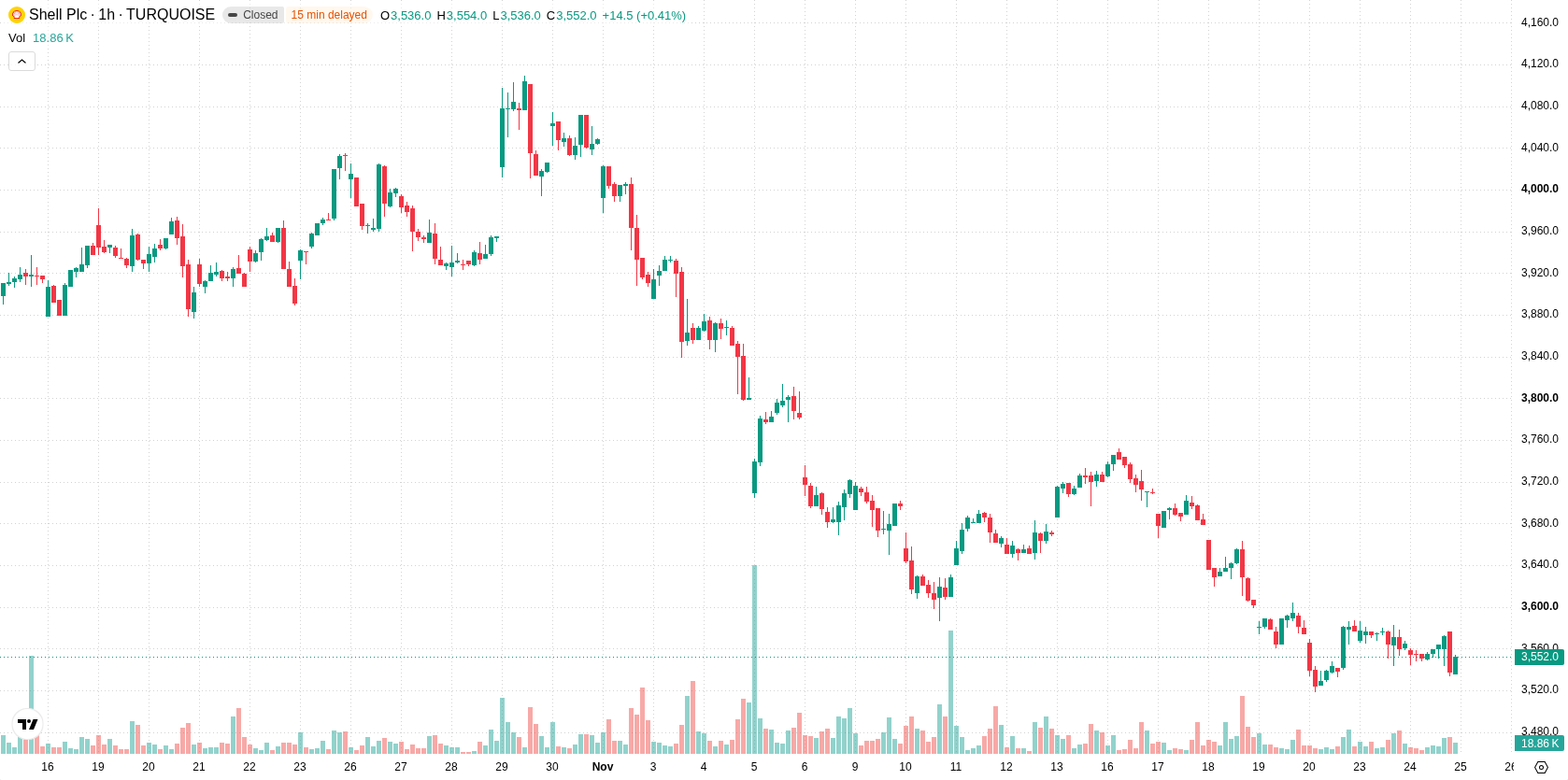
Short-term resistance and weak momentum as sellers dominate
Technically, SHEL is trading below the H1 SMA-20 at GBX3,564 and the H1 SMA-50 at GBX3,589, indicating short- and medium-term resistance. However, the price remains well above the D1 SMA-200 at GBX3,358. Immediate support is provided by the Ichimoku Kijun at GBX3,511. Momentum screens weak, with MACD at Strong Sell and ADX at Sell, while oscillator readings are mixed: RSI and Stoch RSI are neutral, CCI is oversold, and Bull/Bear Power is negative at -3.81, signaling prevailing seller dominance during intraday moves.
Limited upside as downside risks define near-term range
Short term, SHEL is likely to trade within a range of GBX3,447 to GBX3,655. The probability of an upward move is assessed as very low, while further downside carries a very high probability. The baseline scenario forecasts price consolidation within this band; a bullish case would require clearing resistance, while a bearish scenario would unfold if support gives way.
Earlier, analysts noted that Shell faced persistent bearish momentum as a result of external macroeconomic pressures, particularly from rising U.S. Treasury yields. The current article strengthens this view by highlighting continued technical weakness and predicts a high probability of further downside as long as near-term resistance remains intact.









-
 Afghanistan
-
 Albania
-
 Algeria
-
 Angola
-
 Argentina
-
 Armenia
-
 Australia
-
 Austria
-
 Azerbaijan
-
 Bahamas
-
 Bahrain
-
 Bangladesh
-
 Belarus
-
 Belgium
-
 Bolivia
-
 Botswana
-
 Brazil
-
 Brunei
-
 Bulgaria
-
 Cambodia
-
 Cameroon
-
 Canada
-
 Chile
-
 China
-
 Colombia
-
 Congo
-
 Costa Rica
-
 Cote d'Ivoire
-
 Croatia
-
 Cuba
-
 Cyprus
-
 Czechia
-
 DR Congo
-
 Denmark
-
 Dominican Republic
-
 Ecuador
-
 Egypt
-
 El Salvador
-
 Estonia
-
 Eswatini
-
 Ethiopia
-
 Finland
-
 France
-
 Georgia
-
 Germany
-
 Ghana
-
 Greece
-
 Haiti
-
 Hong Kong
-
 Hungary
-
 India
-
 Indonesia
-
 Iran, Islamic republic
-
 Iraq
-
 Ireland
-
 Israel
-
 Italy
-
 Jamaica
-
 Japan
-
 Jordan
-
 Kazakhstan
-
 Kenya
-
 Korea
-
 Kuwait
-
 Kyrgyzstan
-
 Laos
-
 Latvia
-
 Lebanon
-
 Lesotho
-
 Libya
-
 Lithuania
-
 Luxembourg
-
 Madagascar
-
 Malaysia
-
 Malta
-
 Mauritius
-
 Mexico
-
 Moldova
-
 Mongolia
-
 Montenegro
-
 Morocco
-
 Mozambique
-
 Myanmar
-
 Namibia
-
 Nepal
-
 Netherlands
-
 New Zealand
-
 Nigeria
-
 North Macedonia
-
 Norway
-
 Oman
-
 Pakistan
-
 Palestine
-
 Panama
-
 Papua New Guinea
-
 Paraguay
-
 Peru
-
 Philippines
-
 Poland
-
 Portugal
-
 Puerto Rico
-
 Qatar
-
 Reunion
-
 Romania
-
 Rwanda
-
 Saudi Arabia
-
 Serbia
-
 Singapore
-
 Slovakia
-
 Slovenia
-
 Somalia
-
 South Africa
-
 Spain
-
 Sri Lanka
-
 Sweden
-
 Switzerland
-
 Syria
-
 Taiwan
-
 Tajikistan
-
 Tanzania
-
 Thailand
-
 Trinidad and Tobago
-
 Tunisia
-
 Turkey
-
 UAE
-
 Uganda
-
 Ukraine
-
 United Kingdom
-
United States
-
 Uruguay
-
 Uzbekistan
-
 Venezuela
-
 Vietnam
-
 Yemen
-
 Zambia
-
 Zimbabwe
- Forex
- Crypto












