

Can SPCX withstand higher debt costs if Federal Reserve maintains its two percent inflation focus?

SPCX (SPCX) stock is trading lower at $116.95 as of November 25, 2026, with a daily decline of 9.92%. Tightening financial conditions linked to Federal Reserve policy are putting upward pressure on borrowing costs for SPCX and similar companies, with market participants closely watching future shifts in the Fed's inflation targets and rate path.
 132.50
147.29
Highlights
- Bill Ackman warns that the Federal Reserve maintaining a strict 2% inflation target could raise recession risks globally.
- SPCX faces rising debt costs under current monetary policy, making refinancing and corporate investment more expensive for the company.
- Shares of SPCX trade below key moving averages with weak momentum and $134 acting as immediate resistance for any potential reversal.
Fed inflation target warning raises risk for SPCX
According to Benzinga, on November 23, 2026, Bill Ackman warned that the Federal Reserve's commitment to achieving a 2% inflation target risks pushing the global economy into a recession, highlighting SPCX's increasing debt costs as an indicator of tighter financial conditions.
Ackman's warning connects macroeconomic policy to SPCX through the concrete impact of higher borrowing costs, which can make refinancing and corporate investment more expensive for the company. This risk transmission occurs as restrictive Fed policy channels directly into corporate funding expenses and liquidity conditions.
Rising debt costs serve as a case in point for how monetary tightening may ripple through corporate balance sheets, reinforcing the risk that persistent rate policy could further challenge companies like SPCX under current financial conditions.
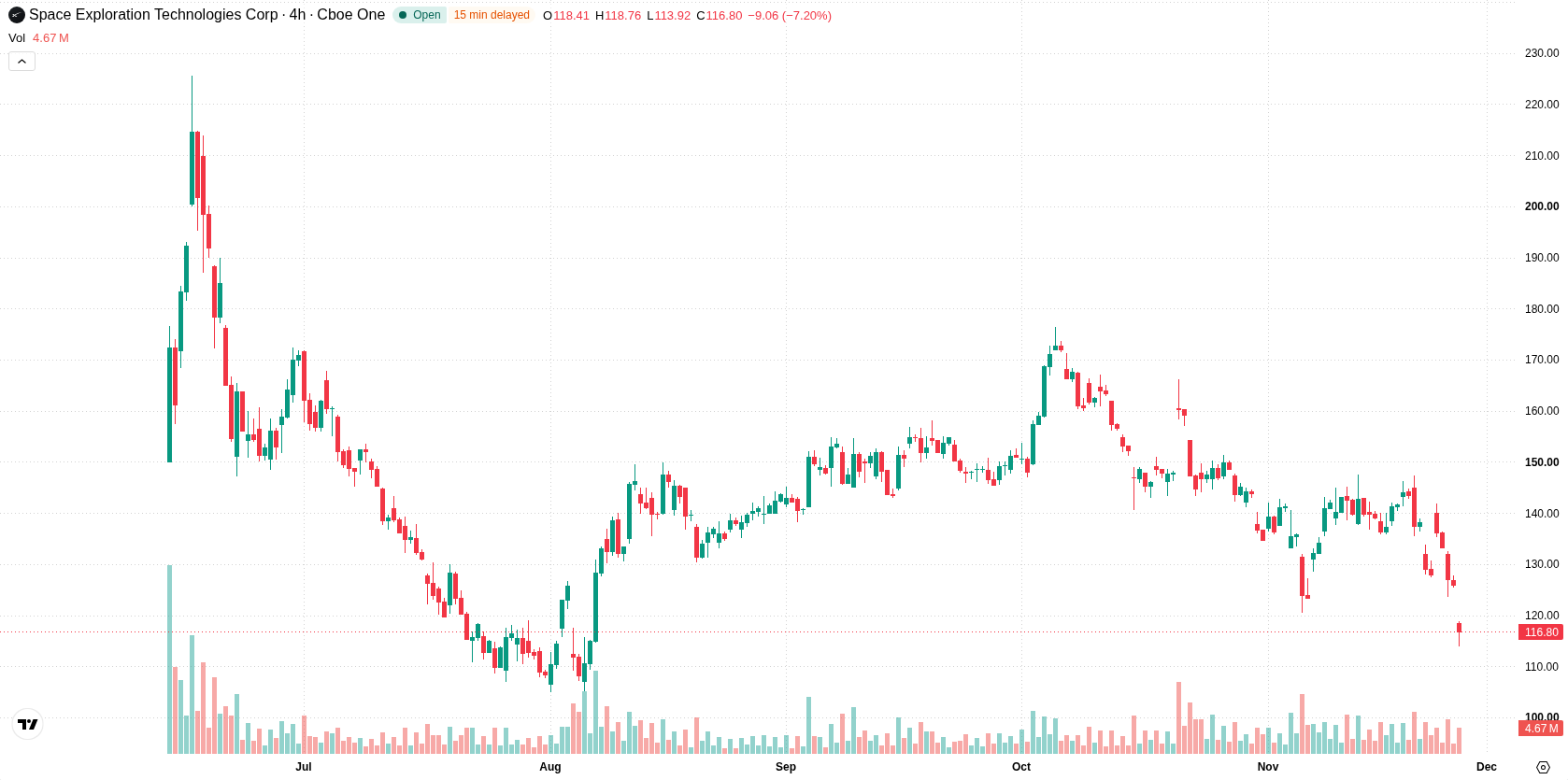
SPCX pressured below daily SMA-50 and resistance zone
On the 4H chart, SPCX continues to trade below its key daily SMA-50 at $147.11, indicating bearish price action relative to this longer-term average. Short-term momentum is also weak, as the latest 4H SMA-20 at $138.71 remains above the current market price.
Technical signals lean negative, with MACD showing a sell bias and the ADX at 11.77 forecasting neutral momentum. The $134 H4 Kijun level acts as nearby resistance and marks a threshold for any reversal attempt.
Fed policy shifts and $134 resistance as key decision points
A sustained change in Federal Reserve rate policy, or a shift away from the strict 2% inflation target, could ease the funding pressures on SPCX. Watch the $134 resistance area, as a close above this level would be the first technical indication of stabilization. Otherwise, persistent tightening from the Fed increases downside risk for SPCX by keeping debt costs elevated and restricting financing options.
Earlier, analysts noted that SPCX was under persistent downside pressure due to operational and regulatory challenges, with technical indicators confirming a bearish outlook. The current article extends this view, as ongoing monetary tightening by the Federal Reserve continues to elevate debt costs for SPCX, making future policy shifts the key macroeconomic factor for any potential stabilization.






Latest SpaceX News





-
 Afghanistan
-
 Albania
-
 Algeria
-
 Angola
-
 Argentina
-
 Armenia
-
 Australia
-
 Austria
-
 Azerbaijan
-
 Bahamas
-
 Bahrain
-
 Bangladesh
-
 Belarus
-
 Belgium
-
 Bolivia
-
 Botswana
-
 Brazil
-
 Brunei
-
 Bulgaria
-
 Cambodia
-
 Cameroon
-
 Canada
-
 Chile
-
 China
-
 Colombia
-
 Congo
-
 Costa Rica
-
 Cote d'Ivoire
-
 Croatia
-
 Cuba
-
 Cyprus
-
 Czechia
-
 DR Congo
-
 Denmark
-
 Dominican Republic
-
 Ecuador
-
 Egypt
-
 El Salvador
-
 Estonia
-
 Eswatini
-
 Ethiopia
-
 Finland
-
 France
-
 Georgia
-
 Germany
-
 Ghana
-
 Greece
-
 Haiti
-
 Hong Kong
-
 Hungary
-
 India
-
 Indonesia
-
 Iran, Islamic republic
-
 Iraq
-
 Ireland
-
 Israel
-
 Italy
-
 Jamaica
-
 Japan
-
 Jordan
-
 Kazakhstan
-
 Kenya
-
 Korea
-
 Kuwait
-
 Kyrgyzstan
-
 Laos
-
 Latvia
-
 Lebanon
-
 Lesotho
-
 Libya
-
 Lithuania
-
 Luxembourg
-
 Madagascar
-
 Malaysia
-
 Malta
-
 Mauritius
-
 Mexico
-
 Moldova
-
 Mongolia
-
 Montenegro
-
 Morocco
-
 Mozambique
-
 Myanmar
-
 Namibia
-
 Nepal
-
 Netherlands
-
 New Zealand
-
 Nigeria
-
 North Macedonia
-
 Norway
-
 Oman
-
 Pakistan
-
 Palestine
-
 Panama
-
 Papua New Guinea
-
 Paraguay
-
 Peru
-
 Philippines
-
 Poland
-
 Portugal
-
 Puerto Rico
-
 Qatar
-
 Reunion
-
 Romania
-
 Rwanda
-
 Saudi Arabia
-
 Serbia
-
 Singapore
-
 Slovakia
-
 Slovenia
-
 Somalia
-
 South Africa
-
 Spain
-
 Sri Lanka
-
 Sweden
-
 Switzerland
-
 Syria
-
 Taiwan
-
 Tajikistan
-
 Tanzania
-
 Thailand
-
 Trinidad and Tobago
-
 Tunisia
-
 Turkey
-
 UAE
-
 Uganda
-
 Ukraine
-
 United Kingdom
-
United States
-
 Uruguay
-
 Uzbekistan
-
 Venezuela
-
 Vietnam
-
 Yemen
-
 Zambia
-
 Zimbabwe
- Forex
- Crypto












