

US tariff decision may deepen cost and margin volatility for Apple amid shifting trade landscape

Apple (AAPL) stock is trading modestly higher as US trade policy developments add uncertainty for global technology firms. The US administration’s latest tariffs on major trading partners, notably China, heighten the risk of higher operating costs and shifting demand. Investors are watching closely for signs of further policy action or supply chain disruptions that could reshape Apple’s cost structure and market exposure.
 354.88
355.28
Highlights
- The US administration announced new tariffs targeting goods from 14 countries, applying especially high rates to Chinese imports to counter excess industrial capacity.
- These tariffs introduce volatility and uncertainty for Apple stock due to increased production costs, profit margin pressure, and the risk of retaliatory actions and supply chain disruption.
- Apple stock holds above key technical support, with bullish momentum signals prevailing unless price breaks below major levels around 350.
US tariffs increase Apple supply risks
According to Reuters, on November 25, 2026, the US administration announced new tariffs on goods from 14 major trading partners, with especially high rates applied to Chinese imports, in an effort to address what it called structural excess industrial capacity.
These tariffs introduce new uncertainty for US technology companies such as Apple, given their extensive reliance on China and other foreign suppliers for manufacturing and assembly. The measures can raise sourcing and production costs, squeeze profit margins, and increase the risk of retaliatory action from trading partners, feeding into volatility and downward movement in both the US equity and currency markets, as observed in the immediate aftermath of the announcement according to Reuters.
While the policy aims to strengthen US industrial competitiveness, it could make pricing and demand less predictable for Apple across global markets. Any escalation, such as retaliatory tariffs or supply chain disruptions, would further intensify these risks for the company.
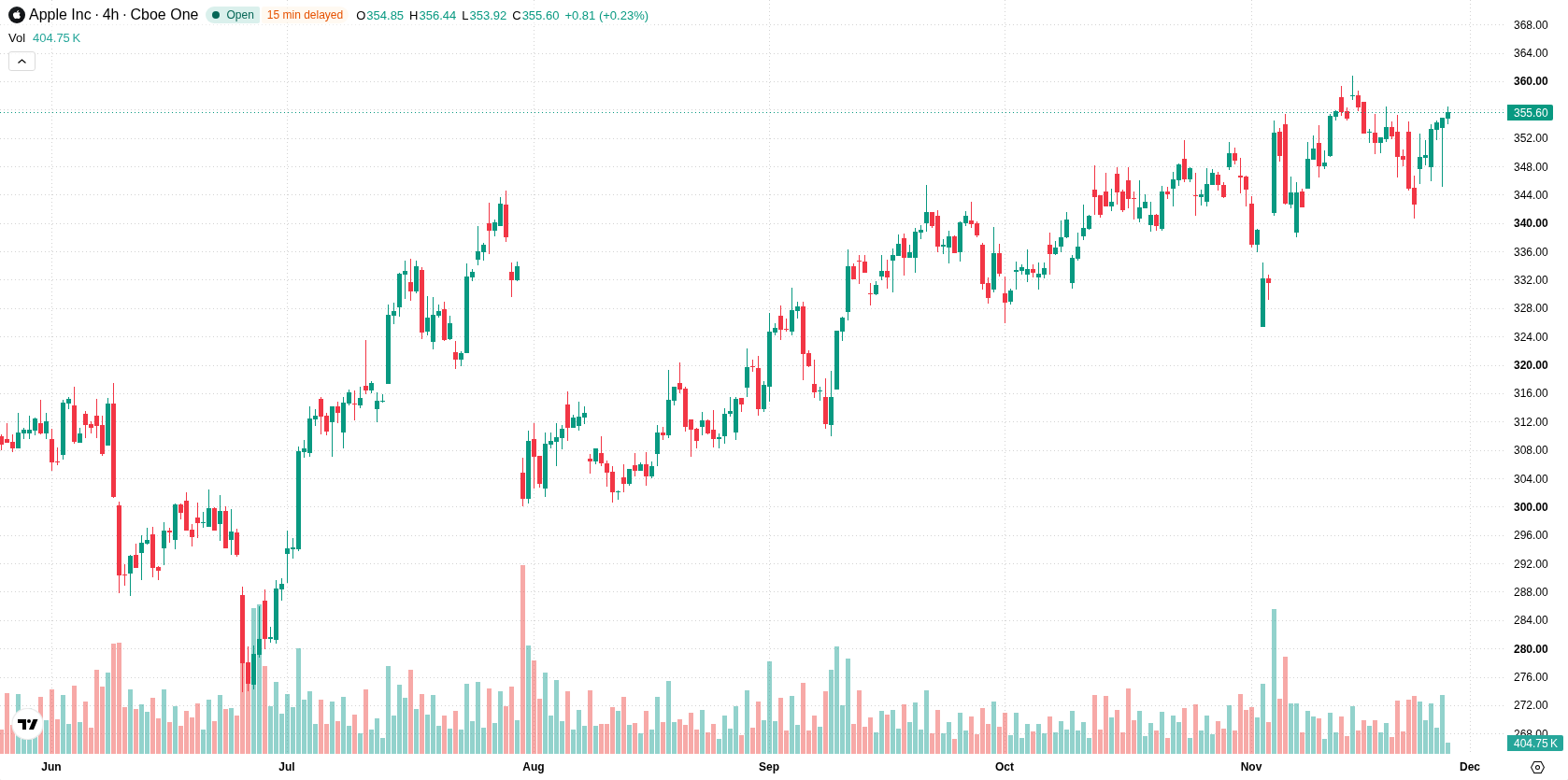
Macro uncertainty but AAPL holds above key moving averages
The current 4H chart reflects the underlying macro risk environment, but price remains technically oriented above the D1 SMA-50 at $342.62 and the D1 SMA-200 at $303.99, suggesting ongoing broad bullish positioning. The 4H SMA-20 at $352.16 is also positioned below the price, indicating near-term momentum is holding up despite macro uncertainties.
The MACD points to a strong buy signal, while ADX remains neutral at 16.62, highlighting that upward momentum is present but not accompanied by a strong trend. The H4 Kijun at $349.57 supports the scenario that current price action has technical backing unless a clear break below this level materializes.
Trade escalation risk versus stability above the $350 support zone
External trade policy uncertainty will remain a key risk to Apple’s margins and supply chain stability in the near term. Continued stability above around $350, which is supported by the H4 Kijun, would help limit the impact of negative headlines. A sustained move below this level would raise concerns about further downside driven by geopolitical or supply disruptions. Monitoring for new tariffs or retaliation remains critical for the next decisive move.
Earlier, analysts noted that Apple faced heightened risks to its cost structure and profitability due to proposed U.S. tariffs on imports from key Asian trading partners. The latest developments reinforce these concerns, as investors now await further policy actions or potential retaliatory measures that could define Apple's next directional move.











-
 Afghanistan
-
 Albania
-
 Algeria
-
 Angola
-
 Argentina
-
 Armenia
-
 Australia
-
 Austria
-
 Azerbaijan
-
 Bahamas
-
 Bahrain
-
 Bangladesh
-
 Belarus
-
 Belgium
-
 Bolivia
-
 Botswana
-
 Brazil
-
 Brunei
-
 Bulgaria
-
 Cambodia
-
 Cameroon
-
 Canada
-
 Chile
-
 China
-
 Colombia
-
 Congo
-
 Costa Rica
-
 Cote d'Ivoire
-
 Croatia
-
 Cuba
-
 Cyprus
-
 Czechia
-
 DR Congo
-
 Denmark
-
 Dominican Republic
-
 Ecuador
-
 Egypt
-
 El Salvador
-
 Estonia
-
 Eswatini
-
 Ethiopia
-
 Finland
-
 France
-
 Georgia
-
 Germany
-
 Ghana
-
 Greece
-
 Haiti
-
 Hong Kong
-
 Hungary
-
 India
-
 Indonesia
-
 Iran, Islamic republic
-
 Iraq
-
 Ireland
-
 Israel
-
 Italy
-
 Jamaica
-
 Japan
-
 Jordan
-
 Kazakhstan
-
 Kenya
-
 Korea
-
 Kuwait
-
 Kyrgyzstan
-
 Laos
-
 Latvia
-
 Lebanon
-
 Lesotho
-
 Libya
-
 Lithuania
-
 Luxembourg
-
 Madagascar
-
 Malaysia
-
 Malta
-
 Mauritius
-
 Mexico
-
 Moldova
-
 Mongolia
-
 Montenegro
-
 Morocco
-
 Mozambique
-
 Myanmar
-
 Namibia
-
 Nepal
-
 Netherlands
-
 New Zealand
-
 Nigeria
-
 North Macedonia
-
 Norway
-
 Oman
-
 Pakistan
-
 Palestine
-
 Panama
-
 Papua New Guinea
-
 Paraguay
-
 Peru
-
 Philippines
-
 Poland
-
 Portugal
-
 Puerto Rico
-
 Qatar
-
 Reunion
-
 Romania
-
 Rwanda
-
 Saudi Arabia
-
 Serbia
-
 Singapore
-
 Slovakia
-
 Slovenia
-
 Somalia
-
 South Africa
-
 Spain
-
 Sri Lanka
-
 Sweden
-
 Switzerland
-
 Syria
-
 Taiwan
-
 Tajikistan
-
 Tanzania
-
 Thailand
-
 Trinidad and Tobago
-
 Tunisia
-
 Turkey
-
 UAE
-
 Uganda
-
 Ukraine
-
 United Kingdom
-
United States
-
 Uruguay
-
 Uzbekistan
-
 Venezuela
-
 Vietnam
-
 Yemen
-
 Zambia
-
 Zimbabwe
- Forex
- Crypto












