
Best Prop Firms With No Daily Drawdown



Editorial Note: While we adhere to strict Editorial Integrity, this post may contain references to products from our partners. Here's an explanation for How We Make Money. None of the data and information on this webpage constitutes investment advice according to our Disclaimer.

Best prop firms with no daily drawdown:
The5ers - Best for Growth-Oriented Traders
OneUp Trader Funding - Best for Flexibility and Payouts
Lux Trading Firm - Best for Customizable Plans and Long-Term Growth
In prop trading, strict daily drawdown limits can stifle trading strategies and create psychological pressure, forcing early exits and risk-averse decisions. However, some prop firms offer traders the flexibility of no daily drawdowns. This article explores the best prop firms without daily drawdown limits, revealing how they provide strategic freedom while balancing risk management, ensuring traders can achieve consistent profitability with less stress. Also you will learn why daily drawdowns matter and how to avoid large drawdowns.
Prop firms with lenient daily drawdown limits
The5ers


The5ers, often referred to by traders as the 5%ers, is a proprietary trading company that operates using its own capital rather than client deposits. Founded in Israel in 2016, The5ers operates globally and provides market access through the MT5 platform, which supports Forex trading, stocks, precious metals, and indices. Registration is paid, with entry fees starting from $39, while overall trading costs remain below the market average. One of the main points highlighted in 2026 reviews of The5ers is access to company funding that can scale up to $4 million, even though this capital itself cannot be withdrawn. Traders instead withdraw profits generated on the account, with the profit split determined by the selected program. For advanced traders, Leverage can reach up to 1:100 on 5ers. The firm positions itself not as a broker, but as a platform focused on active trading combined with structured funding opportunities.
Daily Loss: No daily limit
Max Total Loss: $360, $600, $1200 (depending on plan)
OneUp Trader Funding

This proprietary trading firm with headquarters in Delaware is well-known in its segment of the global market due to its favorable trading conditions and lenient financial policy. Traders can get funding from $25,000 to $250,000. They do not need to pay initial fees, but there are monthly fees from $125 depending on the plan. The challenge has one step and no additional conditions, just the profit target. No withdrawal fees or additional charges. A trader takes 100% of his profit until he earns $10,000. After that, the profit share is 90%. Withdrawal is available from day 1 with just one limit: the minimum amount is $1,000. There is no overall drawdown limit, only daily and trailing drawdowns. Trading is available on 15 platforms. Other features that are worth mentioning include quality educational content, dynamic analytics displayed on the user account dashboard, a two-level strike price system, and a generous referral program.
Daily Loss: No daily limit
Max Total Loss: $1500 to $5500 (depending on plan)
Lux Trading Firm

British prop trader Lux Trading Firm cooperates with Barclays, the largest financial conglomerate in the country. The official partners of Lux Trading Firm are Credit Suisse and Goldman Sachs banks. Lux Trading Firm offers 2 types of accounts. The minimum enrollment fee is GBP 199 (after evaluation, enrollment fees are fully refunded). Clients can get between $50,000 and $1,000,000 under management and increase their balances up to $10 million using TradingView or MetaTrader 5. However, Lux Trading Firm has some restrictions. For example, it is not possible to copy trades or use advisors developed by third parties (only advisors created by traders themselves are allowed).
Daily Loss: No daily limit
Max Total Loss: $1250 to $10000 (depending on plan)
| The5ers | OneUp Trader | Lux Trading Firm | |
|---|---|---|---|
|
Free Evaluation |
Yes | No | No |
|
Demo |
Yes | Yes | No |
|
Funding Up To, $ |
4 000 000 | 250 000 | 10 000 000 |
|
Profit split up to, % |
80 | 90 | 75 |
|
Min Trade Days |
3 | 15 | 29 |
|
Max. Leverage |
1:100 | 1:1 | 1:30 |
|
Open an account |
Go to broker Your capital is at risk. |
Go to broker Your capital is at risk. |
Go to broker Your capital is at risk. |
Why do daily drawdowns matter?
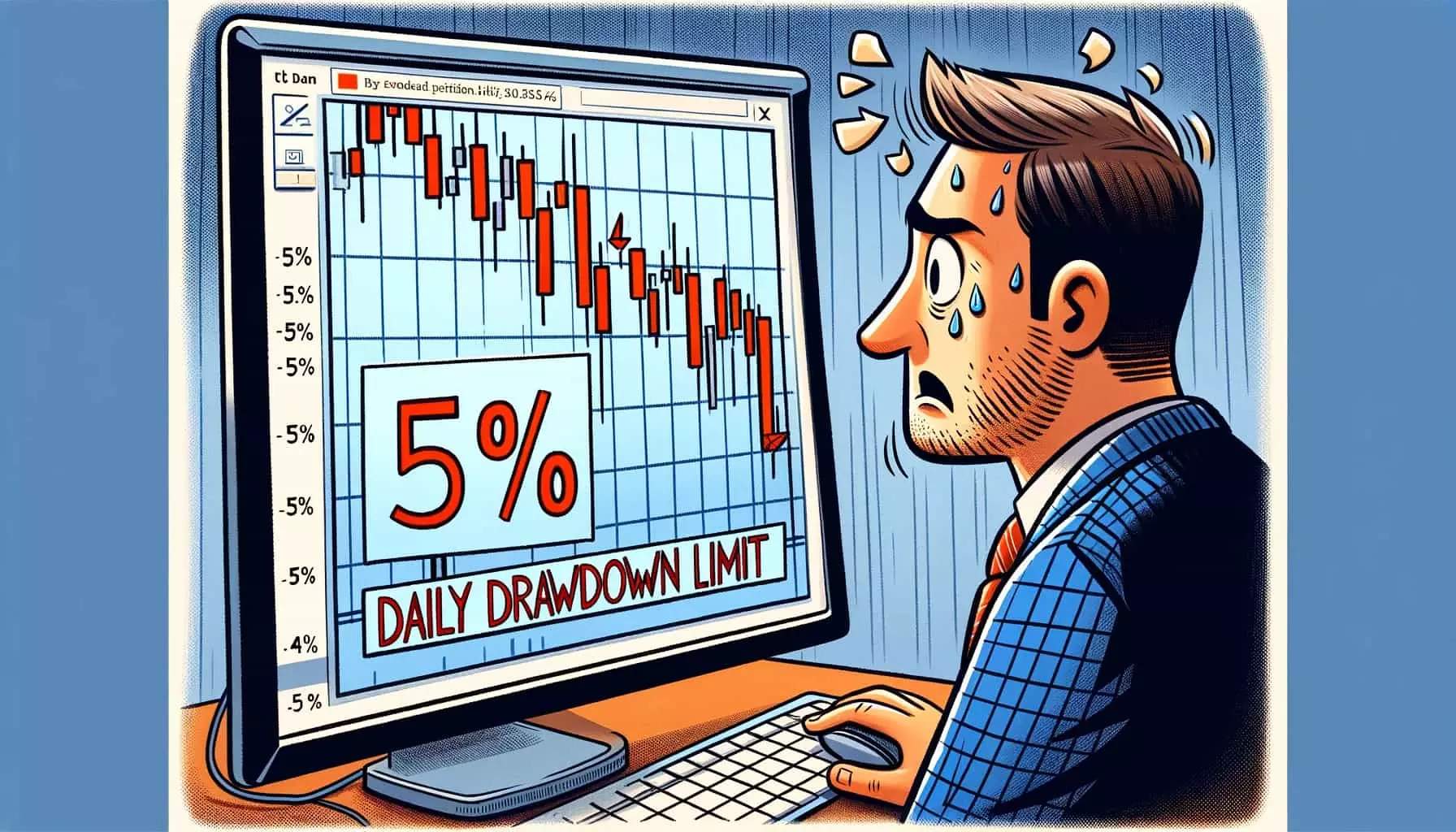
Daily drawdowns play a crucial role in the risk management strategies of prop firms. While some firms enforce strict daily drawdown limits, others opt not to impose them. Understanding the rationale behind these policies helps traders navigate prop firm requirements more effectively.
Why prop firms use daily drawdowns
1. Risk management and capital preservation
Limiting daily exposure: Daily drawdowns protect prop firms by limiting the potential losses a trader can incur in a single trading day;
Avoiding catastrophic losses: By imposing daily limits, firms can prevent traders from wiping out their accounts in one bad day;
Encouraging Consistent Risk Management: Daily drawdowns encourage traders to stick to disciplined risk management practices.
Example: Imagine a prop trading firm sets a daily drawdown limit of 2%. If one exceeds this limit with a 5% loss in a single day, they're forced to stop trading. This prevents them from digging deeper into losses and preserves capital, thereby protecting against huge account blowouts.
2. Encouraging trading discipline
Control over trading psychology: Daily limits prevent traders from engaging in revenge trading after incurring losses, reducing emotional decision-making;
Consistency in strategy: By following strict daily drawdown rules, traders are incentivized to develop consistent trading strategies that minimize drawdowns.
Example: I generally stick to my prop firm's 2% daily drawdown limit. Even if I face a string of losing trades, I never go beyond this limit. As a result, I manage to avoid impulsive decisions driven by emotions like frustration or fear of missing out. This disciplined approach helps me stay focused on my trading strategy.
3. Evaluation and scaling criteria
Qualification standards: Prop firms often use daily drawdowns as a qualifying criterion to assess trader discipline and risk management skills;
Scaling up traders: Maintaining compliance with daily limits helps traders prove their consistency, leading to larger funding opportunities.
Example:
Let's consider Trader A, who consistently respects the prop firm's daily drawdown limit. By doing so, Trader A demonstrates their ability to manage risk effectively. This is important because it shows the prop firm that Trader A can trade profitably even during unpredictable market conditions, without exposing the firm to excessive losses. As a result, the prop firm may be more inclined to provide Trader A with additional trading capital.
Why prop firms use daily drawdowns
1. Flexibility for trading strategies
Swing and long-term trading: Without daily drawdowns, traders can hold positions overnight or for multiple days, benefiting swing and long-term strategies;
Adapting to market movements: Traders can adjust risk and capitalize on market opportunities without the fear of hitting daily limits.
Example:
A firm like The5ers doesn't impose daily drawdowns, allowing traders to adapt their strategies to market changes and take overnight positions.
2. Reduced psychological pressure
Lower anxiety levels: Without daily limits, traders can focus on longer-term goals instead of managing intraday losses.
Better decision-making: Reduced pressure results in more rational trading decisions and adherence to trading plans.
Example:
Traders at firms like OneUp Trader Funding have reported improved decision-making and emotional control due to the absence of daily drawdowns.
3. Fostering Trader Growth
Promoting risk-taking: Eliminating daily drawdowns allows traders to take calculated risks without immediate penalties;
Encouraging consistent profitability: Traders can focus on consistent profitability across longer periods rather than managing daily results.
Example:
Lux Trading Firm allows traders to grow their accounts by maintaining consistent overall profitability without worrying about daily losses.
Some prop trading firms choose not to use daily drawdown limits. This can make trading more risky. Let's say there's a firm where traders can trade without these limits. One trader, named Alex, joins. At first, Alex does well and makes money without worrying about daily drawdown limits. Feeling confident, Alex starts taking bigger risks, moving away from being careful. But without those daily limits, Alex's trading gets riskier.
As Alex keeps trading without those limits, he starts losing money. These losses add up fast, leading to a big drop in his account balance. Because there aren't any daily drawdown rules, Alex doesn't have any boundaries to stop him from taking too many risks. So, what seemed like success at first ends up as a failure.
In this scenario, the prop firm's choice not to have daily drawdown limits puts traders like Alex in danger. Without those limits, traders might start making risky trades without thinking. This can lead to big losses.
Why prop firms and traders need daily drawdowns
Daily drawdown limits are important for prop firms and traders because they help manage risks both in the short term and for the long haul.
Short-term protection:
In the short term, these limits act like a safety net. They stop traders from experiencing big losses in just one day of trading. By having these limits, prop firms and traders can control the impact of sudden market changes or impulsive decisions. This stops them from losing a lot of capital all at once, which could be really bad for a trader's account or for the firm's finances.
Long-term sustainability:
For the long term, daily drawdown limits encourage traders to be smart and careful. When traders stick to these limits, they're more likely to focus on keeping their money safe instead of trying to make quick profits. This helps them build a strong and steady approach to trading, which is better than taking big risks for big rewards. It's like playing the long game rather than going for quick wins.
Compliance and regulation:
These limits are also important for following rules and regulations. They make sure prop firms are managing risks properly and following the rules set by regulators. By sticking to these limits, firms show that they're serious about keeping trading fair and safe for everyone involved. This builds trust and shows that the firm is committed to being responsible with risks.
While daily drawdowns are essential for prop firms to manage risk and evaluate trader discipline, some firms prefer not to use them to encourage flexibility and longer-term profitability. Traders need to understand these policies to align their trading strategies with firm requirements.
For prop firms:
Risk Management: Protects against catastrophic losses and encourages disciplined trading;
Qualification Criteria: Helps assess and select skilled traders.
For traders:
Strategy Alignment: Understanding drawdown rules helps traders develop suitable strategies;
Psychological Control: Managing emotions and sticking to trading plans is easier with clear drawdown policies.
Ultimately, whether a firm imposes daily drawdowns or not, traders must adapt their strategies accordingly to minimize losses, maintain profitability, and achieve consistent growth in prop trading.
How to avoid large drawdowns: 7 tips for prop traders
Avoiding large drawdowns is essential for maintaining capital, passing evaluations, and ensuring consistent profitability as a prop trader. Here are seven tips to help you manage and reduce drawdowns effectively:
1. Implement strict risk management rules
Limit your risk per trade to 1-2% of your total capital to ensure no single trade can significantly impact your account. Also you can set a personal daily loss limit (e.g., 3% of account value) to prevent emotional trading after a bad day. Calculate position sizes based on risk tolerance and stop-loss levels.
2. Diversify your trading strategies
Use a combination of strategies (intraday, swing, etc.) to balance overall risk. Trade different asset classes or currency pairs to spread exposure.
3. Develop a well-defined trading plan
Have specific entry, exit, and risk management criteria for each strategy. Validate the plan through historical data and demo trading. Adjust your plan as market conditions change (e.g., volatility shifts).
4. Review trades and learn from mistakes
Keep a detailed trading journal, including rationale, outcomes, and emotions. Periodically review your trades to identify recurring mistakes and areas of improvement. Adjust and refine strategies based on performance insights.
5. Stay emotionally disciplined
Refrain from chasing losses or trading impulsively after a series of losses. Step away from trading after significant losses to regain focus. Incorporate mindfulness practices to improve emotional regulation.
6. Stay informed and educated
Keep up-to-date with relevant market analysis and news. Continuous Learning: Learn from successful traders, read trading books, and attend webinars or courses. Prop Firm Rules: Fully understand the rules and conditions of your prop firm to avoid unexpected disqualifications.
By following these tips and maintaining a disciplined approach, you can avoid significant drawdowns and enhance your chances of success in prop trading.
Risky trading techniques
Some traders might try risky tactics to stick to daily drawdown limits and avoid losses, but these methods usually don't work out well. Two of these risky strategies are the martingale strategy and averaging down.
The martingale strategy is when traders double their bets after losing, hoping that eventually they'll win and make up for all the losses. But this can be really bad for a trading account. If there are lots of losses in a row, the bets get bigger and bigger, which can't keep going forever and ends up causing big losses;
Averaging down is another risky move. It's when traders keep adding to losing trades, hoping they'll eventually make up for it. But usually, this just leads to even more losses.
These strategies might seem like they help avoid hitting daily drawdown limits, but they don't fix the real problem, which is bad risk management.
Set a personal daily loss limit

As a prop trader, I've found that daily drawdowns are a double-edged sword. They can enforce discipline by limiting daily losses, but they also create psychological pressure that forces early exits. Firms that don't impose daily limits, offer traders flexibility and a more relaxed environment for strategic decision-making.
My advice: Set a personal daily loss limit, even if the prop firm doesn't impose one. A limit of 2-3% of your account value can help avoid substantial daily losses. Adjust your stop-loss orders to balance risk and reward, and trail them as your position becomes profitable to lock in gains. It's also wise to limit trading during high volatility periods, like major news events, unless that's part of your strategy. Diversifying your strategies across different trading styles or asset classes helps reduce the impact of any one losing streak. Finally, keeping a trading journal and reviewing it regularly allows you to identify patterns that lead to significant drawdowns, helping you refine your approach.
Methodology for compiling our ratings of prop firms
Traders Union applies a rigorous methodology to evaluate prop companies using over 100 quantitative and qualitative criteria. Multiple parameters are given individual scores that feed into an overall rating.
Key aspects of the assessment include:
-
Trader testimonials and reviews. Collecting and analyzing feedback from existing and past traders to understand their experiences with the firm.
-
Trading instruments. Companies are evaluated on the range of assets offered, as well as the breadth and depth of available markets.
-
Challenges and evaluation process. Analyzing the firm's challenge system, account types, evaluation criteria, and the process for granting funding.
-
Profit split. Reviewing the profit split structure and terms, scaling plans, and how the firm handles profit distributions.
-
Trading conditions. Examining leverage, execution speeds, commissions, and other trading costs associated with the firm.
-
Platform and technology. Assessing the firm's proprietary trading platform or third-party platforms it supports, including ease of use, functionality, and stability.
-
Education and support. Quality and availability of training materials, webinars, and one-on-one coaching.
Conclusion
Prop firms with no daily drawdown limits offer traders greater flexibility and reduced stress, empowering them to execute their strategies without the pressure of tight daily losses. As outlined by TU analysts, such firms help foster disciplined risk management over the longer term rather than forcing traders to recover hastily from short-term setbacks. For example, firms like The5ers and FTMO stand out for allowing traders to focus on consistency and growth. Ultimately, choosing a prop firm without strict daily drawdowns can unlock a trader's full potential, making disciplined patience the real edge in profitable trading.
FAQs
What types of trading strategies benefit most from prop firms with no daily drawdown limits?
Are there increased risks associated with trading at prop firms that do not enforce daily drawdown policies?
How do maximum total loss limits function in prop firms that do not use daily drawdown restrictions?
What skills or qualities are most important for traders in firms with no daily drawdown ceiling?
Editors' Top Picks and Insights

Is Bitcoin right for you? Five traits shared by many cryptocurrency holders

Chasing hits: Why investors are losing interest in Netflix

Tokenized stocks in the spotlight: How do they work and are they worth trading?

Do politicians make the best stock traders?

Crypto test drive: How automakers are exploring digital assets

Lindsey Graham death: U.S. senator’s crypto legacy
Related Articles
Team that worked on the article
Parshwa is a content expert and finance professional possessing deep knowledge of stock and options trading, technical and fundamental analysis, and equity research. As a Chartered Accountant Finalist, Parshwa also has expertise in Forex, crypto trading, and personal taxation.
Dan Blystone began his trading career in 1998 as an arbitrage clerk on the floor of the Chicago Mercantile Exchange (CME). He later traded bond and Eurex futures at proprietary firms such as Altea Trading, gaining valuable experience in high-frequency trading and risk management.
Chinmay Soni is a financial analyst with more than 5 years of experience in working with stocks, Forex, derivatives, and other assets. As a founder of a boutique research firm and an active researcher, he covers various industries and fields, providing insights backed by statistical data.
Forex leverage is a tool enabling traders to control larger positions with a relatively small amount of capital, amplifying potential profits and losses based on the chosen leverage ratio.
Swing trading is a trading strategy that involves holding positions in financial assets, such as stocks or forex, for several days to weeks, aiming to profit from short- to medium-term price swings or "swings" in the market. Swing traders typically use technical and fundamental analysis to identify potential entry and exit points.
Fundamental analysis is a method or tool that investors use that seeks to determine the intrinsic value of a security by examining economic and financial factors. It considers macroeconomic factors such as the state of the economy and industry conditions.
Risk management is a risk management model that involves controlling potential losses while maximizing profits. The main risk management tools are stop loss, take profit, calculation of position volume taking into account leverage and pip value.
Options trading is a financial derivative strategy that involves the buying and selling of options contracts, which give traders the right (but not the obligation) to buy or sell an underlying asset at a specified price, known as the strike price, before or on a predetermined expiration date. There are two main types of options: call options, which allow the holder to buy the underlying asset, and put options, which allow the holder to sell the underlying asset.


