
Top Commodity-Backed Stablecoins In 2026


Editorial Note: While we adhere to strict Editorial Integrity, this post may contain references to products from our partners. Here's an explanation for How We Make Money. None of the data and information on this webpage constitutes investment advice according to our Disclaimer.
Leading commodity backed stablecoins:
Tether Gold (XAUT). Each token represents one troy ounce of reserved gold stored in Swiss vaults.
Paxos Gold (PAXG). A regulated commodity-backed stablecoin backed by physical gold and overseen by the New York Department of Financial Services.
Kinesis Gold (KAU). A gold-based commodity stablecoin integrated into the Kinesis payments ecosyst em.
Comtech Gold (CGO). Tokenized gold backed by reserves stored in regulated vaults in the UAE.
VNX Gold (VNXAU). A gold-backed digital asset backed by LBMA-certified gold held in European vaults.
The market for commodity stablecoins has grown sharply in 2026. Gold prices hit a record high above $5,500 per ounce earlier this year, pushing demand for on-chain gold exposure to new levels. Institutional players are opening dedicated desks for tokenized gold, and analysts expect continued growth in the sector as tokenized real-world assets expand. Recent commodity-backed stablecoin news has also put regulatory classification firmly in focus, as governments work to define how these asset-backed tokens fit under existing financial law. This guide covers the full list of commodity-backed stablecoins, how they work, and what sets them apart from fiat-pegged alternatives.
Risk warning: Cryptocurrency markets are highly volatile, with sharp price swings and regulatory uncertainties. Research indicates that 75-90% of traders face losses. Only invest discretionary funds and consult an experienced financial advisor.
Commodity-backed stablecoins list: Leading projects in 2026
The list of commodity-backed stablecoins is still relatively small compared with fiat stablecoins, and most projects focus on tokenized gold. These tokens allow investors to gain exposure to physical commodities through blockchain networks while maintaining transparent reserve backing.
Tether Gold (XAUT)
Tether Gold is the biggest name in tokenized gold right now. Each XAUT token equals one troy ounce of LBMA-certified gold stored in high-security Swiss vaults. Behind it is Tether, the same company that runs USDT, the world's largest stablecoin.
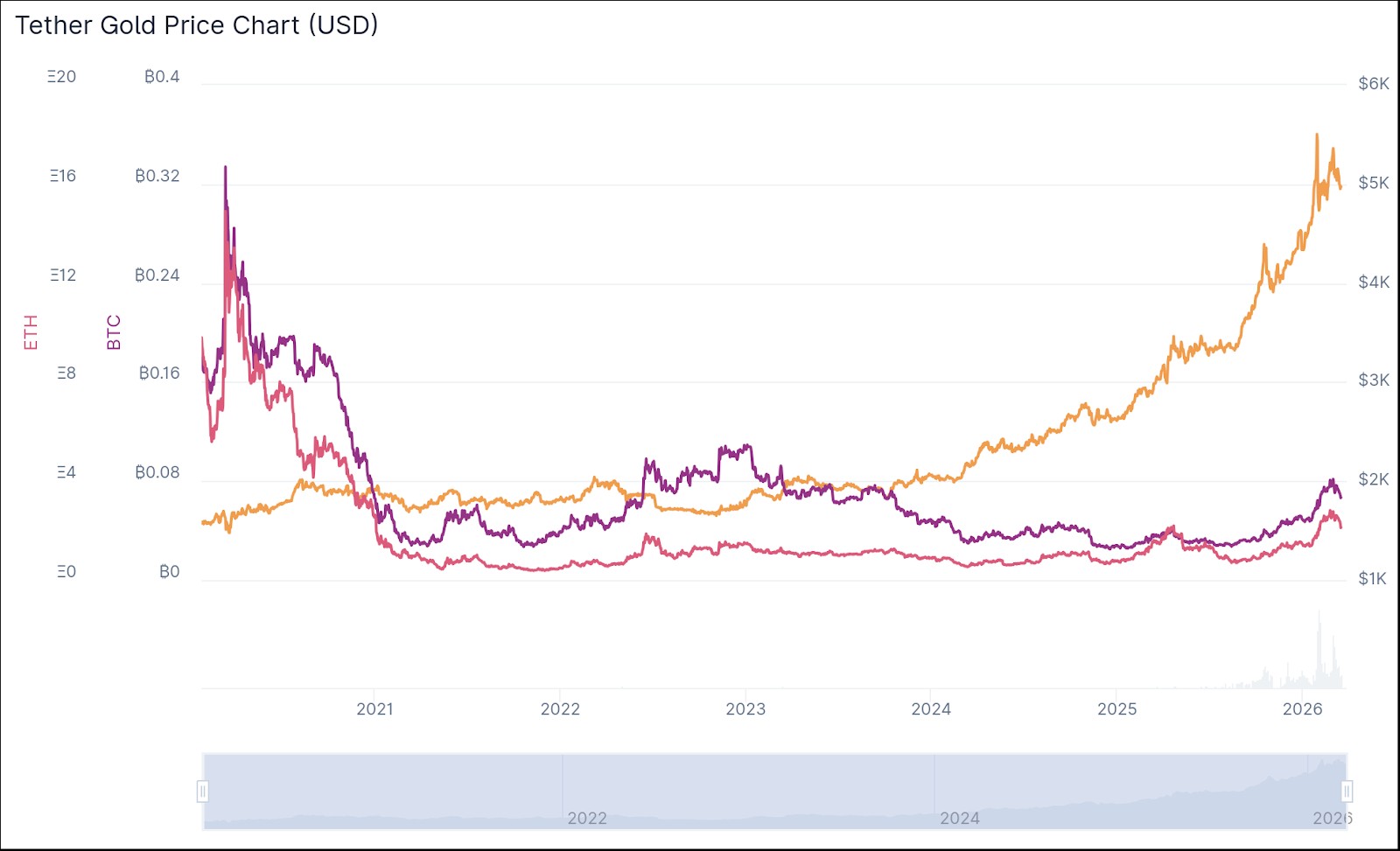
In early 2026, Tether revealed it had been buying up to two tons of gold per week, growing its stockpile to around 140 tons worth roughly $24 billion. That makes them one of the largest non-government gold holders on the planet.
XAUT holds over 50% of the entire tokenized gold market and runs on Ethereum. Quarterly audits are performed by BDO Italia, and holders can verify their specific gold allocation online at any time. Tether also introduced "Scudo", a smaller unit of measurement for on-chain gold, to make smaller transactions easier. It's the go-to pick for investors who want deep liquidity and broad exchange access alongside their gold exposure.
Paxos Gold (PAXG)
If regulation is your top priority, PAXG stands alone. Paxos converted from its NYDFS state charter to a federal national trust charter under the U.S. Office of the Comptroller of the Currency (OCC) in December 2025, making PAXG the only gold-backed digital asset issued under federal regulatory oversight in the United States.
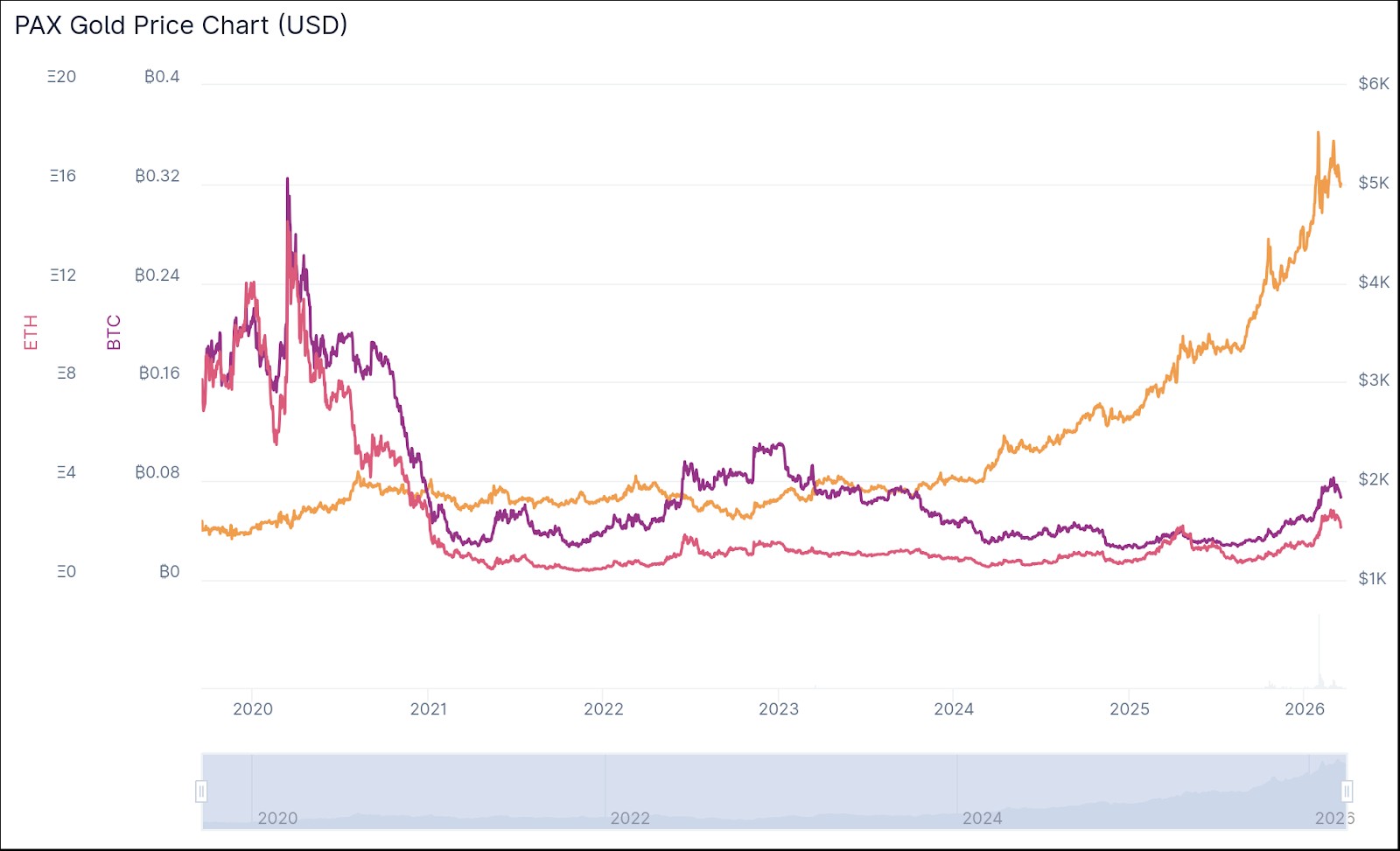
Each token represents one troy ounce of London Good Delivery gold stored in Brink's vaults in London. Monthly audits are conducted by independent firms, and Paxos maintains a bankruptcy-remote structure, meaning your gold stays protected even if the company itself runs into trouble.
One standout feature: you can enter your Ethereum wallet address on the Paxos website and see the actual serial number and physical details of the gold bar tied to your tokens. If you hold enough PAXG (around 430 tokens, equal to one full gold bar), you can redeem it for physical delivery. Zero custody fees, strong DeFi compatibility, and the strongest regulatory credentials in the space make this a favorite for institutions.
Kinesis Gold (KAU)
Kinesis Gold takes a different approach: it's not just about holding gold, it's about spending it. Each KAU token is backed by one gram of 99.99% pure, investment-grade gold bullion, stored in fully insured, audited vaults managed through the Allocated Bullion Exchange (ABX). What makes KAU unique is its built-in yield system: holders earn a passive monthly yield in KAU, funded by a 15% share of Kinesis' global transaction fees.
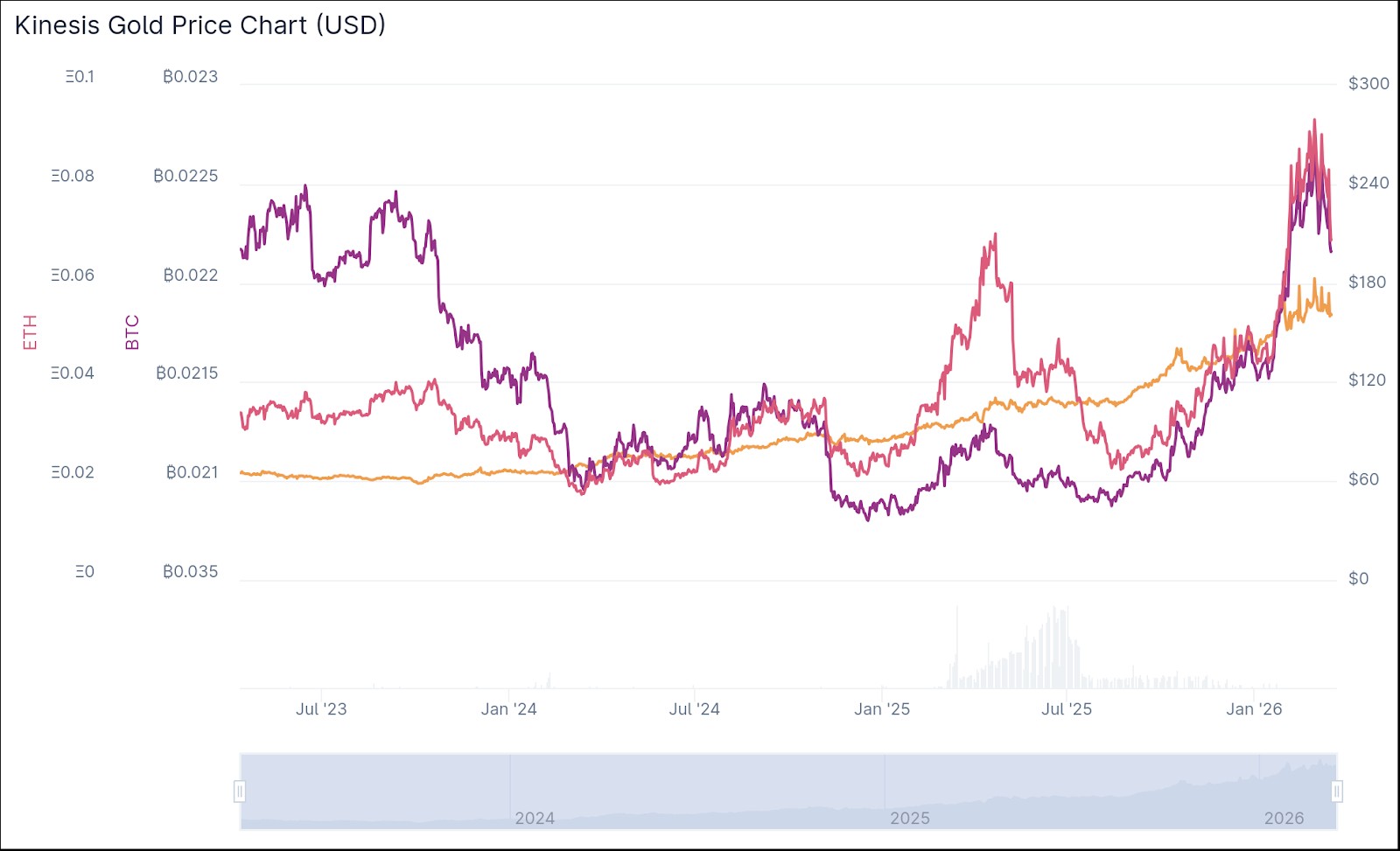
As of late 2025, Kinesis had paid out over $11 million in yields. The platform also launched a Virtual Card (currently in beta in the U.S. as of early 2026) that lets you spend your gold holdings anywhere Visa is accepted, converting KAU to local currency at the point of sale. Kinesis runs on a forked version of the Stellar blockchain and has also introduced a multi-asset payroll solution, allowing businesses to pay employees in gold. The minimum redemption threshold of 100 grams is much lower than most competitors, making physical gold accessible to smaller investors too.
Comtech Gold (CGO)
Comtech Gold stands out for two reasons: it's built on the XDC Network, and it's fully Shariah-compliant. Each CGO token represents one gram of 999.9 purity gold, stored in standardized 1 kg bars in regulated vaults in Dubai.
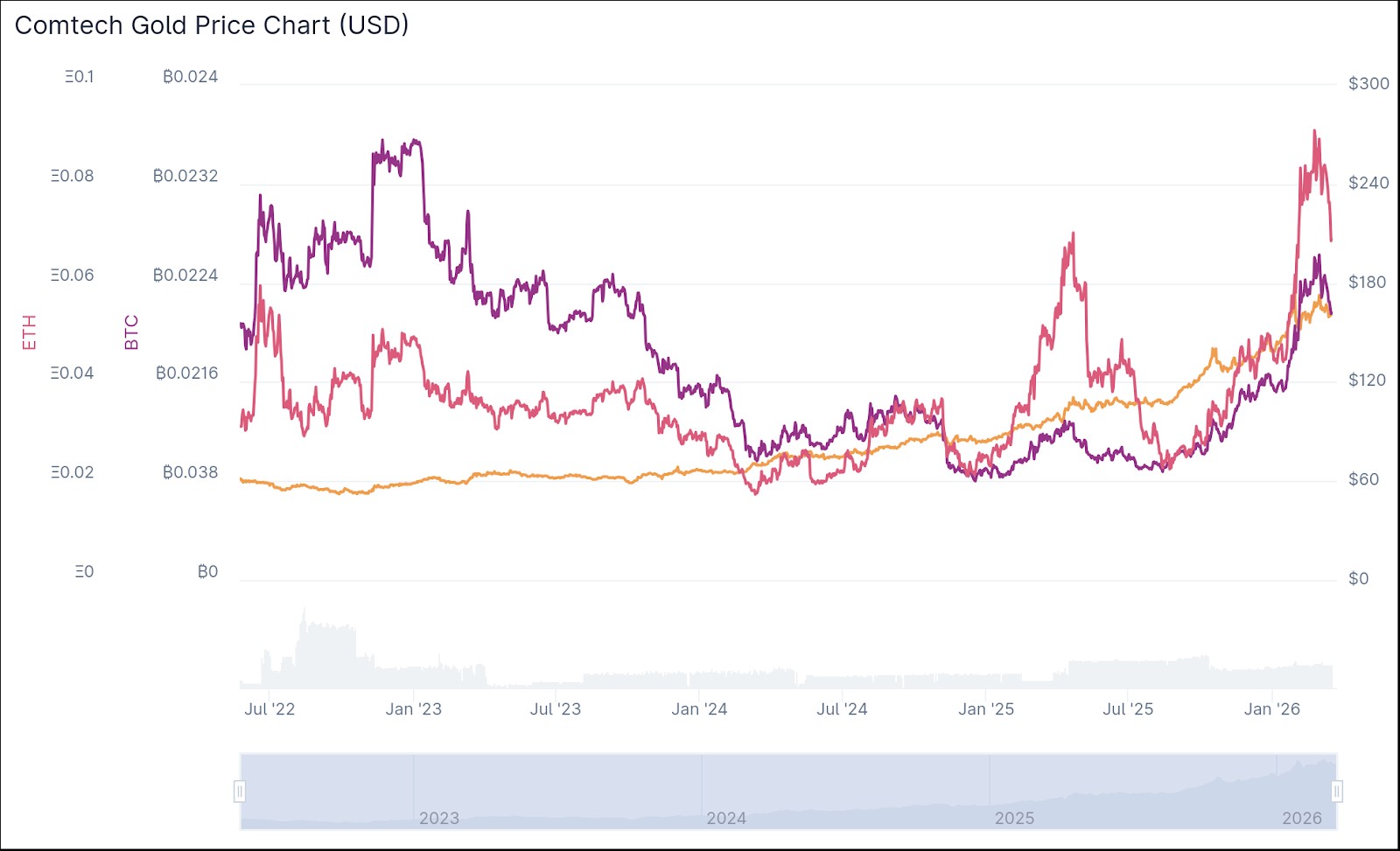
The Shariah certification, issued by recognized scholars in the UAE, is not just a label. It means each transaction results in actual delivery of tokens from seller to buyer, meeting Islamic finance requirements around asset-backing and the prohibition of interest. This opens up a massive market of faith-based investors who previously had limited compliant digital gold options.
CGO is regulated by the Dubai Airport Free Zone Authority and endorsed by the DMCC. In early 2026, UAE digital bank Zand integrated the XDC Network for blockchain payments and institutional custody, with ComTech Gold facilitating blockchain-enabled gold trading through that partnership. The XDC Network itself offers near-zero transaction fees and high speed, which keeps the cost of moving tokenized gold very low. Redemption requires a minimum of 1,000 CGO (1 kg of gold).
VNX Gold (VNXAU)
VNX Gold is the European entry in this space, and it's designed for accessibility. Each VNXAU token equals one gram of LBMA-certified physical gold, stored in segregated vaults at OZL Offenes Zollager in Liechtenstein, sometimes referred to as "Liechtenstein's Fort Knox."
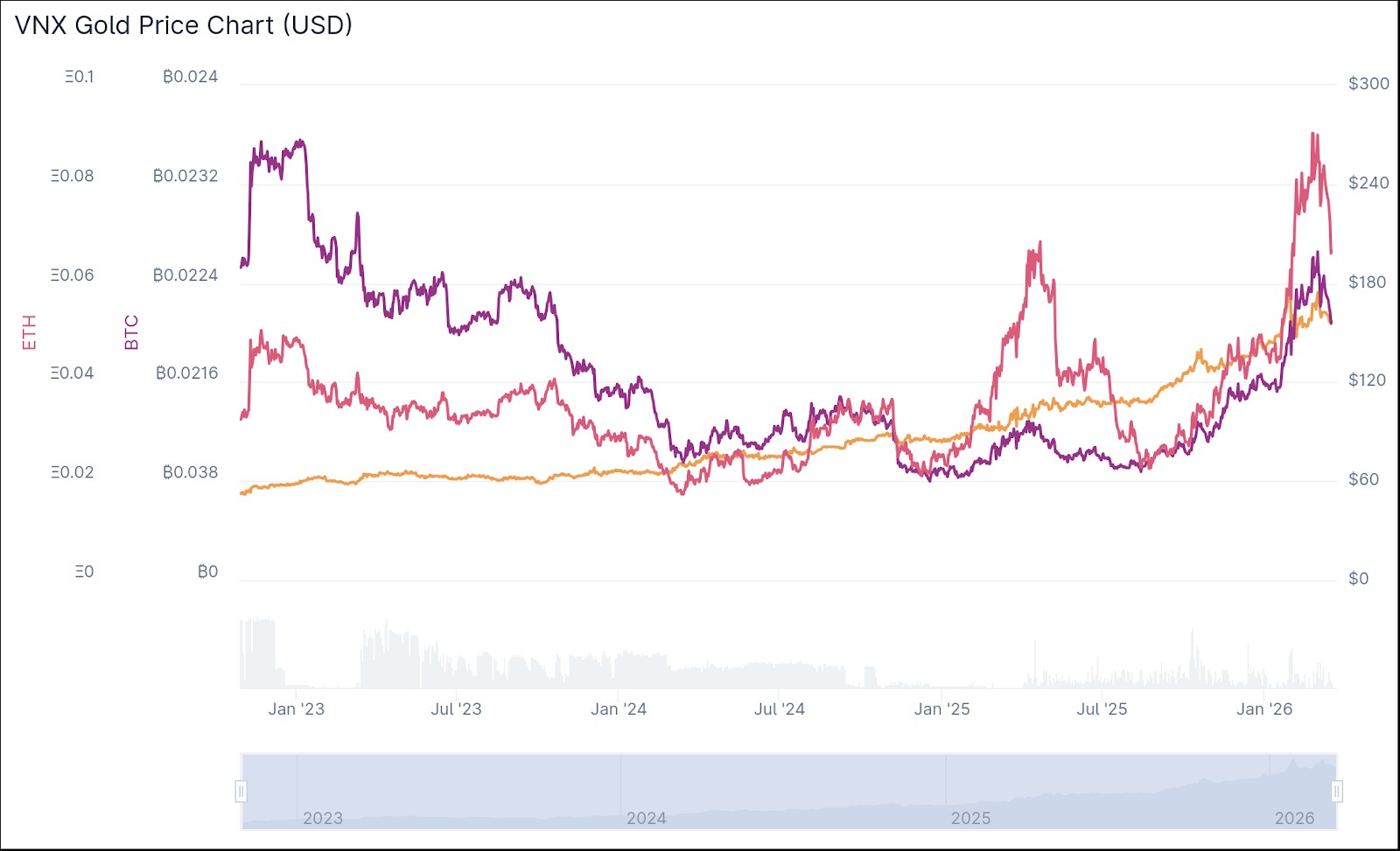
The issuer, VNX Commodities AG, is registered with the Liechtenstein Financial Market Authority (FMA) under the country's Blockchain Act (TVTG), giving it solid European regulatory backing. With a gram-level denomination and a low minimum buy-in, VNXAU is the most affordable entry point among the major tokenized gold options.
The token is available on Ethereum and Q blockchains, with expansion to additional chains underway. It's a much smaller project by market cap (around $5 million) compared to XAUT or PAXG, so liquidity is limited and exchange availability is narrower. But for European investors wanting regulated, insured gold exposure with zero storage fees and the ability to physically collect their gold from the vault or have it delivered, VNXAU fills a clear gap.
While most entries on the list are gold-based, some emerging commodity stablecoins are experimenting with silver and other metals. However, gold remains the dominant asset due to its long-standing role as a global store of value.
Because of strict reserve requirements and regulatory oversight, the list of commodity backed stablecoins remains relatively limited. Still, as tokenization expands across financial markets, more commodity-backed stablecoin projects are expected to emerge in the coming years.
How commodity-collateralized stablecoins work
A commodity-collateralized stablecoin follows a clear four-step lifecycle. Understanding this process helps investors assess whether a token is genuinely backed and redeemable.
Deposit and custody. The investor sends funds to the issuer, who purchases the equivalent commodity and transfers it to a regulated third-party vault. The asset is fully allocated and insured before any token is issued.
Minting. Once the asset is verified in the vault, the issuer mints an equivalent number of tokens on-chain and transfers them to the user's digital wallet. No token can be created without confirmed reserve backing.
Audits and verification. Independent auditors and on-chain proof-of-reserve systems verify that the amount of physical commodity in custody matches the circulating token supply. If vault holdings drop, the system can automatically halt new minting.
Redemption. If the token's price on the secondary market falls below the spot price of the underlying commodity, holders can redeem their tokens for the physical asset or its cash equivalent. This burns the tokens, reducing supply and pushing the price back toward parity. Minimum redemption thresholds apply. For example, KAU requires at least 100 grams for physical delivery.
| Step | What happens |
|---|---|
| Deposit | Investor funds received, commodity purchased and vaulted |
| Mint | Tokens issued on-chain after reserve confirmation |
| Audit | Third-party and on-chain proof-of-reserve verification |
| Redeem | Tokens burned, commodity or cash equivalent returned to holder |
This structure is what separates commodity-backed stablecoins from algorithmic or undercollateralized models, where no physical asset exists to support redemption.
Why commodity stablecoins are growing in 2026
Several converging forces are driving demand for commodity-backed stablecoins this year. Here are the key drivers.
Inflation and currency concerns. Gold prices crossed $5,500 per ounce in early 2026, pushing investors toward hard-asset exposure. Gold-backed tokens let blockchain users hold gold without dealing with physical storage or logistics.
Institutional tokenization of real-world assets. The broader real-world asset tokenization market has been expanding rapidly, with tokenized treasuries paving the way for wider commodity adoption. Financial institutions are now more comfortable with commodity-backed stablecoins that offer transparent audits and regulated custodians.
Diversification beyond fiat stablecoins. Regulatory scrutiny of fiat-pegged tokens has pushed some investors toward alternatives. A commodity-backed stablecoin offers a store of value independent of sovereign currency systems, which fiat-pegged tokens cannot provide.
On-chain accessibility. Traditional commodity investments require brokers or ETFs. Commodity stablecoins can be integrated into DeFi protocols for lending, borrowing, and yield generation, while remaining transferable globally without the logistical complexity of handling physical assets.
Growing institutional infrastructure. Major institutions including JPMorgan, Morgan Stanley, and Citi are actively building tokenization and stablecoin settlement infrastructure, creating a more reliable ecosystem for asset-backed digital tokens.
Are stablecoins considered commodities?
Regulators in several jurisdictions are debating whether certain digital assets should legally be classified as commodities. The discussion has become more relevant as these stablecoins gain wider adoption across global crypto markets.
A commodity-backed stablecoin derives its value from a physical asset such as gold or silver. Because the underlying collateral is a commodity, some policymakers argue that these tokens could qualify for stablecoins to be treated as commodities under existing regulatory frameworks.
Several factors influence how authorities classify these assets:
Underlying collateral. If a commodity-backed stablecoin represents ownership of a physical commodity, regulators may treat the token as a digital form of that commodity asset.
Issuer structure. The legal structure used by the issuing company can determine whether the token functions primarily as a payment instrument or as a stablecoin commodity backed by reserves.
Jurisdictional differences. Regulations for commodity stablecoins vary widely. Some countries regulate tokenized commodities under financial asset laws, while others treat them as digital commodities.
In the United States, gold-backed tokens such as Paxos Gold (PAXG) operate through regulated entities, while digital commodities generally fall under the oversight of the Commodity Futures Trading Commission (CFTC).
Pros and cons of commodity-backed stablecoins
A commodity-backed stablecoin combines blockchain technology with real-world asset backing, but it still carries limitations that users should understand before investing.
- Pros
- Cons
Tangible asset backing. Most commodity-backed stablecoins are supported by physical reserves such as gold or silver stored in professional vaults. This structure provides a clearer value foundation compared with algorithmic stablecoins.
Potential inflation hedge. Because many commodity stablecoins are linked to gold, they may help preserve purchasing power during periods of inflation or currency instability.
Global blockchain transfers. A commodity-backed stablecoin allows investors to transfer value internationally through blockchain networks without the logistics of transporting physical commodities.
Portfolio diversification. Crypto investors can gain exposure to traditional assets without leaving the digital asset ecosystem. This is one reason the commodity-backed stablecoins continue to attract interest from long-term investors.
Commodity price volatility. Although less volatile than cryptocurrencies, commodities still fluctuate in price. The value of a commodity-backed stablecoin will move with the market price of the underlying commodity.
Custody and reserve trust. Investors must rely on the issuer to maintain accurate reserves. Confidence in commodity-collateralized stablecoins depends on transparent audits and secure storage.
Regulatory uncertainty. Governments are still determining how to regulate digital assets backed by physical commodities.
Lower liquidity than fiat stablecoins. Compared with major fiat-pegged tokens, most commodity stablecoins have lower trading volumes and fewer exchange listings.
Commodity-backed vs fiat-backed stablecoins
Both commodity-backed stablecoins and fiat-backed stablecoins aim to reduce volatility compared with traditional cryptocurrencies. However, the source of stability and the primary use cases are very different.
A commodity-backed stablecoin derives its value from a physical asset such as gold or silver stored in reserves. Because of this structure, the price of these commodity stablecoins follows the market value of the underlying commodity rather than maintaining a fixed currency peg.
In contrast, fiat-backed stablecoins are tied to national currencies such as the US dollar. These tokens are designed to maintain a constant value, usually through reserves of cash or short-term government securities held by the issuer.
| Feature | Commodity-backed stablecoins | Fiat-backed stablecoins |
|---|---|---|
| Backing | Physical commodities such as gold or silver | Fiat currency reserves |
| Price movement | Follows commodity market price | Fixed 1:1 currency peg |
| Main use case | Asset exposure and inflation hedging | Trading liquidity and payments |
| Market liquidity | Moderate | Very high |
Because of these differences, investors often view commodity-backed stablecoins as a bridge between traditional commodity markets and digital assets, while fiat-backed tokens are mainly used for trading and settlement within crypto markets.
Where to buy commodity-backed stablecoins?
If you are thinking about buying or trading these tokens, the table below gives a quick side by side view of the main options available. It can help you see which crypto exchanges may be easier to access from your region and where these assets are more commonly listed. Use it as a simple starting point before you decide where to enter the market.
| OKX | Coinbase | Crypto.com | Cryptohopper | BTCC | |
|---|---|---|---|---|---|
|
Crypto |
Yes | Yes | Yes | Yes | Yes |
|
Min. Deposit, $ |
10 | 10 | 1 | No | 10 |
|
Coins Supported |
600+ | 400+ | 400+ | 1000 | 399 |
|
Spot Taker fee, % |
0.1 | 0.5 | 0.5 | 0 | 0.3 |
|
Spot Maker Fee, % |
0.08 | 0.5 | 0.25 | 0 | 0.2 |
|
Demo account |
Yes | No | No | No | Yes |
|
TU overall score |
8.48 | 7.84 | 7.8 | 7.76 | 7.6 |
|
Open an account |
Go to broker Your capital is at risk. |
Go to broker Your capital is at risk. |
Go to broker Your capital is at risk. |
Go to broker Your capital is at risk. |
Go to broker Your capital is at risk.
|
Tokenized commodities need transparency to scale

From my experience analyzing digital asset markets, I have seen commodity-backed stablecoins gradually evolve from niche experiments into credible tokenized assets. Early projects mainly targeted crypto users looking for on-chain gold exposure, but the narrative is now shifting toward broader financial applications. A commodity-backed stablecoin backed by verifiable reserves provides something many digital assets lack, a clear connection to real-world value. That link makes these tokens easier for traditional investors to understand compared with purely algorithmic systems.
At the same time, credibility in this sector depends entirely on transparency. The commodity-backed stablecoins list is still small, and the projects that publish regular reserve attestations and operate under clear regulatory frameworks are the ones most likely to gain long-term trust. In my view, the future of commodity stablecoins will depend less on marketing and more on custody standards, audit transparency, and real adoption in financial infrastructure.
Conclusion
Commodity-backed stablecoins have moved from being obscure crypto experiments to becoming legitimate bridges between real-world assets and digital finance. As demonstrated by leaders like Tether Gold and Paxos Gold, giving investors on-chain access to audited, physically-backed gold is driving rapid adoption and institutional attention. The single most important factor for success in this space is absolute transparency, with projects that offer verifiable reserves and robust regulatory compliance building the strongest trust. The future of finance will belong to digital assets that balance cutting-edge blockchain technology with the unshakeable security of tangible commodities.
FAQs
What risks are associated with holding commodity-backed stablecoins compared to holding the underlying physical commodities?
How do audits and proof-of-reserve mechanisms enhance trust in commodity-backed stablecoins?
Are commodity-backed stablecoins suitable for use in decentralized finance (DeFi) applications?
How does the market liquidity of commodity-backed stablecoins compare to that of fiat-backed stablecoins?
Editors' Top Picks and Insights





Related Articles
Team that worked on the article
Dan Blystone began his trading career in 1998 as an arbitrage clerk on the floor of the Chicago Mercantile Exchange (CME). He later traded bond and Eurex futures at proprietary firms such as Altea Trading, gaining valuable experience in high-frequency trading and risk management.
Chinmay Soni is a financial analyst with more than 5 years of experience in working with stocks, Forex, derivatives, and other assets. As a founder of a boutique research firm and an active researcher, he covers various industries and fields, providing insights backed by statistical data.
Yield refers to the earnings or income derived from an investment. It mirrors the returns generated by owning assets such as stocks, bonds, or other financial instruments.
An investor is an individual, who invests money in an asset with the expectation that its value would appreciate in the future. The asset can be anything, including a bond, debenture, mutual fund, equity, gold, silver, exchange-traded funds (ETFs), and real-estate property.
Cryptocurrency is a type of digital or virtual currency that relies on cryptography for security. Unlike traditional currencies issued by governments (fiat currencies), cryptocurrencies operate on decentralized networks, typically based on blockchain technology.
The CFTC protects the public from fraud, manipulation, and abusive practices related to the sale of commodity and financial futures and options, and to fosters open, competitive, and financially sound futures and option markets.
Bitcoin is a decentralized digital cryptocurrency that was created in 2009 by an anonymous individual or group using the pseudonym Satoshi Nakamoto. It operates on a technology called blockchain, which is a distributed ledger that records all transactions across a network of computers.

-
 Afghanistan
-
 Albania
-
 Algeria
-
 Angola
-
 Argentina
-
 Armenia
-
 Australia
-
 Austria
-
 Azerbaijan
-
 Bahamas
-
 Bahrain
-
 Bangladesh
-
 Belarus
-
 Belgium
-
 Bolivia
-
 Botswana
-
 Brazil
-
 Brunei
-
 Bulgaria
-
 Cambodia
-
 Cameroon
-
 Canada
-
 Chile
Chile
-
 China
China
-
 Colombia
-
 Congo
Congo
-
 Costa Rica
-
 Cote d'Ivoire
-
 Croatia
-
 Cuba
Cuba
-
 Cyprus
-
 Czechia
-
 DR Congo
-
 Denmark
-
 Dominican Republic
-
 Ecuador
-
 Egypt
Egypt
-
 El Salvador
-
 Estonia
-
 Eswatini
-
 Ethiopia
-
 Finland
-
 France
-
 Georgia
-
 Germany
-
 Ghana
Ghana
-
 Greece
-
 Haiti
Haiti
-
 Hong Kong
-
 Hungary
-
 India
India
-
 Indonesia
-
 Iran, Islamic republic
-
 Iraq
Iraq
-
 Ireland
-
 Israel
-
 Italy
Italy
-
 Jamaica
-
 Japan
Japan
-
 Jordan
-
 Kazakhstan
-
 Kenya
Kenya
-
 Korea
Korea
-
 Kuwait
-
 Kyrgyzstan
-
 Laos
Laos
-
 Latvia
-
 Lebanon
-
 Lesotho
-
 Libya
Libya
-
 Lithuania
-
 Luxembourg
-
 Madagascar
-
 Malaysia
-
 Malta
Malta
-
 Mauritius
-
 Mexico
-
 Moldova
-
 Mongolia
-
 Montenegro
-
 Morocco
-
 Mozambique
-
 Myanmar
-
 Namibia
-
 Nepal
Nepal
-
 Netherlands
-
 New Zealand
-
 Nigeria
-
 North Macedonia
-
 Norway
-
 Oman
Oman
-
 Pakistan
-
 Palestine
-
 Panama
-
 Papua New Guinea
-
 Paraguay
-
 Peru
Peru
-
 Philippines
-
 Poland
-
 Portugal
-
 Puerto Rico
-
 Qatar
Qatar
-
 Reunion
-
 Romania
-
 Rwanda
-
 Saudi Arabia
-
 Serbia
-
 Singapore
-
 Slovakia
-
 Slovenia
-
 Somalia
-
 South Africa
-
 Spain
Spain
-
 Sri Lanka
-
 Sweden
-
 Switzerland
-
 Syria
Syria
-
 Taiwan
-
 Tajikistan
-
 Tanzania
-
 Thailand
-
 Trinidad and Tobago
-
 Tunisia
-
 Turkey
-
 UAE
UAE
-
 Uganda
-
 Ukraine
-
 United Kingdom
-
United States
-
 Uruguay
-
 Uzbekistan
-
 Venezuela
-
 Vietnam
-
 Yemen
Yemen
-
 Zambia
-
 Zimbabwe
- Forex
- Crypto












