
Algorithmic Stablecoins List: Mechanisms, Examples, And Risks Explained


Editorial Note: While we adhere to strict Editorial Integrity, this post may contain references to products from our partners. Here's an explanation for How We Make Money. None of the data and information on this webpage constitutes investment advice according to our Disclaimer.
Best algorithmic stablecoins:
USDD. A large-scale algorithmic stablecoin with high market capitalization and deep trading liquidity.
Hylo USD (HYUSD). A multi-platform algorithmic stablecoin designed for cross-ecosystem use and yield strategies.
Mento Dollar (USDM). An algorithmic stablecoin within the Celo ecosystem focused on relative price stability.
Alchemix USD (ALUSD). A self-repaying algorithmic stablecoin backed by future yield rather than liquid reserves.
Algorithmic stablecoins represent one of the most ambitious experiments in decentralized finance. Unlike fiat-backed or overcollateralized stablecoins, they aim to achieve price stability without holding equivalent reserves. Instead, they rely on algorithms, smart contracts, and market incentives to regulate supply and demand.
In theory, this approach removes dependence on centralized issuers and custodians. In practice, many algorithmic stablecoins have struggled to maintain their peg during periods of market stress. Several high-profile failures have reshaped how investors and regulators view this model, raising questions about whether long-term stability is achievable without hard backing.
In this guide, we explain what algorithmic stablecoins are, how algorithmic stablecoins work, the main types and examples of algorithmic stablecoins, and the key risks that make them one of the most fragile segments of the crypto market.
Risk warning: Cryptocurrency markets are highly volatile, with sharp price swings and regulatory uncertainties. Research indicates that 75-90% of traders face losses. Only invest discretionary funds and consult an experienced financial advisor.
Algorithmic stablecoins list and examples
Algorithmic stablecoins remain one of the most complex and debated segments of the crypto market. Unlike fiat-backed stablecoins, these assets aim to maintain a stable value primarily through protocol rules, smart contracts, and economic incentives rather than direct reserve guarantees. Despite higher risk, several algorithmic stablecoins remain active and widely used in DeFi ecosystems in 2026.
Below are the most notable active algorithmic stablecoins and an explanation of how each model works in practice.
USDD
USDD is one of the most visible projects in the algorithmic stablecoins category and is closely associated with the TRON ecosystem. It is positioned as a dollar-pegged digital asset that combines algorithmic issuance rules with a reserve and incentive framework managed by the TRON DAO Reserve.
Unlike early pure algorithmic models, USDD relies on overcollateralization in crypto assets alongside mint and burn mechanisms to support its price. This hybrid structure is designed to improve resilience during market stress while still maintaining an on-chain, non-fiat issuance model. USDD is widely used for settlements, trading, and DeFi applications within TRON and supported networks, which helps sustain relatively deep liquidity compared to many other algorithmic stablecoins.
Hylo USD (HYUSD)
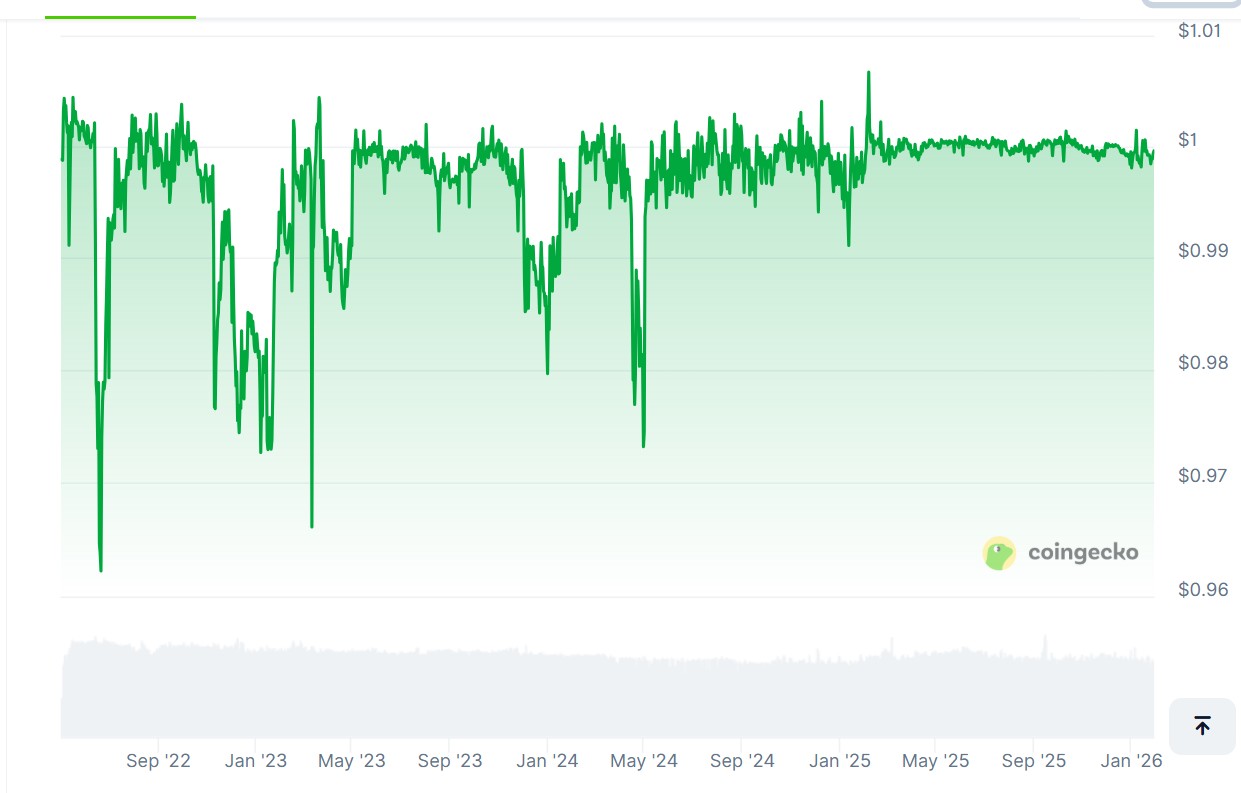
Hylo USD (HYUSD) is a decentralized algorithmic stablecoin developed within the Solana DeFi ecosystem. Its primary goal is to maintain a price close to one U.S. dollar through protocol-level stabilization mechanisms and backing linked to liquid staking tokens.
HYUSD uses staking yields and ecosystem incentives to support its price model, which places it closer to hybrid algorithmic solutions rather than fully uncollateralized designs. The project has achieved meaningful circulation and ongoing trading activity, making it one of the more liquid algorithmic assets on Solana. Its stability depends heavily on staking performance, liquidity conditions, and continued participation in the Solana DeFi environment.
Mento Dollar (USDM)
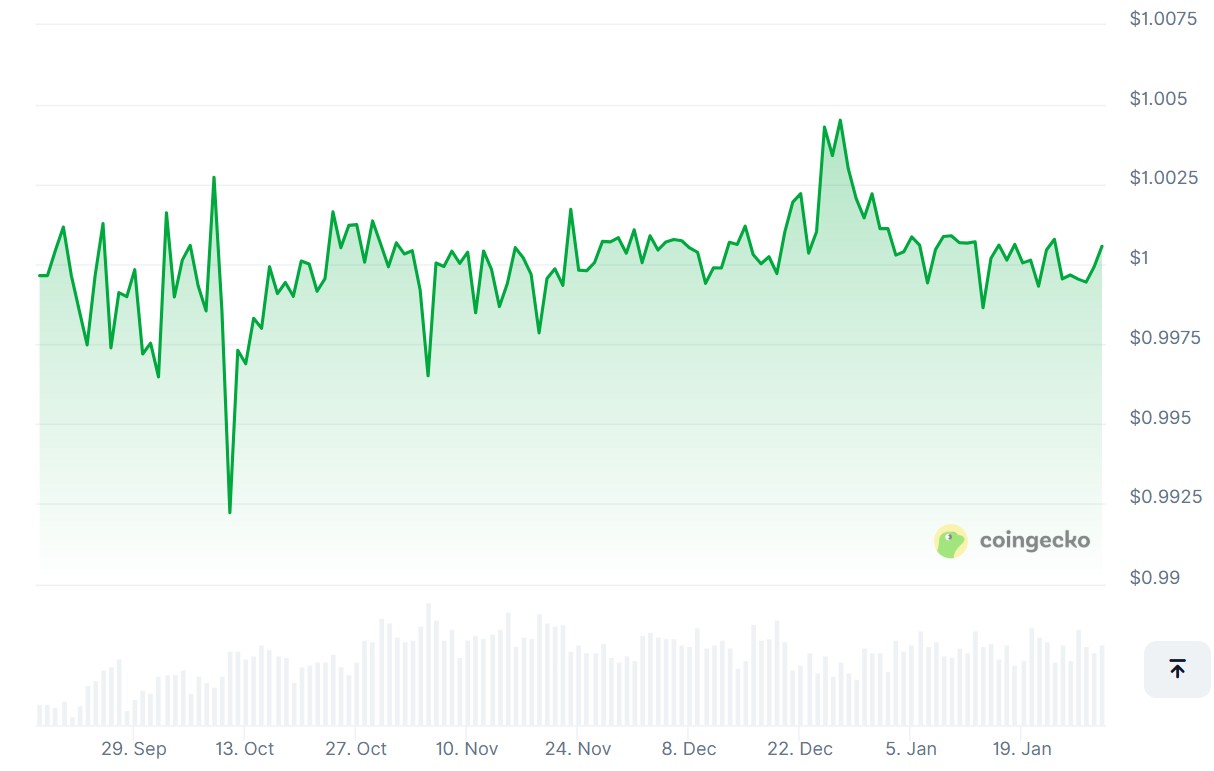
Mento Dollar (USDM) is the algorithmic stablecoin of the Celo ecosystem and the successor to the former Celo Dollar after its rebranding. USDM operates as part of the Mento protocol, which focuses on on-chain foreign exchange and multi-currency stablecoin infrastructure.
The stabilization model relies on on-chain liquidity pools and incentive mechanisms that encourage market participants to keep the exchange rate close to one dollar. Rather than depending on traditional reserves, the protocol uses economic incentives and automated liquidity management to regulate price. Because of this structure, USDM is often referenced when explaining how algorithmic stablecoins work, as market participation and protocol mechanics play a central role in maintaining stability.

Alchemix USD (ALUSD)
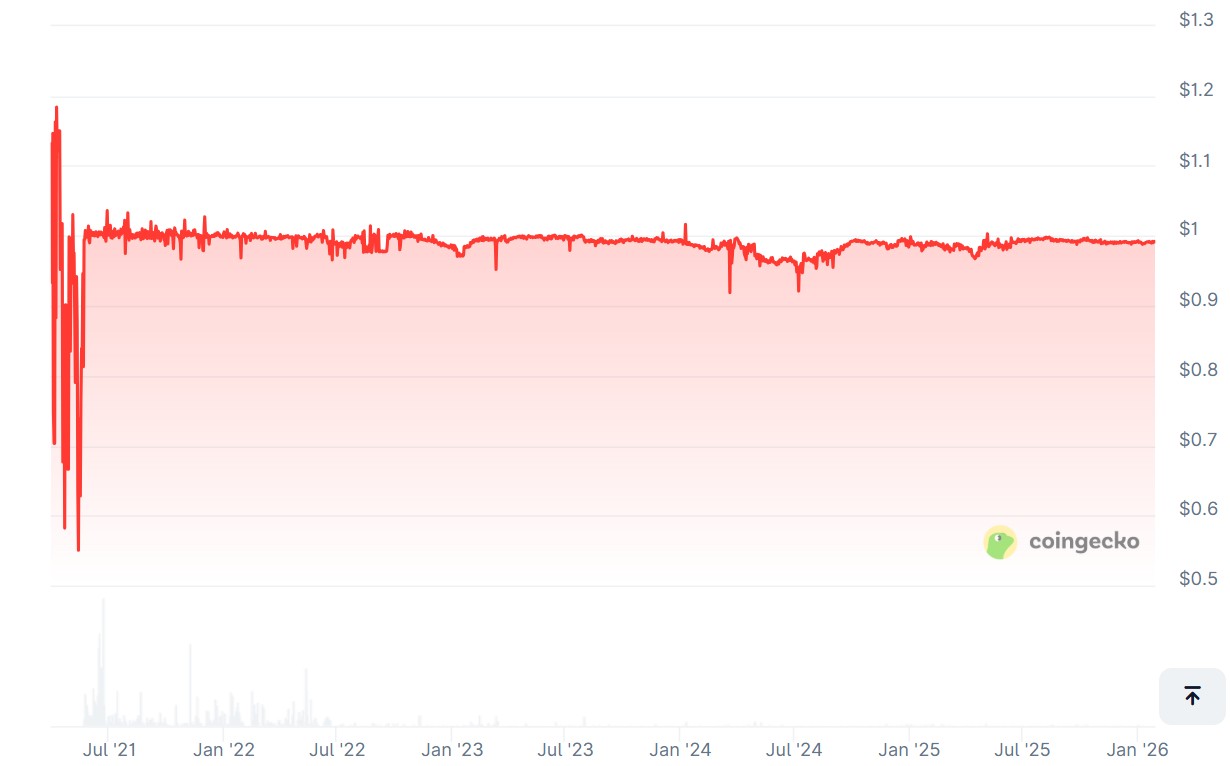
Alchemix USD (ALUSD) represents a distinct approach within the algorithmic stablecoin space and is frequently described as a hybrid or DeFi-native model. ALUSD is issued through the Alchemix protocol, where users deposit collateral and mint a synthetic dollar asset against it.
The defining feature of ALUSD is that the yield generated by the deposited collateral is automatically used to repay the user’s debt over time. This removes the need for active repayment and reduces liquidation pressure under normal conditions. As a result, ALUSD functions less like a traditional stablecoin and more as part of a self-repaying DeFi lending system. Its stability and viability depend on protocol parameters, yield strategies, and overall DeFi market conditions rather than simple reserve backing.
What is an algorithmic stablecoin?
An algorithmic stablecoin is a type of cryptocurrency that aims to maintain a stable value, most often one U.S. dollar, using code-driven monetary mechanisms rather than direct asset reserves. Instead of being backed one-to-one by cash or equivalents, an algorithm based stablecoin relies on smart contracts that automatically manage token supply.
In simple terms, an algo stablecoin tries to stay stable by adjusting how many tokens exist. When demand rises and the price goes above the target, the protocol increases supply. When demand falls and the price drops below the peg, supply is reduced through burns or incentives. This is why such assets are often described as algorithmically backed stablecoins, even though they are not backed by traditional collateral.
Unlike stablecoins backed by fiat currency, an algorithmic stablecoin does not promise guaranteed redemption. Its stability depends on market participation, liquidity, and confidence in the mechanism. If users stop trusting the system, the algorithm alone cannot enforce price stability.
Because of this design, algorithmic stablecoins are commonly viewed as experimental financial instruments rather than digital cash equivalents. While some models incorporate partial collateral, the defining feature remains that price stability is governed primarily by algorithms, not reserves.
This distinction is critical when evaluating which stablecoins are algorithmic, how they behave during stress, and why many algorithm stablecoins have failed to hold their peg over time.
| Feature | Algorithmic stablecoin | Asset-backed stablecoin |
|---|---|---|
| Backing model | Algorithms and incentives | Fiat or liquid reserves |
| Issuer control | Minimal or decentralized | Centralized entity |
| Transparency | On-chain logic | Off-chain audits |
| Stability profile | Highly variable | Relatively stable |
| Risk profile | High | Low to moderate |
This structural difference explains why algorithmic stablecoins are often classified as experimental financial instruments rather than cash equivalents.
How do algorithmic stablecoins work?
To understand how algorithmic stablecoins work, it helps to think of them as automated monetary systems. An algorithmic stablecoin mechanism uses smart contracts to manage supply in response to market price changes, with the goal of keeping the token close to its target value.
When the market price rises above the peg, the protocol increases supply. When the price falls below the peg, supply is reduced or demand is incentivized. These actions are executed automatically, without human intervention, which is why this model is described as algorithmic.
Most algorithmic stablecoins rely on a combination of the following components.
Elastic supply adjustments. When demand rises and the price moves above the peg, new tokens are minted, and when demand falls below the target, supply is reduced through burns or removals.
Incentive-driven arbitrage. Traders are rewarded for buying below the peg or selling above it, helping stabilize price through market incentives.
Secondary or governance tokens. Many designs use a second token to absorb volatility and support the algorithmic stablecoins peg maintenance mechanism.
Fully automated execution. All supply changes are enforced by smart contracts without human intervention, which removes discretion during periods of market stress.
While the theory behind how algorithmic stablecoins maintain their peg appears sound, real markets are not perfectly rational. During stress events, liquidity dries up, arbitrageurs step back, and confidence weakens. When this happens, the same mechanisms designed to stabilize the system can accelerate losses instead.
Types of algorithmic stablecoins
Understanding the types of algorithmic stablecoins is essential when evaluating how different designs behave under market stress. While all algorithmic stablecoins aim to maintain price stability through automated mechanisms, their internal structures vary significantly.
Below are the main categories used to classify algorithmic stablecoins today.
Pure algorithmic stablecoins. These designs have no collateral backing and rely entirely on supply and demand algorithms to maintain the peg. Historically, this category includes some of the most well-known algorithmic stablecoin failures, as confidence-based systems tend to break down quickly during market stress.
Fractional algorithmic stablecoins. A fractional algorithmic stablecoin combines partial collateral backing with algorithmic supply controls. The collateral ratio adjusts dynamically, which helps reduce reflexive collapse risk compared to fully uncollateralized models.
Seigniorage-based stablecoins. These models use a secondary or governance token to absorb volatility. Holders of the stablecoin depend on future demand for the secondary asset, which makes this structure vulnerable during prolonged downturns.
Elastic supply stablecoins. Instead of defending a strict peg, these algorithm stablecoins adjust user balances directly through rebasing mechanisms. While technically elegant, they are rarely used for payments or pricing due to unpredictable balance changes.
Most recent designs have moved away from pure models and toward hybrid structures. As a result, many projects now describe themselves as algorithmically backed stablecoins rather than fully algorithmic ones, reflecting lessons learned from earlier collapses.
Algorithmic stablecoin failures and collapse patterns
The history of algorithmic stablecoins is closely tied to repeated failure cycles. While each project uses different mechanics, most algorithmic stablecoin failures follow similar patterns once market conditions turn unfavorable.
A typical algorithmic stablecoin collapse begins with a loss of confidence. When users start selling, the stabilization mechanism increases supply or incentivizes arbitrage. Instead of restoring the peg, this often creates additional sell pressure, triggering a negative feedback loop.
Several common collapse patterns appear across past designs:
Reflexive supply spirals. As price falls, supply expansion or secondary token issuance accelerates losses instead of correcting them.
Arbitrage breakdown. During stress, arbitrageurs step back due to liquidity risk, undermining the core mechanism of an algorithmic stablecoin.
Secondary token collapse. In dual-token models, the governance or volatility-absorbing token rapidly loses value, removing the system’s main support.
Liquidity exhaustion. Once liquidity pools thin out, even small trades can cause large price deviations in an algorithmic stablecoin, leading to a full crash.
These events highlight a key weakness. Algorithms can react instantly, but they cannot create demand when confidence disappears. As a result, stabilization logic often amplifies volatility instead of containing it during market stress.
Algorithmic stablecoin risks
The risks of algorithmic stablecoins go far beyond normal crypto price volatility. Because these systems depend on incentives and market behavior, their failure modes tend to accelerate under stress rather than stabilize.
Below are the key algorithmic stablecoin risks that investors and users should understand.
Reflexive sell pressure. When prices fall, stabilization mechanisms may increase supply or trigger secondary token issuance, which can intensify selling instead of stopping it.
Dependence on market confidence. Algorithmic stablecoins rely on continuous demand and participation, and once confidence weakens, algorithms alone cannot restore stability.
Liquidity shocks. During periods of low liquidity, even small trades can break the peg, making recovery difficult or impossible.
Secondary token exposure. Many models shift risk to a governance or volatility-absorbing token, which can collapse rapidly during downturns.
Smart contract and oracle risks. Errors in pricing feeds or contract logic can trigger incorrect supply adjustments at critical moments.
Governance delays. Decentralized governance may react too slowly during fast-moving markets, allowing losses to compound.
Are any algorithmic stablecoins truly stable today?
At present, no algorithmic stablecoin can be considered truly stable in the same sense as fiat-backed or fully overcollateralized alternatives. While some designs have improved since early failures, algorithmic stablecoins still rely on market confidence, liquidity, and incentives rather than guaranteed backing.
Projects that remain active are sometimes described as more resilient algo stablecoins, but resilience does not equal stability. These protocols typically use partial collateralization, conservative supply adjustments, and tighter governance controls. Such measures reduce risk but do not eliminate the core fragility of an algorithm based stablecoin.
From a structural perspective, the main limitation remains unchanged. When demand weakens sharply, even well-designed algorithmic stablecoins struggle to maintain their peg. Algorithms can react instantly, but they cannot create liquidity or restore confidence once participants exit the market.
For this reason, algorithmic stablecoins today are best viewed as experimental financial instruments rather than dependable stores of value. They may function during calm market conditions, but they do not provide the predictability required for everyday payments or long-term value preservation.
In practical terms, no algorithmic stablecoin currently meets the standard of long-term price stability expected from low-risk stable assets.
Because algorithmic stablecoins are mainly accessed through trading and liquidity platforms, the choice of exchange also matters for how users interact with them. A reliable exchange helps ensure smoother access, clearer pricing, and fewer disruptions when market conditions change. The table below highlights some of the best crypto exchanges in your region, providing a practical reference alongside the discussion of algorithmic stablecoin risks and examples.
| OKX | Coinbase | Crypto.com | Cryptohopper | BTCC | |
|---|---|---|---|---|---|
|
Min. Deposit, $ |
10 | 10 | 1 | No | 10 |
|
Coins Supported |
600+ | 400+ | 400+ | 1000 | 399 |
|
Spot Taker fee, % |
0.1 | 0.5 | 0.5 | 0 | 0.3 |
|
Spot Maker Fee, % |
0.08 | 0.5 | 0.25 | 0 | 0.2 |
|
Alerts |
Yes | Yes | Yes | Yes | No |
|
Copy trading |
Yes | No | No | Yes | Yes |
|
TU overall score |
8.48 | 7.84 | 7.8 | 7.76 | 7.6 |
|
Open an account |
Go to broker Your capital is at risk. |
Go to broker Your capital is at risk. |
Go to broker Your capital is at risk. |
Go to broker Your capital is at risk. |
Go to broker Your capital is at risk.
|
Algorithms fail when confidence disappears

I have followed algorithmic stablecoins both as a market analyst and as a participant in DeFi experiments, and the biggest lesson for me is how quickly theory breaks down under pressure. On paper, the mechanisms look balanced and self-correcting. In real markets, fear, speed, and thin liquidity dominate. When confidence fades, algorithms respond exactly as designed, but that response often deepens the imbalance instead of fixing it.
What this shows is that algorithmic stablecoins are not just technical systems, they are behavioral ones. Their success assumes active arbitrage, continuous demand, and rational decision-making, all of which disappear during stress events. For me, that is the defining limitation. These designs can still be useful in controlled or experimental environments, but they should never be treated as low-risk or cash-like instruments.
Conclusion
Algorithmic stablecoins promise innovative solutions for digital currency stability, but their reliance on complex market mechanisms makes them inherently fragile. High-profile examples like Terra/LUNA have shown that without robust demand and responsive mechanisms, these coins are vulnerable to cascading failures and loss of peg. While these projects demonstrate the creativity in the crypto space, they also highlight the persistent challenges in achieving true stability without collateral backing. Ultimately, the failures of past algorithmic stablecoins serve as a powerful reminder: in finance, elegant code cannot always replace trust and real-world value.
FAQs
What are the main differences between pure and hybrid algorithmic stablecoin models?
How do algorithmic stablecoins compare to fiat-backed stablecoins in terms of transparency?
What factors most commonly trigger a loss of confidence in algorithmic stablecoins?
In what scenarios are algorithmic stablecoins most vulnerable to failure?
Editors' Top Picks and Insights





Related Articles
Team that worked on the article
Viktoras Karapetjanc is a seasoned financial trader, market analyst, and content creator with over 20 years of expertise in Forex, cryptocurrency, and stock markets. As a contributor to the Traders Union website, he provides in-depth analysis, data-driven strategies, and educational content to empower traders of all levels.
Dan Blystone began his trading career in 1998 as an arbitrage clerk on the floor of the Chicago Mercantile Exchange (CME). He later traded bond and Eurex futures at proprietary firms such as Altea Trading, gaining valuable experience in high-frequency trading and risk management.
Chinmay Soni is a financial analyst with more than 5 years of experience in working with stocks, Forex, derivatives, and other assets. As a founder of a boutique research firm and an active researcher, he covers various industries and fields, providing insights backed by statistical data.
Ethereum is a decentralized blockchain platform and cryptocurrency that was proposed by Vitalik Buterin in late 2013 and development began in early 2014. It was designed as a versatile platform for creating decentralized applications (DApps) and smart contracts.
Risk management is a risk management model that involves controlling potential losses while maximizing profits. The main risk management tools are stop loss, take profit, calculation of position volume taking into account leverage and pip value.
Index in trading is the measure of the performance of a group of stocks, which can include the assets and securities in it.
Cryptocurrency is a type of digital or virtual currency that relies on cryptography for security. Unlike traditional currencies issued by governments (fiat currencies), cryptocurrencies operate on decentralized networks, typically based on blockchain technology.
Volatility refers to the degree of variation or fluctuation in the price or value of a financial asset, such as stocks, bonds, or cryptocurrencies, over a period of time. Higher volatility indicates that an asset's price is experiencing more significant and rapid price swings, while lower volatility suggests relatively stable and gradual price movements.

-
 Afghanistan
-
 Albania
-
 Algeria
-
 Angola
-
 Argentina
-
 Armenia
-
 Australia
-
 Austria
-
 Azerbaijan
-
 Bahamas
-
 Bahrain
-
 Bangladesh
-
 Belarus
-
 Belgium
-
 Bolivia
-
 Botswana
-
 Brazil
-
 Brunei
-
 Bulgaria
-
 Cambodia
-
 Cameroon
-
 Canada
-
 Chile
Chile
-
 China
China
-
 Colombia
-
 Congo
Congo
-
 Costa Rica
-
 Cote d'Ivoire
-
 Croatia
-
 Cuba
Cuba
-
 Cyprus
-
 Czechia
-
 DR Congo
-
 Denmark
-
 Dominican Republic
-
 Ecuador
-
 Egypt
Egypt
-
 El Salvador
-
 Estonia
-
 Eswatini
-
 Ethiopia
-
 Finland
-
 France
-
 Georgia
-
 Germany
-
 Ghana
Ghana
-
 Greece
-
 Haiti
Haiti
-
 Hong Kong
-
 Hungary
-
 India
India
-
 Indonesia
-
 Iran, Islamic republic
-
 Iraq
Iraq
-
 Ireland
-
 Israel
-
 Italy
Italy
-
 Jamaica
-
 Japan
Japan
-
 Jordan
-
 Kazakhstan
-
 Kenya
Kenya
-
 Korea
Korea
-
 Kuwait
-
 Kyrgyzstan
-
 Laos
Laos
-
 Latvia
-
 Lebanon
-
 Lesotho
-
 Libya
Libya
-
 Lithuania
-
 Luxembourg
-
 Madagascar
-
 Malaysia
-
 Malta
Malta
-
 Mauritius
-
 Mexico
-
 Moldova
-
 Mongolia
-
 Montenegro
-
 Morocco
-
 Mozambique
-
 Myanmar
-
 Namibia
-
 Nepal
Nepal
-
 Netherlands
-
 New Zealand
-
 Nigeria
-
 North Macedonia
-
 Norway
-
 Oman
Oman
-
 Pakistan
-
 Palestine
-
 Panama
-
 Papua New Guinea
-
 Paraguay
-
 Peru
Peru
-
 Philippines
-
 Poland
-
 Portugal
-
 Puerto Rico
-
 Qatar
Qatar
-
 Reunion
-
 Romania
-
 Rwanda
-
 Saudi Arabia
-
 Serbia
-
 Singapore
-
 Slovakia
-
 Slovenia
-
 Somalia
-
 South Africa
-
 Spain
Spain
-
 Sri Lanka
-
 Sweden
-
 Switzerland
-
 Syria
Syria
-
 Taiwan
-
 Tajikistan
-
 Tanzania
-
 Thailand
-
 Trinidad and Tobago
-
 Tunisia
-
 Turkey
-
 UAE
UAE
-
 Uganda
-
 Ukraine
-
 United Kingdom
-
United States
-
 Uruguay
-
 Uzbekistan
-
 Venezuela
-
 Vietnam
-
 Yemen
Yemen
-
 Zambia
-
 Zimbabwe
- Forex
- Crypto










- Algorithmic stablecoins list and examples
- What is an algorithmic stablecoin?
- How do algorithmic stablecoins work?
- Types of algorithmic stablecoins
- Algorithmic stablecoin failures and collapse patterns
- Algorithmic stablecoin risks
- Are any algorithmic stablecoins truly stable today?
- Expert opinion
- Conclusion
- FAQs


