
Cryptocurrencies And Stablecoins Pegged To Gold



Editorial Note: While we adhere to strict Editorial Integrity, this post may contain references to products from our partners. Here's an explanation for How We Make Money. None of the data and information on this webpage constitutes investment advice according to our Disclaimer.
Gold-backed stablecoins and gold-backed cryptocurrencies:
Tether Gold (XAUT): A classic gold-backed stablecoin supported by physical gold stored in certified vaults.
PAX Gold (PAXG): A regulated stablecoin backed by London Good Delivery standard gold.
Kinesis Gold (KAU): A gold-backed stablecoin integrated into a broader payments ecosystem.
Gold Fund Tokens (GLDF): A cryptocurrency linked to a portfolio of gold-related assets.
Gold Index Coin (GIX): An index-based cryptocurrency tracking the price of gold.
Gold Synthetic Asset (GSA): A synthetic crypto asset designed to replicate the price of gold.
Gold in crypto refers to digital assets that derive their value from gold, allowing investors to access precious metals through blockchain technology without holding physical bullion. These instruments are often described as gold-backed cryptocurrencies, but they do not all function in the same way.
The most straightforward category is gold-backed stablecoins, where each token is directly linked to a specific amount of physical gold held in vaults. At the same time, there are gold-backed cryptocurrencies that are not stablecoins by nature. These assets may track gold prices through funds, indices, or synthetic mechanisms rather than strict physical reserves.
Understanding this distinction is critical. All gold-backed stablecoins are gold-backed cryptocurrencies, but not every gold-backed cryptocurrency qualifies as a stablecoin. In this article, we explain how gold works in crypto, examine different models of cryptocurrencies backed by gold, and help investors understand which tools are suited for storage, trading, or diversification.
Risk warning: Cryptocurrency markets are highly volatile, with sharp price swings and regulatory uncertainties. Research indicates that 75-90% of traders face losses. Only invest discretionary funds and consult an experienced financial advisor.
Top stablecoins pegged to gold
Gold-backed stablecoins are the most direct form of cryptocurrency backed by gold. These assets are designed to maintain a close relationship with the price of physical gold by linking each token to a specific amount of metal held in secure vaults. Because of this structure, they are often described as a digital alternative to owning bullion.
By definition, every gold-backed stablecoin also qualifies as a gold-backed cryptocurrency. However, unlike other gold-linked crypto assets, stablecoins are built around reserve-backed stability rather than price replication through financial instruments.
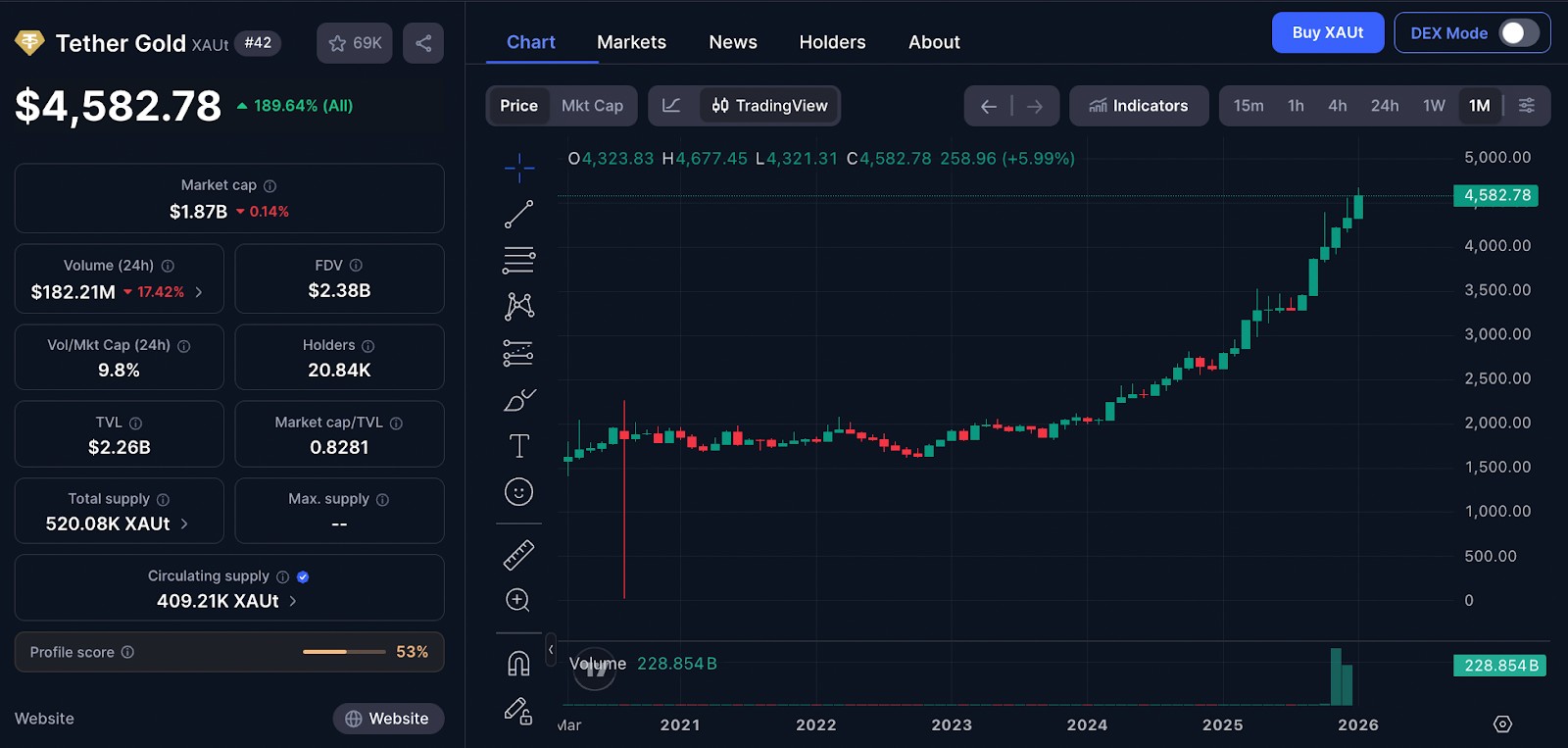
Tether Gold (XAUT)
Tether Gold (XAUT) is one of the most widely recognized gold-backed stablecoins. Each token represents one troy ounce of physical gold held in certified vaults. Token ownership is recorded on the blockchain, while the underlying gold reserves are held in custody and verified through issuer reporting rather than stored directly on-chain.
Tether Gold is frequently mentioned in discussions about gold-backed crypto because of its clear reserve structure and liquidity. As a stablecoin backed by gold, it is primarily used for value preservation and portfolio hedging rather than speculative trading.
PAX Gold (PAXG)
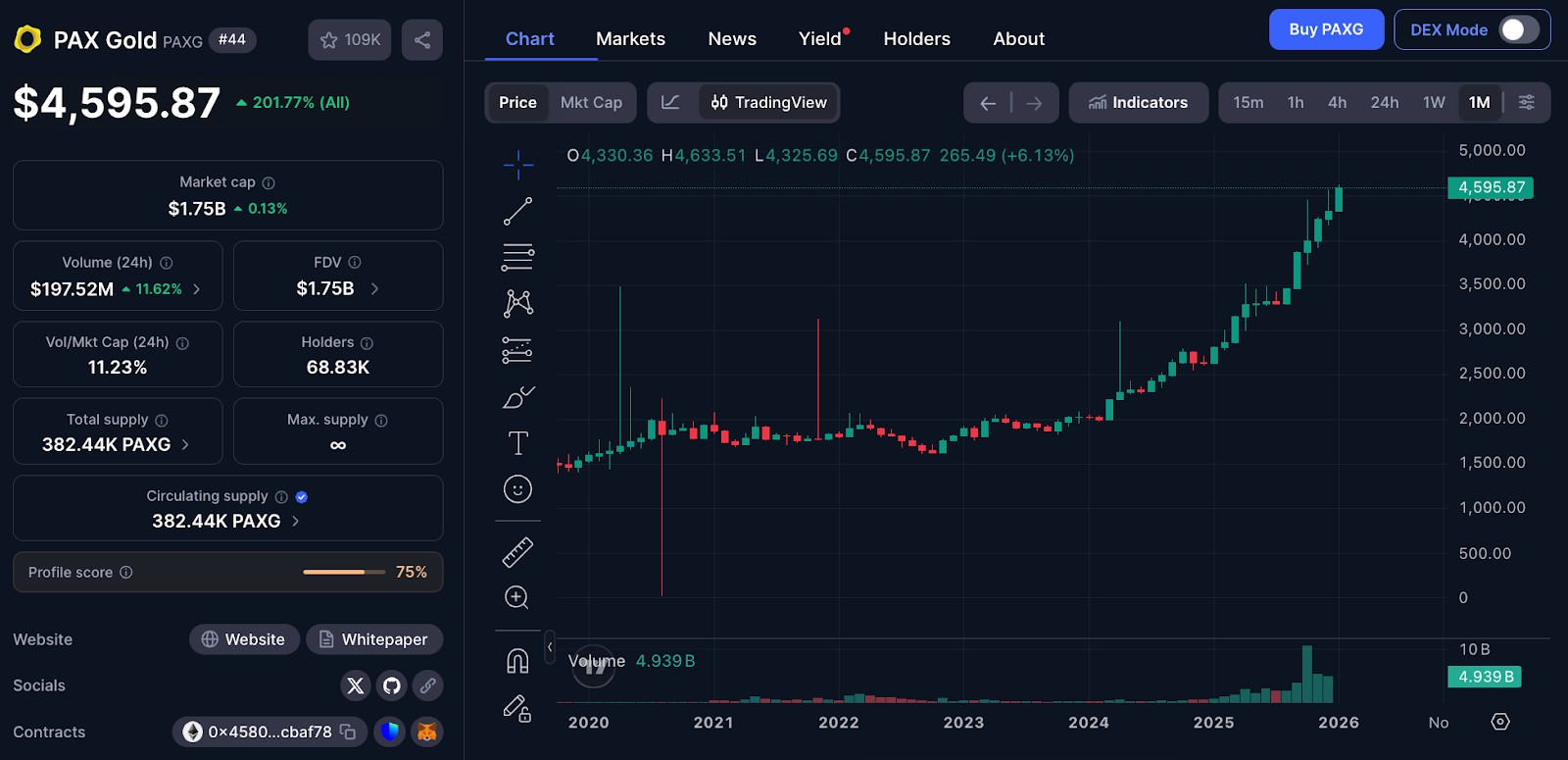
PAX Gold (PAXG), often referred to as Paxos Gold, is a regulated gold-backed stablecoin tied to London Good Delivery gold. Each token corresponds to one fine troy ounce of physical gold, with transparent reserve reporting.
Because of its regulatory framework and redeemability, PAX Gold is often cited when users search for the best gold-backed stablecoin for long-term holding. It is also actively used in decentralized finance, combining gold exposure with on-chain utility.
Kinesis Gold (KAU)
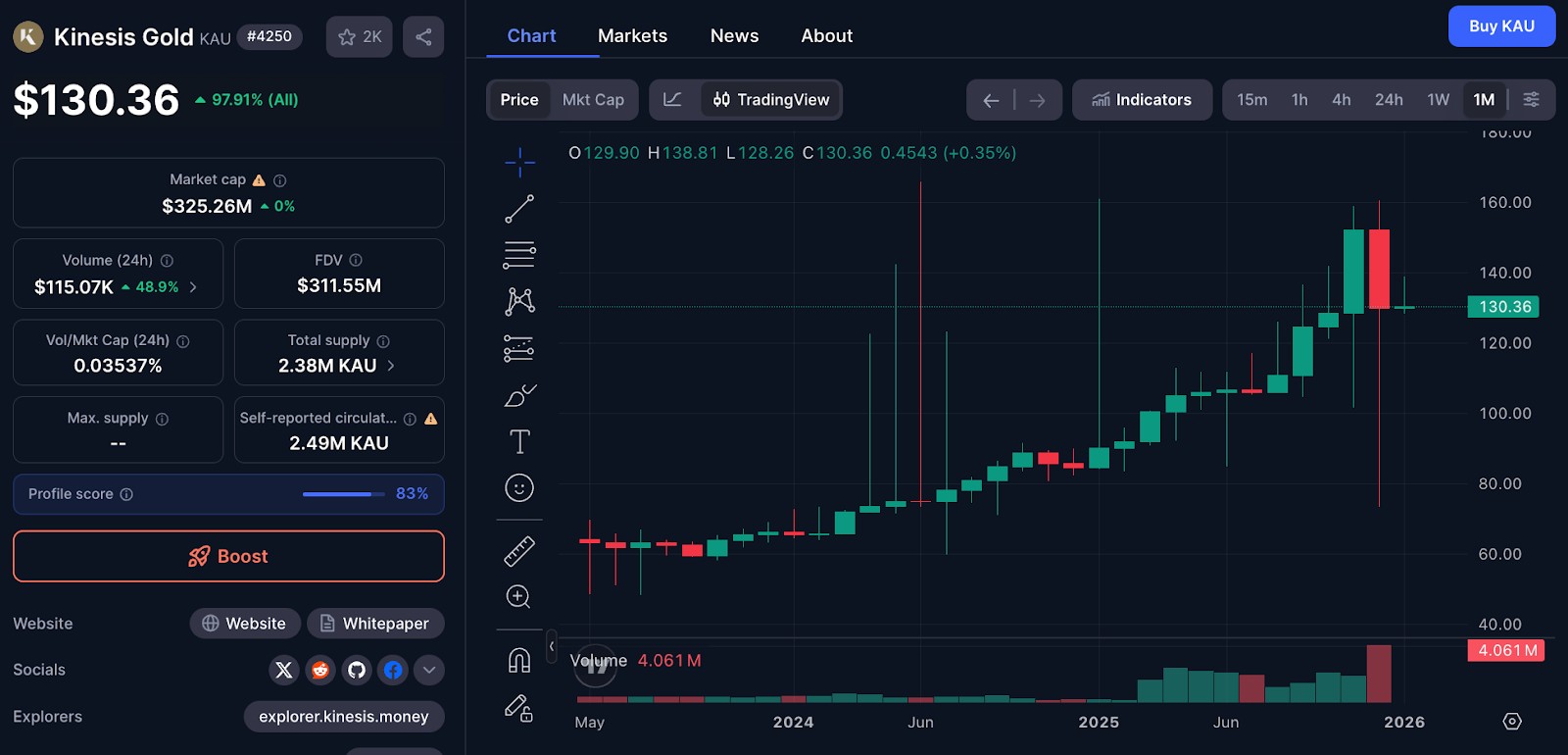
Kinesis Gold (KAU) represents one gram of physical gold stored in insured vaults. Unlike more passive gold-backed tokens, KAU is designed to function as both a store of value and a transactional asset within the Kinesis ecosystem.
KAU is sometimes described as a gold stablecoin because it maintains a close link to gold prices while supporting payments and transfers. Although it still qualifies as a stablecoin pegged to gold, its emphasis on usability differentiates it from traditional gold-backed stablecoins.
Cryptocurrencies pegged to gold
Gold-backed cryptocurrencies are linked to the value of gold but do not qualify as stablecoins by design. These assets use alternative mechanisms to reference gold prices rather than maintaining a strict reserve-backed peg.
Unlike gold-backed stablecoins, these cryptocurrencies may rely on tokenized funds, price indices, or synthetic models. Their value is influenced by gold, but it is not guaranteed through direct ownership of a fixed quantity of physical metal. This distinction explains why not every gold-backed cryptocurrency can be considered a stablecoin, even though both serve as forms of gold in crypto.
Gold Fund Tokens (GLDF)
Gold Fund Tokens (GLDF) are crypto assets linked to a basket of gold-related assets managed by an investment fund. Unlike traditional gold-backed stablecoins, GLDF does not maintain a strict 1:1 peg to physical ounces of gold at all times but instead reflects the overall value of the underlying portfolio. The token is designed for crypto portfolio diversification with gold as the reference asset.
Gold Index Coin (GIX)
Gold Index Coin (GIX) is an index-based token whose value is calculated from the aggregated price of gold and related financial instruments. This type of gold-linked cryptocurrency provides investors with exposure to gold through an index pricing mechanism rather than direct physical backing.
Gold Synthetic Asset (GSA)
Gold Synthetic Asset (GSA) is a synthetic asset built on smart contracts that tracks the price of gold using derivatives and oracle feeds. This structure enables price exposure to global gold markets without holding physical metal, making GSA an example of digital gold in crypto with an alternative collateral model.
Comparison of gold-backed crypto assets
Gold-related crypto assets differ not only in structure, but also in how closely they track gold prices, how transparent their backing is, and how they are typically used by investors. Looking at these differences side by side helps clarify the practical gap between gold-backed stablecoins and other forms of gold-backed cryptocurrencies.
Assets commonly described as gold-backed stablecoins are built around direct physical reserves. Each token corresponds to a specific quantity of gold held in vaults, which supports a tighter price relationship and clearer ownership logic. Because of this design, these assets are focused on capital preservation rather than trading flexibility.
By contrast, many gold-backed cryptocurrencies use indirect exposure. These may include tokenized fund shares, index-based pricing, or synthetic replication. They do not guarantee a fixed gold equivalent. As a result, price deviations are more likely, especially during periods of market stress.
| Asset type | Backing | Liquidity | Audit & transparency | Physical gold redemption |
|---|---|---|---|---|
| Gold-backed stablecoins | Physical gold stored in vaults | High | Regular reserve audits | Available with certain projects |
| Gold-pegged cryptocurrencies | Funds, indices, synthetic models | Medium or low | Depends on project structure | Usually not available |
Note! All gold-backed stablecoins are cryptocurrencies, but not every gold-linked cryptocurrency is a stablecoin. Some projects use gold merely as a reference, not as strict collateral.
How gold pegging works in cryptocurrencies
Gold pegging in crypto refers to the methods used to link a digital asset’s value to the price of gold. While the end goal is similar across projects, preserving exposure to gold, the underlying mechanisms vary significantly. These differences determine whether an asset qualifies as a gold-backed stablecoin or belongs to the broader category of gold-backed cryptocurrencies.
Understanding how gold is linked to crypto assets is essential before evaluating specific tokens. Some projects rely on physical gold reserves, while others use financial instruments or synthetic price tracking. Each approach carries different levels of stability, transparency, and risk.
Direct physical gold backing
The most straightforward model is direct backing with physical gold. In this case, the cryptocurrency is backed by gold stored in professional vaults, and each token represents a fixed quantity of metal. Reserve data is typically verified through audits or attestations.
This structure is characteristic of gold-backed stablecoins, where maintaining a close link to gold’s market value is a primary objective. These assets are generally designed for value preservation rather than speculative trading and are often used as defensive tools during periods of market volatility.
Tokenization of gold funds and assets
Some gold-backed cryptocurrencies do not hold physical gold directly. Instead, they represent ownership or exposure to gold through tokenized shares in funds or portfolios that invest in gold-related assets.
In this model, gold in crypto is accessed through financial structures rather than metal reserves. While the token’s value still depends on gold prices, it does not maintain a strict one-to-one relationship with physical ounces. These assets are typically more flexible but also introduce additional layers of financial and operational risk.
Synthetic and index-based models
A separate group of projects uses synthetic or index-based mechanisms to mirror gold prices. These cryptocurrencies rely on smart contracts, price oracles, and derivatives to track gold’s value without holding physical metal or fund shares.
This approach allows gold exposure within decentralized environments but increases reliance on technical infrastructure and market conditions. Such assets are considered gold-backed cryptocurrencies, but they are not stablecoins, as their value is not secured by direct reserves.
How investors use gold in cryptocurrency
Gold-linked digital assets – including gold-backed stablecoins and other gold-pegged cryptocurrencies – are practical tools for managing volatility, preserving value, and moving capital within the crypto ecosystem.
Key use cases:
Hedging market volatility. Investors shift funds into gold-backed crypto during sharp market swings to reduce exposure to high-risk assets without exiting into fiat.
Portfolio diversification. Adding gold exposure helps balance portfolios heavily tied to Bitcoin and altcoins. In this role, gold acts as a stabilizer, not a growth asset.
Value management on exchanges. Traders temporarily convert positions into gold-linked tokens to lock in value while staying within exchange infrastructure and liquidity pools.
Capital transfers between platforms. Gold-backed crypto assets are divisible and easily transferable, making them efficient instruments for moving funds across exchanges, wallets, and DeFi protocols.
Digital alternative to physical gold. Investors gain gold exposure without storage costs, physical custody risks, or limited market hours – maintaining continuous access via blockchain networks.
Pros and cons of gold-backed cryptocurrencies
- Pros
- Cons
Link to a real asset. Gold-backed cryptocurrencies derive their value from gold, which reduces reliance on speculative market sentiment and adds a layer of intrinsic value.
Digital accessibility. Exposure to gold through cryptocurrency removes the need to store or transport physical metal while allowing instant transfers and on-chain ownership.
Divisibility. Crypto-based gold assets make it possible to own and transfer fractional amounts of gold, lowering the entry barrier for retail investors.
Continuous market access. Gold-linked crypto assets can be traded around the clock on crypto platforms, unlike traditional gold markets with limited trading hours.
Ecosystem integration. Some gold-backed cryptocurrencies can be used within decentralized finance applications, enabling additional functionality beyond simple storage.
Custodial dependence. Most gold-backed stablecoins rely on third-party vaults and custodians, which introduces counterparty risk.
Liquidity constraints. Not all gold-backed cryptocurrencies have deep trading volumes, which can lead to wider spreads and slower execution.
Regulatory exposure. Assets tied to both cryptocurrency and gold may fall under multiple regulatory frameworks, increasing uncertainty.
Imperfect price tracking. Gold-linked cryptocurrencies that are not stablecoins may deviate from gold prices, especially during market stress.
Limited growth potential. These assets are generally designed for stability and capital preservation rather than aggressive returns.
Gold in crypto: How to choose the right one for your goals
Not all gold-related digital assets serve the same purpose. While they are often grouped under the umbrella of gold-backed cryptocurrencies, the way they track gold and the role they play in a portfolio can differ significantly. Choosing the right option starts with understanding how closely the asset is tied to gold and how you plan to use it.

When stability is the main priority
If the primary goal is preserving value with minimal price deviation, gold-backed stablecoins are usually the most appropriate choice. These assets are designed to maintain a close relationship with physical gold and are often listed among the best gold-backed stablecoins for conservative strategies. They are commonly used as a digital alternative to holding bullion and are better suited for storage than for active speculation.
When broader exposure matters more than a strict peg
Some investors prefer gold-backed cryptocurrencies that do not function as stablecoins. These assets still fall under the category of cryptocurrency backed by gold, but they reference gold through indices, funds, or synthetic mechanisms. While this approach may introduce more variability, it can also offer additional flexibility within a crypto portfolio.
When comparing reputation and reliability
Another important factor is trust. Projects differ in transparency, custody models, and regulatory oversight. For investors focused on safety, evaluating which assets are considered among the best gold-backed cryptocurrencies or which have a reputation for consistent reserve reporting can help narrow the field. Stablecoins backed by audited gold reserves typically rank higher in this regard than synthetic or index-based tokens.
When aligning the asset with a specific task
A practical way to decide is to match the asset type to its intended use:
Value preservation. Gold-backed stablecoins are generally better suited for holding value over time.
Portfolio diversification. Gold-linked cryptocurrencies can reduce reliance on Bitcoin and altcoins.
Operational flexibility. Some gold crypto assets are easier to move across platforms or integrate into broader crypto strategies.
Choosing the right crypto exchange
Selecting a cryptocurrency exchange is crucial when working with any digital asset, regardless of type or purpose. The platform’s reliability, user interface, and operational stability directly affect not only the trading experience but also the safety of your funds. This is especially important when dealing with cryptocurrency backed by gold, where a poor platform choice can negate the benefits of the asset itself. Below is a comparison table of major crypto exchanges based on key parameters, including trading conditions, accessibility, and security.
| Coinbase | OKX | Crypto.com | Kraken | Cryptohopper | |
|---|---|---|---|---|---|
|
Min. Deposit, $ |
10 | 10 | 1 | 10 | No |
|
Coins Supported |
249 | 329 | 250 | 278 | 1000 |
|
Spot Taker fee, % |
0.5 | 0.1 | 0.5 | 0.4 | 0 |
|
Spot Maker Fee, % |
0.5 | 0.08 | 0.25 | 0.25 | 0 |
|
Alerts |
Yes | Yes | Yes | Yes | Yes |
|
Copy trading |
No | Yes | No | Yes | Yes |
|
TU overall score |
8.6 | 8.48 | 8.44 | 8.32 | 7.85 |
|
Open an account |
Go to broker Your capital is at risk. |
Go to broker Your capital is at risk. |
Go to broker Your capital is at risk. |
Go to broker Your capital is at risk. |
Go to broker Your capital is at risk. |
Risks and warnings
Gold-linked crypto assets are often viewed as more stable than traditional cryptocurrencies, but they are not risk-free. Whether an investor is using a gold-backed stablecoin or another form of cryptocurrency backed by gold, it is important to understand the limitations.
Key risks to consider include:
Custody risk. Most gold-backed stablecoins depend on third-party vaults and custodians to store physical gold. If access to those reserves is disrupted, the value proposition of the asset may be affected.
Transparency limitations. Not all projects provide frequent or independent audits of gold reserves, which makes it harder to assess how securely the cryptocurrency is backed by gold.
Regulatory uncertainty. Assets that combine elements of crypto and commodities may fall under evolving regulatory frameworks, particularly for gold-backed cryptocurrencies operating across multiple jurisdictions.
Liquidity risk. Some gold-linked crypto assets have limited trading volume, which can result in wider spreads and difficulty exiting positions quickly.
Price deviation. Gold-backed cryptocurrencies that are not stablecoins may diverge from gold prices, especially during periods of market stress or low liquidity.
Technical exposure. Smart contract vulnerabilities, oracle failures, or platform outages can impact access to gold crypto assets, even when the underlying gold value remains stable.
Gold-backed crypto supports stability, not speculation

Over the years, I’ve come to view gold-backed crypto assets as a stabilizing layer rather than an investment driver. I’ve used gold-backed stablecoins during turbulent market phases to protect capital while keeping funds inside the crypto ecosystem. They didn’t boost returns, but they reduced pressure to make rushed decisions and helped me stay positioned while volatility played out.
What matters most is understanding structure. Stablecoins backed by gold behave very differently from other gold-linked cryptocurrencies that rely on indices or synthetic pricing. Treating them as interchangeable often leads to disappointment. In my experience, gold in crypto works best once an investor already has exposure to growth assets and needs balance, not excitement.
Conclusion
In the rapidly evolving world of digital finance, gold-backed stablecoins and cryptocurrencies offer a compelling fusion of traditional value and blockchain efficiency. While both provide exposure to gold, stablecoins like PAX Gold prioritize price stability and direct gold redemption, making them ideal for preservation-minded investors. In contrast, gold-backed cryptocurrencies may incorporate additional features such as staking rewards or yield generation, introducing both opportunities and added risk. Ultimately, the choice depends on whether you prioritize stability and tangible value or seek innovation and higher potential rewards. As the digital gold rush accelerates, discerning the nuance between these options will be key to maximizing both security and upside in your portfolio.
FAQs
What are the redeemability options for gold-backed stablecoins versus other gold-pegged cryptocurrencies?
How does liquidity differ between gold-backed stablecoins and other gold-linked crypto assets?
What factors should investors consider when selecting a gold-backed digital asset for value storage?
Are gold-backed cryptocurrencies affected by the operating hours of traditional gold markets?
Editors' Top Picks and Insights

Bitcoin mining is getting greener, but the debate isn't over

Asia's largest IPO: How CXMT became China's most valuable company

Global fintech in 2026: Three trends that matter

From Jesus Christ to aliens: Polymarket's most absurd prediction markets

Hunting crypto owners: Why criminals have gone offline

BitMEX is shutting down: Why Trump could not save the exchange
Related Articles
Team that worked on the article
Oleg Tkachenko is an economic analyst and risk manager having more than 14 years of experience in working with systemically important banks, investment companies, and analytical platforms. He has been a Traders Union analyst since 2018.
Dan Blystone began his trading career in 1998 as an arbitrage clerk on the floor of the Chicago Mercantile Exchange (CME). He later traded bond and Eurex futures at proprietary firms such as Altea Trading, gaining valuable experience in high-frequency trading and risk management.
Chinmay Soni is a financial analyst with more than 5 years of experience in working with stocks, Forex, derivatives, and other assets. As a founder of a boutique research firm and an active researcher, he covers various industries and fields, providing insights backed by statistical data.
Risk management is a risk management model that involves controlling potential losses while maximizing profits. The main risk management tools are stop loss, take profit, calculation of position volume taking into account leverage and pip value.
The deviation is a statistical measure of how much a set of data varies from the mean or average value. In forex trading, this measure is often calculated using standard deviation that helps traders in assessing the degree of variability or volatility in currency price movements.
Index in trading is the measure of the performance of a group of stocks, which can include the assets and securities in it.
An investor is an individual, who invests money in an asset with the expectation that its value would appreciate in the future. The asset can be anything, including a bond, debenture, mutual fund, equity, gold, silver, exchange-traded funds (ETFs), and real-estate property.
Volatility refers to the degree of variation or fluctuation in the price or value of a financial asset, such as stocks, bonds, or cryptocurrencies, over a period of time. Higher volatility indicates that an asset's price is experiencing more significant and rapid price swings, while lower volatility suggests relatively stable and gradual price movements.


-
 Afghanistan
-
 Albania
-
 Algeria
-
 Angola
-
 Argentina
-
 Armenia
-
 Australia
-
 Austria
-
 Azerbaijan
-
 Bahamas
-
 Bahrain
-
 Bangladesh
-
 Belarus
-
 Belgium
-
 Bolivia
-
 Botswana
-
 Brazil
-
 Brunei
-
 Bulgaria
-
 Cambodia
-
 Cameroon
-
 Canada
-
 Chile
Chile
-
 China
China
-
 Colombia
-
 Congo
Congo
-
 Costa Rica
-
 Cote d'Ivoire
-
 Croatia
-
 Cuba
Cuba
-
 Cyprus
-
 Czechia
-
 DR Congo
-
 Denmark
-
 Dominican Republic
-
 Ecuador
-
 Egypt
Egypt
-
 El Salvador
-
 Estonia
-
 Eswatini
-
 Ethiopia
-
 Finland
-
 France
-
 Georgia
-
 Germany
-
 Ghana
Ghana
-
 Greece
-
 Haiti
Haiti
-
 Hong Kong
-
 Hungary
-
 India
India
-
 Indonesia
-
 Iran, Islamic republic
-
 Iraq
Iraq
-
 Ireland
-
 Israel
-
 Italy
Italy
-
 Jamaica
-
 Japan
Japan
-
 Jordan
-
 Kazakhstan
-
 Kenya
Kenya
-
 Korea
Korea
-
 Kuwait
-
 Kyrgyzstan
-
 Laos
Laos
-
 Latvia
-
 Lebanon
-
 Lesotho
-
 Libya
Libya
-
 Lithuania
-
 Luxembourg
-
 Madagascar
-
 Malaysia
-
 Malta
Malta
-
 Mauritius
-
 Mexico
-
 Moldova
-
 Mongolia
-
 Montenegro
-
 Morocco
-
 Mozambique
-
 Myanmar
-
 Namibia
-
 Nepal
Nepal
-
 Netherlands
-
 New Zealand
-
 Nigeria
-
 North Macedonia
-
 Norway
-
 Oman
Oman
-
 Pakistan
-
 Palestine
-
 Panama
-
 Papua New Guinea
-
 Paraguay
-
 Peru
Peru
-
 Philippines
-
 Poland
-
 Portugal
-
 Puerto Rico
-
 Qatar
Qatar
-
 Reunion
-
 Romania
-
 Rwanda
-
 Saudi Arabia
-
 Serbia
-
 Singapore
-
 Slovakia
-
 Slovenia
-
 Somalia
-
 South Africa
-
 Spain
Spain
-
 Sri Lanka
-
 Sweden
-
 Switzerland
-
 Syria
Syria
-
 Taiwan
-
 Tajikistan
-
 Tanzania
-
 Thailand
-
 Trinidad and Tobago
-
 Tunisia
-
 Turkey
-
 UAE
UAE
-
 Uganda
-
 Ukraine
-
 United Kingdom
-
United States
-
 Uruguay
-
 Uzbekistan
-
 Venezuela
-
 Vietnam
-
 Yemen
Yemen
-
 Zambia
-
 Zimbabwe
- Forex
- Crypto










- Top stablecoins pegged to gold
- Cryptocurrencies pegged to gold
- Comparison of gold-backed crypto assets
- How gold pegging works in cryptocurrencies
- How investors use gold in cryptocurrency
- Pros and cons of gold-backed cryptocurrencies
- Gold in crypto: How to choose the right one for your goals
- Choosing the right crypto exchange
- Risks and warnings
- Expert opinion
- Conclusion
- FAQs


