
Singapore Dollar Stablecoin (XSGD): Guide For Traders And Institutions


Editorial Note: While we adhere to strict Editorial Integrity, this post may contain references to products from our partners. Here's an explanation for How We Make Money. None of the data and information on this webpage constitutes investment advice according to our Disclaimer.
The Singapore dollar backed stablecoin used in 2026 is XSGD, a fiat-backed digital asset issued under Singapore’s regulatory framework. XSGD is pegged 1:1 to the SGD and backed by reserves held in MAS-regulated banks, making it suitable for compliant settlement, trading, and on-chain payments. Issued by a Singapore-regulated entity and operating within the Monetary Authority of Singapore’s stablecoin framework, XSGD is widely used for compliant settlement, trading, and on-chain payments.
The market for Singapore dollar backed stablecoins has matured significantly by 2026, driven by tighter regulation, institutional demand, and practical settlement needs. Unlike offshore stablecoins, a SGD-pegged digital asset issued in Singapore is designed to operate within a clearly defined legal and financial framework.
As adoption expands, the stablecoin ecosystem in Singapore is increasingly used for trading, payments, and low-volatility settlement across multiple blockchains. Understanding how the SGD stablecoin works, where it is used, and how it differs from other stablecoins in Singapore is essential for traders and institutions operating in regulated digital markets.
Risk warning: Cryptocurrency markets are highly volatile, with sharp price swings and regulatory uncertainties. Research indicates that 75-90% of traders face losses. Only invest discretionary funds and consult an experienced financial advisor.
Singapore dollar stablecoin explained
A stablecoin is a digital asset designed to track the value of a fiat currency while operating on blockchain networks. Its purpose is to enable fast, programmable transactions without the price volatility seen in most cryptocurrencies.
A SGD stablecoin is pegged to the Singapore dollar and backed by fiat reserves. This structure allows users to move value on-chain while maintaining exposure to a stable national currency. In practice, stablecoins are used for payments, trading, settlement, and treasury management where predictability matters.
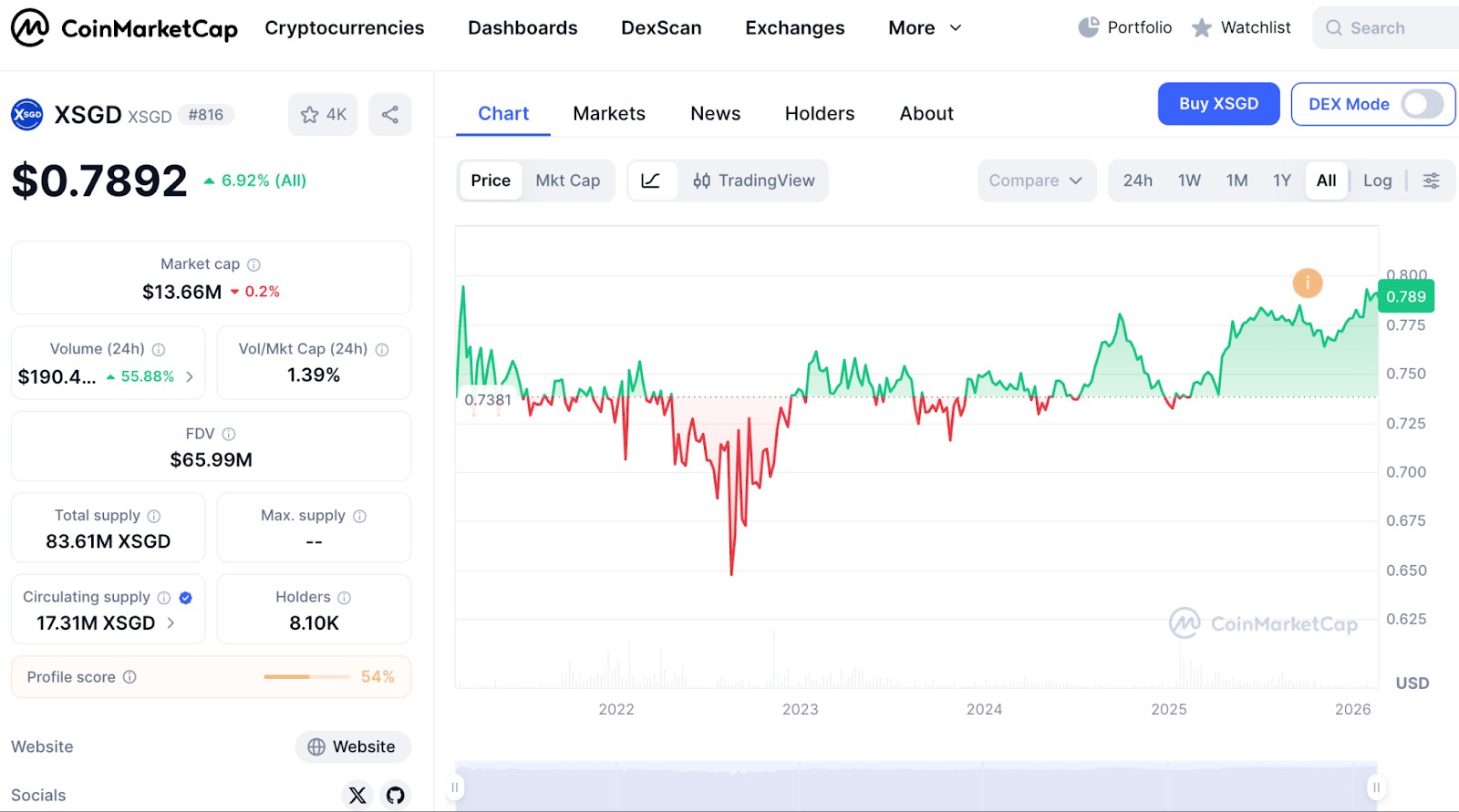
Peg structure and liquidity
The reliability of a Singapore dollar backed stablecoin depends on how its peg is maintained and how easily users can enter or exit positions. For traders and institutions, these mechanics matter more than branding or network count.
Peg mechanism. XSGD stablecoin is pegged 1:1 to the SGD, meaning each token represents one Singapore dollar held in reserve.
Reserve backing. The SGD stablecoin is fully backed by fiat reserves, not algorithmic models or crypto collateral.
Custody model. Fiat reserves are held in segregated accounts with regulated financial institutions in Singapore, in line with Monetary Authority of Singapore requirements, reducing counterparty and custody risk.
Audit process. Regular reserve attestations are published to verify backing and circulation alignment.
Redemption access. Token holders can redeem XSGD through approved platforms, supporting price stability during market stress.
Liquidity profile. On-chain liquidity is concentrated on major networks, enabling efficient swaps and low slippage for typical trade sizes.
De-pegging history. XSGD has generally traded close to its 1:1 SGD peg, with only minor and temporary deviations observed during periods of market volatility.
To use XSGD effectively, access to the right trading venue matters just as much as understanding the peg structure and regulation behind it. Not every platform supports SGD-based pairs or provides reliable liquidity for Singapore dollar stablecoins. The comparison below highlights crypto exchanges available in your region where you can access and manage assets like XSGD within a regulated trading environment.
| Coinbase | OKX | BTCC | Cryptohopper | Crypto.com | |
|---|---|---|---|---|---|
|
Min. Deposit, $ |
10 | 10 | 10 | No | 1 |
|
Coins Supported |
400+ | 600+ | 399 | 1000 | 400+ |
|
Spot Taker fee, % |
0.5 | 0.1 | 0.3 | 0 | 0.5 |
|
Spot Maker Fee, % |
0.5 | 0.08 | 0.2 | 0 | 0.25 |
|
Alerts |
Yes | Yes | No | Yes | Yes |
|
Copy trading |
No | Yes | Yes | Yes | No |
|
TU overall score |
8.5 | 8.46 | 8.08 | 7.8 | 7.76 |
|
Open an account |
Go to broker Your capital is at risk. |
Go to broker Your capital is at risk. |
Go to broker Your capital is at risk.
|
Go to broker Your capital is at risk. |
Go to broker Your capital is at risk. |
XSGD network usage and adoption trends in 2026
The latest available data from StraitsX and Cointelegraph reveals an ecosystem with deepening activity and growing trust among both institutional and retail participants. Here’s a snapshot of key performance metrics for stablecoin adoption in Singapore:
| Metric | Value |
|---|---|
| Primary usage | Payments, settlement, trading |
| Circulating supply (approx) | ~16–18M XSGD (variable) |
| Market cap estimate (USD) | ~US$12–14M (approx.) |
| Supported blockchains | Multi-chain |
The transaction volumes and global distribution of active addresses highlight the ongoing utility and acceptance of the SGD stablecoin across decentralized ecosystems.
Solana integration and settlement innovations
In 2026, the planned native deployment of XSGD on Solana represents a technical expansion aimed at faster settlement and lower transaction costs, particularly for institutional and high-frequency use cases.
Native deployment. XSGD is issued directly on Solana rather than bridged, reducing complexity and smart contract risk.
Near-instant settlement. Sub-second finality enables rapid clearing for high-frequency transfers and on-chain trading activity.
Low transaction costs. Typical fees remain negligible, improving efficiency for small and frequent SGD-based transactions.
Cross-chain routing. Solana complements existing networks by acting as a high-speed settlement layer within the broader multi-chain setup.
Institutional relevance. Faster execution supports use cases such as treasury movement, Forex-related settlement, and internal liquidity routing.
Multi-chain deployment and access
One of the key strengths of XSGD is its broad multi-chain availability. Rather than relying on a single network, XSGD is deployed across several blockchains to support different settlement speeds, cost profiles, and use cases.
This approach allows traders and institutions to choose the most efficient environment depending on whether they prioritize low fees, fast finality, or integration with specific DeFi and payment systems. As a result, the stablecoin ecosystem in Singapore supports both retail transactions and institutional workflows without forcing users into a single infrastructure.
The table below summarizes how XSGD is deployed across major networks in 2026, highlighting transaction costs, settlement speed, and primary use cases.
| Blockchain | Transaction cost (avg) | Settlement speed | XSGD availability | Use case highlights |
|---|---|---|---|---|
| Ethereum | ~$1.00–$1.50 | ~15 sec | Yes | DeFi, lending, swaps |
| Polygon | <$0.01 | ~2 sec | Yes | Retail payments, cheap swaps |
| Arbitrum | <$0.05 | ~2–3 sec | Yes | High-speed DeFi |
| Avalanche | <$0.10 | ~3 sec | Yes | Treasury and DEX liquidity |
| Zilliqa | Negligible | ~30 sec | Yes | SG-native chain payments |
| Hedera | <$0.01 | ~5 sec | Yes | Corporate payment pilots |
| XRP Ledger | <$0.001 | ~4 sec | Yes | RippleNet integration, FX rails |
| Solana | <$0.01 | <1 sec | Planned 2026 | Ultra-fast swaps, institutional rails |
Trading and hedging with XSGD
XSGD is primarily used as a low-volatility instrument for trading, hedging, and settlement rather than as a speculative asset. Its value comes from predictable pricing and multi-chain accessibility.
SGD exposure without fiat rails. XSGD allows traders to maintain exposure to the SGD stablecoin without relying on traditional banking infrastructure, which is useful when direct fiat settlement is slow or unavailable.
Forex proxy usage. In crypto markets that do not offer direct SGD pairs, XSGD functions as a synthetic substitute for holding Singapore dollars on-chain.
Pair trading and rotation. Traders use XSGD in pairs against USD stablecoins or major crypto assets to manage currency exposure during regional macro events.
Cross-platform settlement. XSGD enables transfers between centralized exchanges, decentralized platforms, and wallets without converting back to fiat.
Treasury and risk management. Institutions use XSGD to park capital in a non-volatile asset while retaining the ability to deploy funds quickly across chains.
Because of these characteristics, stablecoins in Singapore like XSGD are often integrated into broader trading and hedging strategies where capital efficiency and settlement certainty matter more than yield generation.
XSGD use cases and strategies
The XSGD is used most effectively when integrated into specific operational or trading workflows. Its value comes from stability, regulatory clarity, and on-chain flexibility rather than speculative upside.
Forex settlement proxy. Traders use XSGD to settle SGD-denominated positions on-chain when direct fiat settlement is unavailable, reducing FX friction and settlement delays.
Cross-border payments. XSGD supports fast transfers between Singapore-based platforms and offshore counterparties, helping businesses align payments with local accounting and tax requirements.
Arbitrage execution. Price differences between centralized exchanges and decentralized liquidity pools allow short-term arbitrage opportunities, especially during regional news or low-liquidity periods.
Treasury parking. Corporate and DAO treasuries use XSGD to hold idle capital in a SGD-aligned asset while maintaining immediate deployability across multiple blockchains.
DeFi liquidity and collateral. On supported platforms, XSGD can be supplied to liquidity pools or used as collateral, enabling yield generation without exposing capital to currency volatility.

These strategies highlight how stablecoins in Singapore are used as functional financial tools. For traders and institutions, success with XSGD depends on liquidity access, redemption clarity, and disciplined allocation rather than aggressive risk-taking.
Regulatory and market outlook
The outlook for the Singapore dollar backed stablecoin market is closely tied to regulatory consistency and cross-border interoperability. Singapore continues to position itself as a reference jurisdiction for compliant digital assets rather than a high-growth experimental market.
Regulatory clarity. The Monetary Authority of Singapore maintains clear rules around reserve backing, audits, and redemption for fiat-backed stablecoins, which supports long-term trust.
Market stability over scale. Unlike jurisdictions focused on rapid expansion, Singapore prioritizes controlled growth, limiting systemic risk while supporting real-world use.
Institutional alignment. Banks, payment providers, and fintech firms increasingly treat XSGD as settlement infrastructure rather than a trading product.
Cross-border compatibility. As other regions introduce stablecoin frameworks, XSGD is well positioned to integrate with regulated corridors linking Asia-Pacific, Europe, and selected U.S. platforms.
CBDC coexistence. Singapore’s approach suggests stablecoins and central bank digital currency initiatives can operate in parallel, serving different settlement and programmability needs.
Overall, the stablecoin ecosystem in Singapore is expected to grow steadily rather than explosively. Value creation will come from compliance, interoperability, and integration into existing financial workflows rather than from speculative demand.
| Jurisdiction | Regulation status | Reserve requirements | Audit required | Example stablecoins |
|---|---|---|---|---|
| Singapore (MAS) | Finalized (2023) | 100% fiat reserve, audit mandatory | Yes, monthly | XSGD, XUSD |
| European Union | Phased under MiCAR (2024–2026) | Asset-backed, reserve rules under MiCAR | Yes (MiCAR) | EURe, Circle EU pilot |
| United States | Proposed legislation, not finalized | Unclear, varies by use-case | No federal rule yet | USDC, PYUSD |
| Japan (FSA) | Operational rules (2023) | Reserve custody in licensed banks is required | Yes, mandatory | JPYC, MUFG coin |
| United Kingdom | Consultation phase (2026) | Not defined, pending stablecoin bill | TBD | GBP stablecoin trials |
| Hong Kong (SFC) | Draft guidance issued (2025) | Local reserves expected for issuers | Expected | HKD stablecoin pilots |
XSGD is infrastructure, not speculation

In my view, the Singapore dollar backed stablecoin XSGD works best when treated as settlement infrastructure rather than a trading instrument. Its real strength lies in regulatory clarity, predictable redemption, and multi-chain accessibility, which matter far more than short-term yield or volume.
Traders and institutions using XSGD effectively tend to focus on liquidity routing, currency exposure management, and operational efficiency, especially in Asia-Pacific flows. I generally advise prioritizing platforms with clear audit disclosures and reliable on-off ramps, since these determine whether a stablecoin can be used confidently at scale. When integrated carefully, XSGD improves capital mobility and reduces friction without adding unnecessary risk.
Conclusion
XSGD stands out as a robust and compliant digital asset, offering traders and institutions the security of fiat-backed reserves alongside the flexibility of multi-chain deployment. Rather than chasing speculative gains, its primary value lies in facilitating seamless settlement, payments, and liquidity routing across regional and global platforms. For example, businesses can use XSGD to streamline cross-border payments or manage treasury reserves efficiently while staying within Singapore’s clear regulatory framework. As the stablecoin ecosystem evolves, the real edge will belong to assets like XSGD that serve as trusted infrastructure, making capital movement smarter and safer for modern digital finance.
FAQs
How does XSGD maintain its price stability and what factors could temporarily affect its peg?
Which blockchains currently support XSGD and how does multi-chain deployment benefit users?
What are common use cases for XSGD beyond standard trading activities?
How does Singapore’s regulatory approach to stablecoins differ from other major jurisdictions?
Editors' Top Picks and Insights






Related Articles
Team that worked on the article
Aleksandra Chaikina has been a contributor to Traders Union since 2021. With over 15 years of experience in copywriting and more than 5 years focused on financial content, she specializes in producing detailed guides, analytics, and comparative reviews across various sectors, including cryptocurrencies, Forex, investment strategies, and financial technologies.
Dan Blystone began his trading career in 1998 as an arbitrage clerk on the floor of the Chicago Mercantile Exchange (CME). He later traded bond and Eurex futures at proprietary firms such as Altea Trading, gaining valuable experience in high-frequency trading and risk management.
Chinmay Soni is a financial analyst with more than 5 years of experience in working with stocks, Forex, derivatives, and other assets. As a founder of a boutique research firm and an active researcher, he covers various industries and fields, providing insights backed by statistical data.
The deviation is a statistical measure of how much a set of data varies from the mean or average value. In forex trading, this measure is often calculated using standard deviation that helps traders in assessing the degree of variability or volatility in currency price movements.
Bitcoin is a decentralized digital cryptocurrency that was created in 2009 by an anonymous individual or group using the pseudonym Satoshi Nakamoto. It operates on a technology called blockchain, which is a distributed ledger that records all transactions across a network of computers.
Yield refers to the earnings or income derived from an investment. It mirrors the returns generated by owning assets such as stocks, bonds, or other financial instruments.
CFD is a contract between an investor/trader and seller that demonstrates that the trader will need to pay the price difference between the current value of the asset and its value at the time of contract to the seller.
Volatility refers to the degree of variation or fluctuation in the price or value of a financial asset, such as stocks, bonds, or cryptocurrencies, over a period of time. Higher volatility indicates that an asset's price is experiencing more significant and rapid price swings, while lower volatility suggests relatively stable and gradual price movements.

-
 Afghanistan
-
 Albania
-
 Algeria
-
 Angola
-
 Argentina
-
 Armenia
-
 Australia
-
 Austria
-
 Azerbaijan
-
 Bahamas
-
 Bahrain
-
 Bangladesh
-
 Belarus
-
 Belgium
-
 Bolivia
-
 Botswana
-
 Brazil
-
 Brunei
-
 Bulgaria
-
 Cambodia
-
 Cameroon
-
 Canada
-
 Chile
Chile
-
 China
China
-
 Colombia
-
 Congo
Congo
-
 Costa Rica
-
 Cote d'Ivoire
-
 Croatia
-
 Cuba
Cuba
-
 Cyprus
-
 Czechia
-
 DR Congo
-
 Denmark
-
 Dominican Republic
-
 Ecuador
-
 Egypt
Egypt
-
 El Salvador
-
 Estonia
-
 Eswatini
-
 Ethiopia
-
 Finland
-
 France
-
 Georgia
-
 Germany
-
 Ghana
Ghana
-
 Greece
-
 Haiti
Haiti
-
 Hong Kong
-
 Hungary
-
 India
India
-
 Indonesia
-
 Iran, Islamic republic
-
 Iraq
Iraq
-
 Ireland
-
 Israel
-
 Italy
Italy
-
 Jamaica
-
 Japan
Japan
-
 Jordan
-
 Kazakhstan
-
 Kenya
Kenya
-
 Korea
Korea
-
 Kuwait
-
 Kyrgyzstan
-
 Laos
Laos
-
 Latvia
-
 Lebanon
-
 Lesotho
-
 Libya
Libya
-
 Lithuania
-
 Luxembourg
-
 Madagascar
-
 Malaysia
-
 Malta
Malta
-
 Mauritius
-
 Mexico
-
 Moldova
-
 Mongolia
-
 Montenegro
-
 Morocco
-
 Mozambique
-
 Myanmar
-
 Namibia
-
 Nepal
Nepal
-
 Netherlands
-
 New Zealand
-
 Nigeria
-
 North Macedonia
-
 Norway
-
 Oman
Oman
-
 Pakistan
-
 Palestine
-
 Panama
-
 Papua New Guinea
-
 Paraguay
-
 Peru
Peru
-
 Philippines
-
 Poland
-
 Portugal
-
 Puerto Rico
-
 Qatar
Qatar
-
 Reunion
-
 Romania
-
 Rwanda
-
 Saudi Arabia
-
 Serbia
-
 Singapore
-
 Slovakia
-
 Slovenia
-
 Somalia
-
 South Africa
-
 Spain
Spain
-
 Sri Lanka
-
 Sweden
-
 Switzerland
-
 Syria
Syria
-
 Taiwan
-
 Tajikistan
-
 Tanzania
-
 Thailand
-
 Trinidad and Tobago
-
 Tunisia
-
 Turkey
-
 UAE
UAE
-
 Uganda
-
 Ukraine
-
 United Kingdom
-
United States
-
 Uruguay
-
 Uzbekistan
-
 Venezuela
-
 Vietnam
-
 Yemen
Yemen
-
 Zambia
-
 Zimbabwe
- Forex
- Crypto












