
Germany’s Crypto Investments: An Overview



Editorial Note: While we adhere to strict Editorial Integrity, this post may contain references to products from our partners. Here's an explanation for How We Make Money. None of the data and information on this webpage constitutes investment advice according to our Disclaimer.
In early 2024, German authorities seized about 50.000 bitcoins, worth roughly $2.17 billion, from criminal activities, especially the Movie2K piracy case. Between mid-June and mid-July 2024, the government sold these bitcoins, bringing in around $2.88 billion, averaging $57,900 per coin. This made their overall holdings near to zero. These sales caused short-term price drops of 5-10%. Looking ahead, Germany plans to tighten cryptocurrency regulations, develop a central bank digital currency (CBDC), and adopt blockchain technology in the public sector.
The German government holds a large amount of Bitcoin, mostly seized from criminal cases. Over the years, it has both kept and sold digital assets, influencing crypto prices and sparking regulatory debates in Europe.
Breakdown of Germany’s cryptocurrency holdings
Back in January 2024, the German government had about 50.000 Bitcoins, mostly taken from the piracy site Movie2K.to. At that time, these were worth around $2.1 billion.
Between June and July 2024, they started selling off these Bitcoins:
June 19, 2024. They moved about 6.500 BTC, sending some to exchanges like Kraken, Bitstamp, and Coinbase.
July 2, 2024. They transferred some BTC to major exchanges, including Bitstamp, Coinbase, and Kraken.
July 8, 2024. Another batch of BTC was sent to exchanges and market makers.
July 11, 2024. More BTC was moved to platforms like Kraken, Bitstamp, and Coinbase.
July 12, 2024. They sold off the last of their Bitcoin holdings, moving about 3,846 BTC.
Over these weeks, Germany went from holding nearly 50.000 BTC to none. They spread out the sales across different exchanges and market makers to avoid shaking up the market too much.
While Bitcoin made up most of Germany's crypto stash, we don't know much about whether they had other digital currencies like Ethereum or stablecoins. The spotlight has mainly been on Bitcoin because of its high value and the size of the seizure.
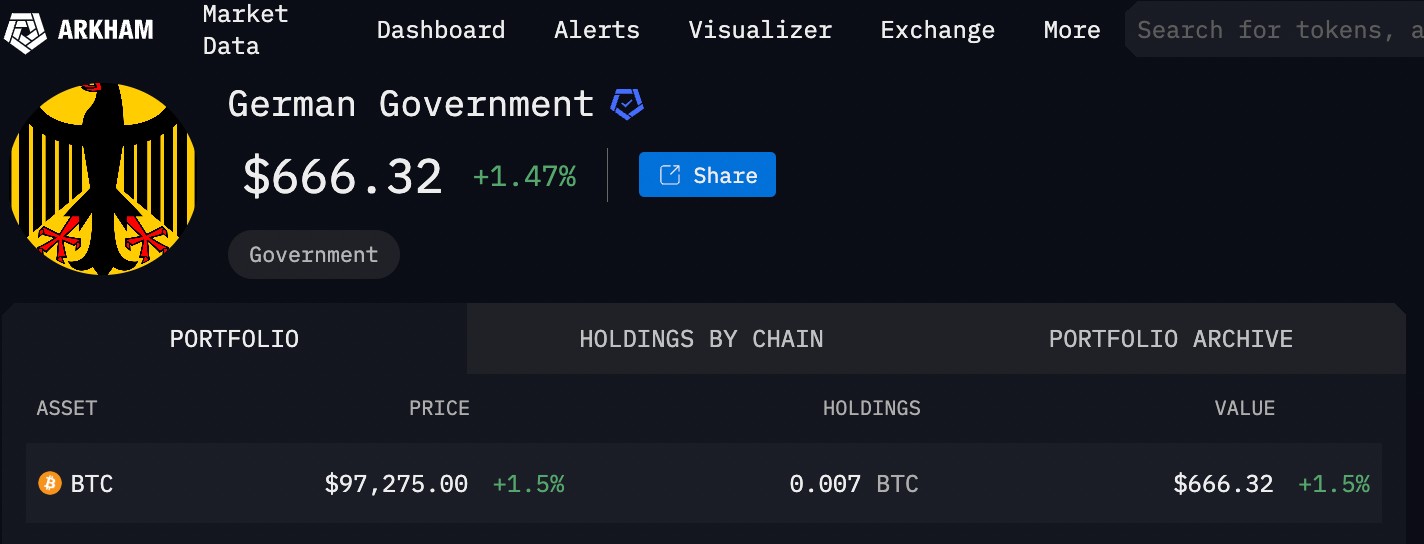
German government’s crypto sales and market reactions
The German government's recent Bitcoin sales have significantly influenced the cryptocurrency market. Here's what you should know:
Timing affects potential profits. Following the sales, Bitcoin's value surpassed $100,000, suggesting that holding the assets longer could have yielded an additional $2.35 billion for the government.
Strategic considerations for asset liquidation. The approach to selling seized cryptocurrencies varies by country; Germany's rapid liquidation contrasts with more measured strategies, such as the U.S. government's use of auctions, highlighting the importance of timing and method in asset disposal.
Ethical considerations and regulatory scrutiny
Germany's method of dealing with seized cryptocurrencies has ignited discussions about the ethics and regulations of such practices.
Impact on market stability. Selling off large amounts of confiscated Bitcoin, like Germany's mid-2024 sale of nearly 50,000 BTC, can disrupt the market, leading to price swings and shaking investor trust.
Missed financial opportunities. By selling seized Bitcoin too soon, Germany missed out on potential gains; offloading at $54,000 per BTC in 2024 led to a $1.7 billion loss compared to later higher prices.
Legal obligations versus strategic holding. German laws require selling seized assets to avoid losing value during long legal cases, but some argue that holding onto assets like Bitcoin could better serve public finances.
Regulatory compliance and transparency. It's essential that selling seized cryptocurrencies follows anti-money laundering rules and is done openly to keep public trust and meet legal requirements.
Ethical use of proceeds. Deciding how to use the money from crypto sales involves moral choices; whether to fund public services, help crime victims, or other uses shows the government's values and ethics.
Germany’s cryptocurrency strategy

Germany has a well-defined blockchain and crypto strategy aimed at integrating digital assets into its financial ecosystem while maintaining strict oversight. Key initiatives include:
Blockchain strategy implementation. Germany has incorporated blockchain technology into its regulatory framework.
Public sector innovation. Exploring digital currency use cases within government operations.
EU compliance. Aligning with broader European cryptocurrency regulations.
Future outlook: What’s next for Germany in crypto?
Germany is positioning itself as a leader in the cryptocurrency landscape, with several unique developments on the horizon.
MiCA regulations are reshaping the market. The Markets in Crypto-Assets Regulation (MiCA), effective since December 2024, provides a unified legal framework across the EU. This clarity is attracting major crypto exchanges to establish operations in Germany, enhancing market stability and consumer trust.
Tax policies favor long-term holders. Germany's tax laws exempt individuals from paying taxes on cryptocurrency gains if the assets are held for more than one year. This policy encourages investors to adopt long-term strategies, potentially reducing market volatility.
Digital euro is on the horizon. The European Central Bank is progressing toward introducing a digital euro, with a decision expected by the end of 2025. This initiative aims to provide a secure, central bank-backed digital currency, complementing existing payment systems and potentially integrating with the crypto ecosystem.
Political shifts could influence crypto adoption. The upcoming German parliamentary election on February 23, 2025, features parties with varying stances on cryptocurrency regulation. The election outcomes could significantly impact the country's crypto policies, affecting both investors and businesses.
Enhanced regulatory oversight is imminent. Germany's Federal Financial Supervisory Authority (BaFin) is intensifying its focus on cryptocurrency transactions, implementing stringent measures to combat money laundering and ensure compliance. This increased oversight aims to foster a secure and transparent crypto environment.
Risks and warnings
Regulations are changing. Germany treats cryptocurrencies like regular financial products. This means if you're trading or holding crypto for others, you need approval from BaFin, the country's financial watchdog. Using services without this approval can get you into legal trouble and might cost you money.
Scams are becoming more common. Lately, there's been a spike in crypto investment scams. Fraudsters use clever tricks, like fake websites and unexpected offers that seem too good to pass up. Earlier this year, some people in Germany lost a lot of money to these scams. Always double-check investment offers and consult official sources before jumping in.
Environmental rules matter. Germany is big on going green, so there's a close watch on crypto mining because it uses a lot of energy. This means some crypto activities might face restrictions or even bans to protect the environment.
Taxes have their own rules. If you hold onto your cryptocurrency for over a year before selling, you won't owe taxes on it in Germany. But if you sell sooner, you might have to pay up. Knowing these details can help you plan better and stay on the right side of the law.
Germany’s political scenario can significantly impact the crypto market

Understanding Germany's changing rules on cryptocurrencies is more than just knowing the basics; it requires strategic thinking and flexibility. As of February 2025, the political scene is set for big changes, with the federal election on February 23rd possibly altering financial laws, including those for digital currencies. For example, the Alternative for Germany (AfD) party wants to loosen regulations on Bitcoin and other cryptocurrencies to encourage growth and use in this area.
On the other hand, some parties are pushing for tighter controls, which could affect how digital currencies are bought and sold. If you're new to this, it's important to keep up with these political changes, as they can directly affect your investment choices and the laws around cryptocurrencies in Germany.
Besides keeping an eye on politics, think about spreading your crypto investments to include assets that match Germany's possible new regulations. For instance, if rules become more relaxed, putting money into decentralized finance (DeFi) projects might be a good move, as they could grow faster in a freer setting.
Also, understanding tax rules is key. Germany has good tax benefits for long-term crypto investments; if you hold assets for more than a year, you don't have to pay taxes on them. Planning how long you keep your investments can help you save on taxes. Joining local crypto groups and online discussions can also give you up-to-date advice and support from others, making it easier to handle the challenges of the German crypto market with confidence.
Conclusion
Germany’s crypto portfolio highlights the intersection between government intervention and digital asset markets. While its Bitcoin reserves have played a role in shaping price movements and regulatory discourse, the long-term strategy remains uncertain. Traders should remain cautious of large-scale governmental liquidations and their potential market implications.
FAQs
What cryptocurrencies are in the German government’s crypto portfolio?
Primarily Bitcoin (BTC), with possible minor Ethereum (ETH) and stablecoin holdings from law enforcement seizures.
How much is Germany’s crypto portfolio worth?
Estimates varied, but before recent sell-offs, Germany controlled over $3 billion in Bitcoin at one point.
How does Germany handle seized crypto assets?
Seized assets are typically auctioned or liquidated through government-regulated exchanges.
Does Germany plan to keep its Bitcoin holdings?
The government has actively sold portions of its holdings, indicating a preference for liquidation rather than long-term investment.
Editors' Top Picks and Insights

The privacy paradox: How the crypto mixer market has changed

Is Bitcoin right for you? Five traits shared by many cryptocurrency holders

Chasing hits: Why investors are losing interest in Netflix

Tokenized stocks in the spotlight: How do they work and are they worth trading?

Do politicians make the best stock traders?

Crypto test drive: How automakers are exploring digital assets
Related Articles
Team that worked on the article
Oleg Tkachenko is an economic analyst and risk manager having more than 14 years of experience in working with systemically important banks, investment companies, and analytical platforms. He has been a Traders Union analyst since 2018.
Chinmay Soni is a financial analyst with more than 5 years of experience in working with stocks, Forex, derivatives, and other assets. As a founder of a boutique research firm and an active researcher, he covers various industries and fields, providing insights backed by statistical data.
Mirjan Hipolito is a journalist and news editor at Traders Union. She is an expert crypto writer with five years of experience in the financial markets.

-
 Afghanistan
-
 Albania
-
 Algeria
-
 Angola
-
 Argentina
-
 Armenia
-
 Australia
-
 Austria
-
 Azerbaijan
-
 Bahamas
-
 Bahrain
-
 Bangladesh
-
 Belarus
-
 Belgium
-
 Bolivia
-
 Botswana
-
 Brazil
-
 Brunei
-
 Bulgaria
-
 Cambodia
-
 Cameroon
-
 Canada
-
 Chile
Chile
-
 China
China
-
 Colombia
-
 Congo
Congo
-
 Costa Rica
-
 Cote d'Ivoire
-
 Croatia
-
 Cuba
Cuba
-
 Cyprus
-
 Czechia
-
 DR Congo
-
 Denmark
-
 Dominican Republic
-
 Ecuador
-
 Egypt
Egypt
-
 El Salvador
-
 Estonia
-
 Eswatini
-
 Ethiopia
-
 Finland
-
 France
-
 Georgia
-
 Germany
-
 Ghana
Ghana
-
 Greece
-
 Haiti
Haiti
-
 Hong Kong
-
 Hungary
-
 India
India
-
 Indonesia
-
 Iran, Islamic republic
-
 Iraq
Iraq
-
 Ireland
-
 Israel
-
 Italy
Italy
-
 Jamaica
-
 Japan
Japan
-
 Jordan
-
 Kazakhstan
-
 Kenya
Kenya
-
 Korea
Korea
-
 Kuwait
-
 Kyrgyzstan
-
 Laos
Laos
-
 Latvia
-
 Lebanon
-
 Lesotho
-
 Libya
Libya
-
 Lithuania
-
 Luxembourg
-
 Madagascar
-
 Malaysia
-
 Malta
Malta
-
 Mauritius
-
 Mexico
-
 Moldova
-
 Mongolia
-
 Montenegro
-
 Morocco
-
 Mozambique
-
 Myanmar
-
 Namibia
-
 Nepal
Nepal
-
 Netherlands
-
 New Zealand
-
 Nigeria
-
 North Macedonia
-
 Norway
-
 Oman
Oman
-
 Pakistan
-
 Palestine
-
 Panama
-
 Papua New Guinea
-
 Paraguay
-
 Peru
Peru
-
 Philippines
-
 Poland
-
 Portugal
-
 Puerto Rico
-
 Qatar
Qatar
-
 Reunion
-
 Romania
-
 Rwanda
-
 Saudi Arabia
-
 Serbia
-
 Singapore
-
 Slovakia
-
 Slovenia
-
 Somalia
-
 South Africa
-
 Spain
Spain
-
 Sri Lanka
-
 Sweden
-
 Switzerland
-
 Syria
Syria
-
 Taiwan
-
 Tajikistan
-
 Tanzania
-
 Thailand
-
 Trinidad and Tobago
-
 Tunisia
-
 Turkey
-
 UAE
UAE
-
 Uganda
-
 Ukraine
-
 United Kingdom
-
United States
-
 Uruguay
-
 Uzbekistan
-
 Venezuela
-
 Vietnam
-
 Yemen
Yemen
-
 Zambia
-
 Zimbabwe
- Forex
- Crypto











