What Makes XRP Valuable: An In-Depth Analysis


Editorial Note: While we adhere to strict Editorial Integrity, this post may contain references to products from our partners. Here's an explanation for How We Make Money. None of the data and information on this webpage constitutes investment advice according to our Disclaimer.
XRP is valuable because it enables fast, low-cost cross-border transactions for banks and financial institutions, making it a practical solution for global payments. Its value is also driven by institutional adoption, regulatory clarity, and its unique consensus mechanism, which ensures scalability and security.
So what really drives XRP’s valuation? Is it just hype, or do its core features and adoption give it long-term credibility? The answer lies in its unique infrastructure, growing institutional use, and the regulatory milestones it’s crossed.
In this guide, we take a closer look at the key factors behind XRP’s value — from technology and market trends to expert views and smart investment strategies.
Risk warning: Cryptocurrency markets are highly volatile, with sharp price swings and regulatory uncertainties. Research indicates that 75-90% of traders face losses. Only invest discretionary funds and consult an experienced financial advisor.
Factors contributing to XRP's value
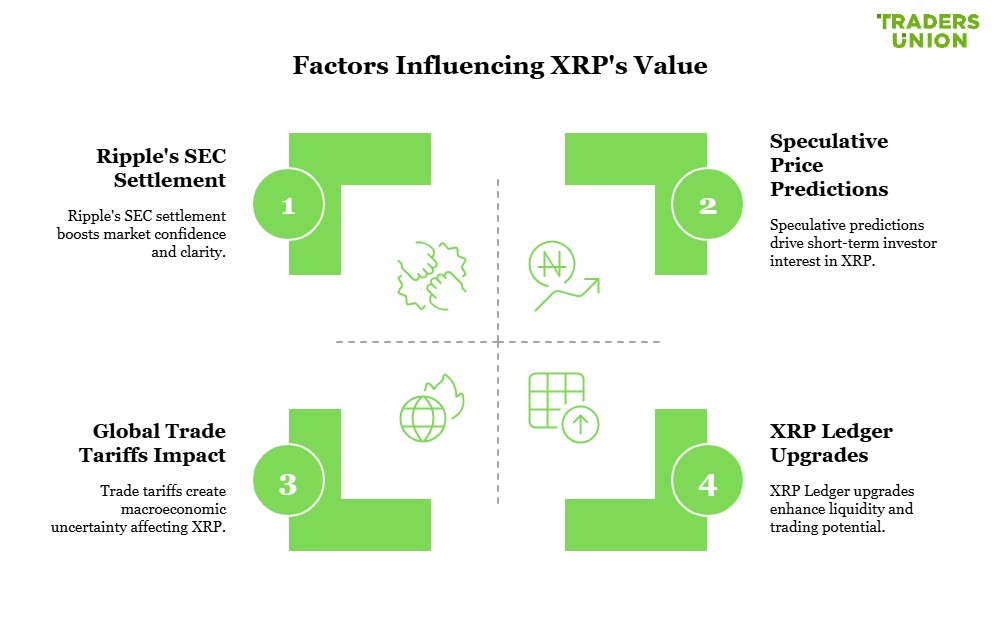
XRP’s market value is shaped by a combination of regulatory outcomes, network upgrades, broader economic conditions, and investor behavior. Each of these factors plays a critical role in influencing both short-term price movements and long-term investor confidence.
Regulatory developments
Legal clarity continues to be one of the most influential drivers of XRP’s price. In a major development, Ripple recently settled its case with the U.S. Securities and Exchange Commission by agreeing to pay a reduced fine of $50 million. This comes after a prolonged legal battle and is viewed as a step toward removing uncertainty around XRP’s status in the U.S.
Technological progress and adoption
The XRP Ledger is undergoing significant upgrades. A major one is the upcoming integration of an Automated Market Maker (AMM) feature. This upgrade is expected to improve liquidity and increase usage of the XRP Ledger for trading and payments.
Ripple is also exploring the launch of its own stablecoin, RLUSD, and may be considering a public listing. These developments signal growing ambition and a broader push toward expanding XRP’s use in financial infrastructure, which can have a direct impact on demand.
Macroeconomic influences
XRP, like most digital assets, reacts to broader market trends. Recent announcements around tariffs and global trade have created uncertainty, causing investors to rebalance their portfolios. Cryptocurrencies often get caught in this movement, especially when traders seek safer or more stable assets during economic shifts.
Understanding XRP's fundamentals
XRP is a digital asset built for efficient international payments. It runs on the XRP Ledger (XRPL), a decentralized, open-source blockchain that has been active since 2012.
Key features of XRP
Fixed supply. XRP has a total supply of 100 billion tokens, all created at launch. There’s no mining involved.
Fast and low-cost transactions. Transfers using XRP usually settle in seconds and cost very little, making it a practical choice for cross-border transfers.
Decentralized infrastructure. The XRP Ledger is supported by a global network of validators. These independent nodes help verify transactions and maintain the network without a central authority.
Main uses
XRP is often used as a bridge currency in global payments. It allows money to move between different fiat currencies quickly and with minimal cost — addressing delays and high fees in traditional banking systems.
Technology behind XRP

The XRP Ledger (XRPL) is a decentralized, open-source blockchain designed to support fast, low-cost cross-border payments. Its technology is distinct from other blockchains due to its unique consensus protocol and network structure.
Consensus mechanism
Instead of relying on energy-intensive systems like proof-of-work or proof-of-stake, the XRPL uses its own consensus protocol. A group of independent validators work together to approve transactions every 3 to 5 seconds. These validators are selected from a trusted list known as the Unique Node List (UNL). This setup enables faster transaction times and minimal energy usage.
Network design
The XRP Ledger operates on a peer-to-peer network with a structure that ensures short paths between nodes and efficient communication. This design improves the system’s speed and reliability. However, the network experiences frequent changes in node participation, which can influence long-term stability and security.
Energy efficiency
The XRP Ledger is known for its low energy use. Unlike traditional blockchains that consume large amounts of electricity, XRPL’s consensus process requires very little power — similar to the energy used by a basic server. This makes it a more sustainable option for blockchain transactions.
XRP outlook: Structure, momentum, and value drivers in 2026
XRP’s price action continues to reflect a cautious market, shaped by both technical headwinds and the broader fundamental backdrop. While recent developments — like Ripple’s partial regulatory resolution and XRPL’s upcoming upgrades — offer long-term promise, the short-term structure remains weighed down by lingering selling pressure and market hesitation.
Trend structure and market behavior

XRP has remained in a downtrend since failing to break above the $2.55 resistance zone, a long-standing supply area visible on higher timeframes. In late March, the price broke below a rising wedge — a bearish continuation pattern — adding further pressure on buyers. As of April 1, 2025, XRP trades around $2.13, showing mild support near the $2.06–$2.10 zone, but remains beneath all key moving averages, signaling weakness.
Support and resistance zones

The 4-hour chart highlights a critical near-term demand zone at $2.06–$2.10, which has been tested multiple times with limited bounce strength. A break below this could open up downside toward the more stable higher-timeframe support at $1.90–$2.00.
On the upside, resistance levels stack up quickly. The first hurdle lies at $2.22, which coincides with a cluster of short-term EMAs. Beyond that, $2.40 and $2.55 are well-established distribution levels from March, where sellers were previously dominant.
Moving averages and EMA structure

XRP remains under the 20, 50, 100, and 200 EMAs on the 4H chart — an indication that sellers continue to control the pace. The 20 EMA at $2.14 is nearly level with current price, suggesting indecision in the very short term. For any shift in momentum, XRP would need a confirmed breakout above the 200 EMA, which sits around $2.33. Until that happens, the downtrend bias remains intact.
Momentum indicators: RSI and MACD

The RSI on the 4H chart has rebounded to around 45 after briefly dipping below 30, signaling a short-term bullish divergence. However, it's not yet strong enough to flip momentum in favor of buyers.
MACD shows a slow crossover above the signal line, with green histogram bars appearing — hinting at a potential recovery. That said, the weak slope and low volume mean any upside should be viewed with caution unless backed by a strong breakout.
Bollinger Bands
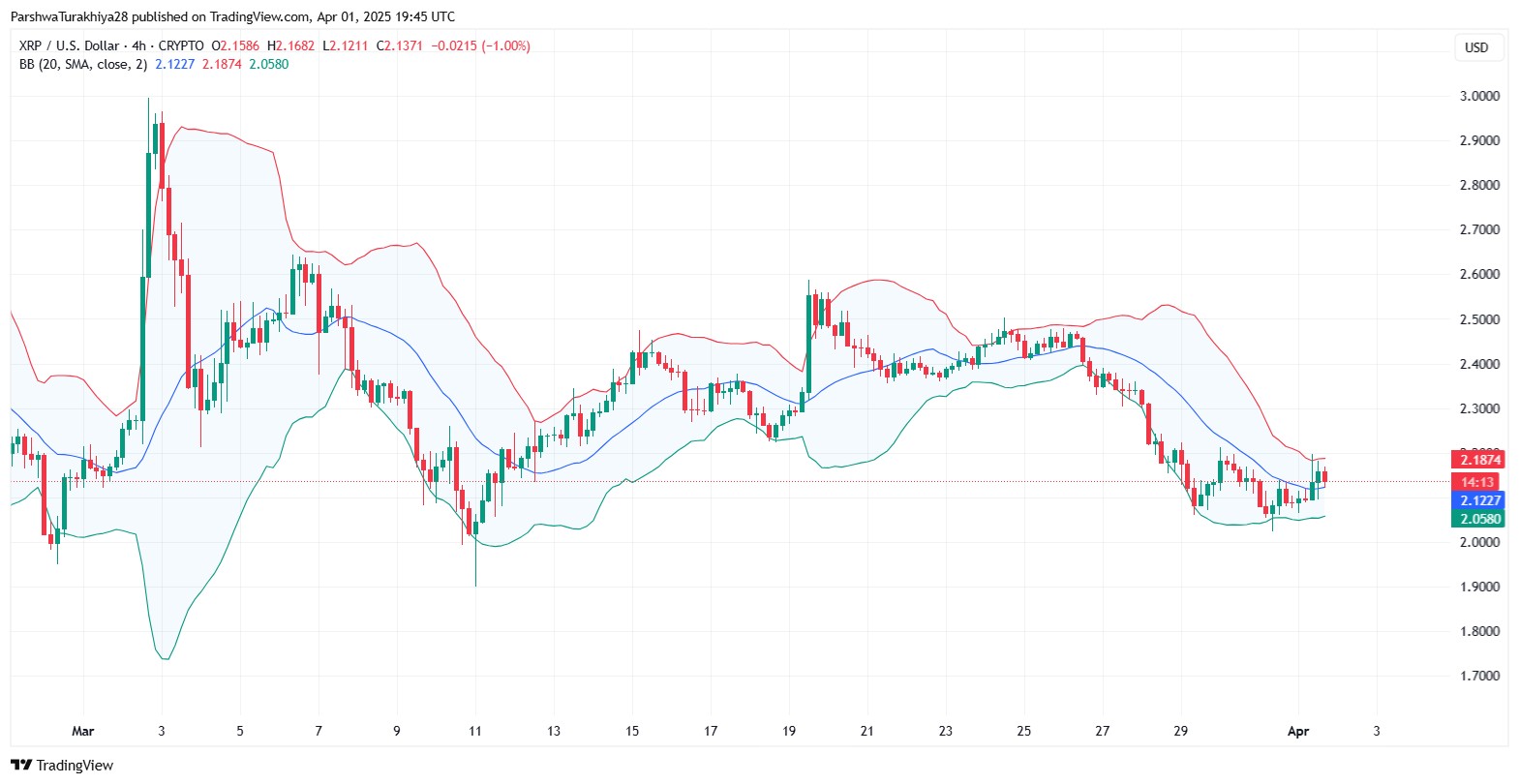
Bollinger Bands are starting to contract, pointing to reduced volatility and potential buildup for a larger move. The price is attempting to reclaim the mid-band near $2.12, which may act as immediate support. A clean breakout above the upper band (~$2.19) could target the $2.25–2.30 area. A rejection here would likely trigger another test of the lower band near $2.05.
Fibonacci retracement levels

Using the recent swing high of $2.5878 and swing low of $1.9011 on the daily chart, key Fibonacci retracement levels suggest the following zones:
0.236 level at $2.24.
0.382 level at $2.35.
0.5 level at $2.45.
0.618 level at $2.56.
Unless XRP decisively closes above $2.24, the broader bearish structure remains in play. A failure to reclaim this level could pave the way for deeper pullbacks. In a high-volume breakdown, Fibonacci extension targets include $1.47 (1.618 level) and $0.79 (2.618 level), though these are more likely in extreme downside scenarios.
Based on the strategies and insights shared above, we’ve selected a list of top exchanges where you can buy, trade, or invest in XRP with confidence and strategic advantage.
| Foundation year | Min. Deposit, $ | Spot Taker fee, % | Spot Maker Fee, % | Deposit fee | Withdrawal fee | Demo account | Regulation | TU overall score | Open an account | |
|---|---|---|---|---|---|---|---|---|---|---|
| 2017 | 10 | 0.1 | 0.08 | No | 0.0004 BTC 2.6 USDT | Yes | No | 8.48 | Go to broker Your capital is at risk. |
|
| 2012 | 10 | 0.5 | 0.5 | No | Fixed fee - 25 USD PayPal - 1.5% USDC - 10 USD | No | No | 7.84 | Go to broker Your capital is at risk. |
|
| 2016 | 1 | 0.5 | 0.25 | No | 0.0005 BTC | No | Malta Financial Services Authority | 7.8 | Go to broker Your capital is at risk. |
|
| 2018 | No | 0 | 0 | No | No | No | No | 7.76 | Go to broker Your capital is at risk. |
|
| 2011 | 10 | 0.3 | 0.2 | No | 0.0004 BTC 0.005 ETH 6%. if there was no futures trading | Yes | FCIS, FinCEN, FINTRAC | 7.6 | Go to broker Your capital is at risk.
|
Why trust us
15+ years of independent market analysis
140+ evaluation criteria, reviewed by 50+ experts
Data-driven reviews of 200+ platforms, updated regularly
20+ industry awards & a wide network of global media partners
Learn more about our methodology and editorial policies.


XRP price forecast
| Year | Price in the middle of the year | Price at the end of the year |
|---|---|---|
| 2026 | $1 | $1.1 |
| 2027 | $2 | $1.5 |
| 2028 | $1.4 | $1.6 |
| 2029 | $1.5 | $1.6 |
| 2030 | $2.8 | $2.6 |
| 2031 | $2.7 | $2.4 |
| 2032 | $2 | $1.7 |
| 2033 | $1.6 | $1.3 |
| 2034 | $1.3 | $1.3 |
| 2035 | $1.3 | $1 |
| 2036 | $1 | $1.7 |
| 2037 | $1.9 | $1.7 |
| 2038 | $2.9 | $3.3 |
| 2039 | $5.6 | $4.2 |
| 2040 | $4.1 | $4.5 |
XRP News

Will XRP hold above $1.3242 support amid validator uncertainty and mixed technical signals?
Why is XRP price down 6.4% today?

Ripple settlement update brings utility to XRP but sellers keep control
AI agent settlement growth coincides with XRP price consolidation near key resistance
XRP holds market attention as technical signals remain mixed
XRP remains pinned below 20-day moving average as resistance caps recovery attempts: weekly outlook
Look at how XRP functions during liquidity crunches

Most beginners look at XRP like any other altcoin — but here’s what they miss: the real value of XRP doesn’t lie in speculation or hype. It lies in how frictionless value flows through choke points in global finance. If you want to understand XRP’s potential, stop comparing it to Ethereum or Bitcoin.
Instead, look at how XRP functions during liquidity crunches between disconnected financial systems. When a local bank in Southeast Asia can settle cross-border payments in seconds using XRP instead of waiting for correspondent banking approval, that’s not just efficiency — it’s utility priced into velocity. Track how often XRP gets used as a bridge asset in low-liquidity corridors. That’s where demand spikes quietly, long before it shows up on your news feed.
Also, don’t just follow wallet activity — follow “invisible activity.” Look at metrics like the number of payment channels opened on XRPL or spikes in ODL (On-Demand Liquidity) volumes in smaller remittance corridors. These subtle upticks often precede price movements because they reflect real-world usage, not retail FOMO.
Conclusion
XRP’s value in 2026 stems from more than market sentiment — it’s anchored in real-world utility, regulatory clarity, and rising institutional use. With Ripple’s legal battles easing and major upgrades like AMM integration underway, XRP is positioned as a key player in global finance. Its role in bridging liquidity gaps, powering cross-border payments, and attracting ETF interest gives it strong long-term potential.
Still, investors must remain aware of macroeconomic shifts, evolving competition, and adoption rates. The smartest strategies aren’t built on hype — they’re built on understanding where XRP fits into the next financial era. Informed positioning and risk-aware investing will be key to unlocking its full potential.
FAQs
How does RippleNet impact XRP’s utility?
RippleNet enhances XRP’s utility by connecting banks and payment providers through a unified network for cross-border transactions. When institutions use XRP as a bridge currency in RippleNet’s On-Demand Liquidity (ODL), it reduces settlement time and cost, driving real transactional demand for the token.
Is XRP energy efficient compared to Bitcoin and Ethereum?
Yes. Unlike Bitcoin and Ethereum’s older proof-of-work models, XRP uses a consensus mechanism that requires minimal energy — comparable to the electricity consumption of a lightbulb. This efficiency makes it attractive to institutions under pressure to meet ESG standards.
Can XRP be used in DeFi applications?
With recent upgrades to the XRPLedger, including native AMM integration and smart contract support via sidechains, XRP is becoming increasingly compatible with decentralized finance (DeFi) use cases. This opens the door for lending, liquidity pools, and synthetic asset creation on the XRPL.
How is XRP different from stablecoins like USDT or USDC?
Unlike stablecoins, which are pegged to fiat and require centralized issuers, XRP is a freely traded digital asset used for liquidity and settlement. It offers more flexibility in bridging currencies across regions, without depending on reserves or custodians.
Editors' Top Picks and Insights




Related Articles
Team that worked on the article
Peter Emmanuel Chijioke is a professional personal finance, Forex, crypto, blockchain, NFT, and Web3 writer and a contributor to the Traders Union website. As a computer science graduate with a robust background in programming, machine learning, and blockchain technology, he possesses a comprehensive understanding of software, technologies, cryptocurrency, and Forex trading.
Chinmay Soni is a financial analyst with more than 5 years of experience in working with stocks, Forex, derivatives, and other assets. As a founder of a boutique research firm and an active researcher, he covers various industries and fields, providing insights backed by statistical data.
Mirjan Hipolito is a journalist and news editor at Traders Union. She is an expert crypto writer with five years of experience in the financial markets.
Yield refers to the earnings or income derived from an investment. It mirrors the returns generated by owning assets such as stocks, bonds, or other financial instruments.
Index in trading is the measure of the performance of a group of stocks, which can include the assets and securities in it.
Crypto trading involves the buying and selling of cryptocurrencies, such as Bitcoin, Ethereum, or other digital assets, with the aim of making a profit from price fluctuations.
Ethereum is a decentralized blockchain platform and cryptocurrency that was proposed by Vitalik Buterin in late 2013 and development began in early 2014. It was designed as a versatile platform for creating decentralized applications (DApps) and smart contracts.
An investor is an individual, who invests money in an asset with the expectation that its value would appreciate in the future. The asset can be anything, including a bond, debenture, mutual fund, equity, gold, silver, exchange-traded funds (ETFs), and real-estate property.

-
 Afghanistan
-
 Albania
-
 Algeria
-
 Angola
-
 Argentina
-
 Armenia
-
 Australia
-
 Austria
-
 Azerbaijan
-
 Bahamas
-
 Bahrain
-
 Bangladesh
-
 Belarus
-
 Belgium
-
 Bolivia
-
 Botswana
-
 Brazil
-
 Brunei
-
 Bulgaria
-
 Cambodia
-
 Cameroon
-
 Canada
-
 Chile
Chile
-
 China
China
-
 Colombia
-
 Congo
Congo
-
 Costa Rica
-
 Cote d'Ivoire
-
 Croatia
-
 Cuba
Cuba
-
 Cyprus
-
 Czechia
-
 DR Congo
-
 Denmark
-
 Dominican Republic
-
 Ecuador
-
 Egypt
Egypt
-
 El Salvador
-
 Estonia
-
 Eswatini
-
 Ethiopia
-
 Finland
-
 France
-
 Georgia
-
 Germany
-
 Ghana
Ghana
-
 Greece
-
 Haiti
Haiti
-
 Hong Kong
-
 Hungary
-
 India
India
-
 Indonesia
-
 Iran, Islamic republic
-
 Iraq
Iraq
-
 Ireland
-
 Israel
-
 Italy
Italy
-
 Jamaica
-
 Japan
Japan
-
 Jordan
-
 Kazakhstan
-
 Kenya
Kenya
-
 Korea
Korea
-
 Kuwait
-
 Kyrgyzstan
-
 Laos
Laos
-
 Latvia
-
 Lebanon
-
 Lesotho
-
 Libya
Libya
-
 Lithuania
-
 Luxembourg
-
 Madagascar
-
 Malaysia
-
 Malta
Malta
-
 Mauritius
-
 Mexico
-
 Moldova
-
 Mongolia
-
 Montenegro
-
 Morocco
-
 Mozambique
-
 Myanmar
-
 Namibia
-
 Nepal
Nepal
-
 Netherlands
-
 New Zealand
-
 Nigeria
-
 North Macedonia
-
 Norway
-
 Oman
Oman
-
 Pakistan
-
 Palestine
-
 Panama
-
 Papua New Guinea
-
 Paraguay
-
 Peru
Peru
-
 Philippines
-
 Poland
-
 Portugal
-
 Puerto Rico
-
 Qatar
Qatar
-
 Reunion
-
 Romania
-
 Rwanda
-
 Saudi Arabia
-
 Serbia
-
 Singapore
-
 Slovakia
-
 Slovenia
-
 Somalia
-
 South Africa
-
 Spain
Spain
-
 Sri Lanka
-
 Sweden
-
 Switzerland
-
 Syria
Syria
-
 Taiwan
-
 Tajikistan
-
 Tanzania
-
 Thailand
-
 Trinidad and Tobago
-
 Tunisia
-
 Turkey
-
 UAE
UAE
-
 Uganda
-
 Ukraine
-
 United Kingdom
-
United States
-
 Uruguay
-
 Uzbekistan
-
 Venezuela
-
 Vietnam
-
 Yemen
Yemen
-
 Zambia
-
 Zimbabwe
- Forex
- Crypto