
Bitcoin rises after Middle East tensions boost capital rotation to crypto

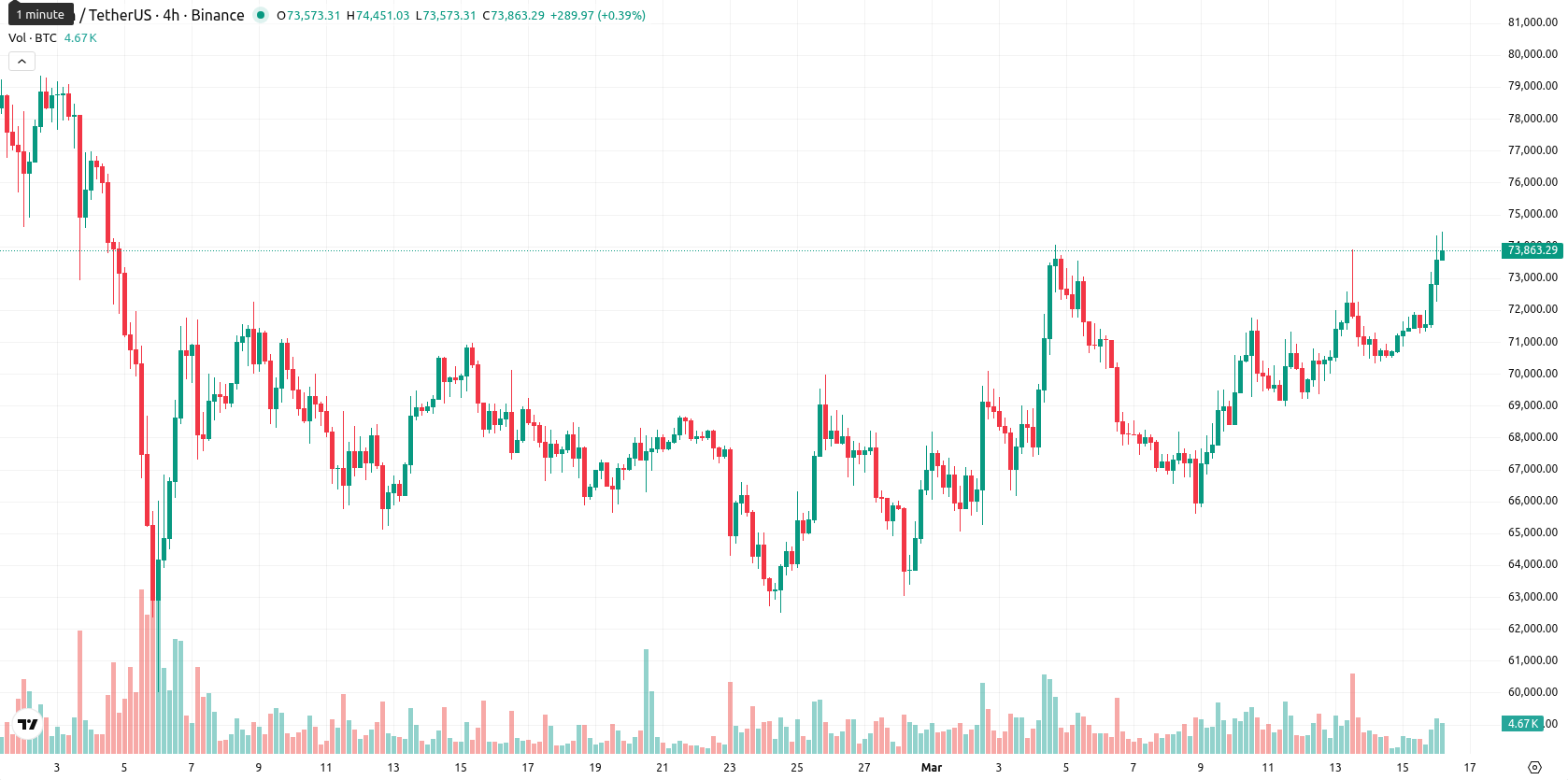
Bitcoin (BTC) is trading at $73,803.71, posting a daily gain of 3.28%. The asset holds well above its 20-day ($68,701.38) and 50-day ($71,419.98) simple moving averages, but remains below the longer-term 200-day SMA at $93,948.33, reflecting short- to medium-term bullish momentum with overhead longer-term resistance.
 62642
64700.00
62642
64700.00
Highlights
- Escalating US-Iran-Israel conflict and Middle East instability have boosted geopolitical risk, driving capital flows into liquid, globally accessible assets like Bitcoin.
- Safe-haven demand and threats to the Strait of Hormuz underpin Bitcoin’s price recovery and persistent risk of market and inflation disruption.
- Technicals show BTC consolidating between $70,000 and $75,000, with overbought signals suggesting high volatility and increased risk of short-term pullback.
Safe-haven demand intensifies as Middle East conflict disrupts markets
Ongoing military conflict involving the United States, Iran, and Israel has triggered heightened geopolitical risk, increasing volatility and driving capital rotation into liquid, globally accessible assets. The Iran conflict sparked sharp market reactions, with Bitcoin initially dropping 8.5% on February 28 during the first wave of US and Israeli attacks. As hostilities escalated through March 7, including Iranian missile strikes on Gulf states and further tanker attacks on March 12, safe-haven flows supported Bitcoin's swift recovery and price stability above $69,000. Continued geopolitical uncertainty in the Middle East—particularly around the Strait of Hormuz, a key global energy chokepoint—elevates the risk of spillover disruptions to inflation and global financial markets, amplifying liquidity flows into Bitcoin.
Overbought signals emerge as bullish momentum clashes with long-term resistance
BTC is holding above its SMA-20 ($68,701.38) and SMA-50 ($71,419.98), but still below the SMA-200 ($93,948.33), indicating strong bullish momentum in the short to medium term, with longer-term resistance in place. The Ichimoku Kijun level is providing immediate support at $68,280.14. On the indicators side, the ADX signals a robust trend and MACD is neutral, while the RSI at 57.12 shows healthy momentum. However, Stoch RSI and CCI are both overbought, and BBP is strongly positive and overbought across all intraday intervals, confirming buyer dominance but also signaling short-term exhaustion; the Awesome Oscillator (AO) further supports the upward trend.
Consolidation favored as volatility rises and upside potential diminishes
Looking ahead over the next five trading days, BTC is expected to consolidate within the $70,000 to $75,000 volatility band relative to current levels, reflecting recent heightened price swings. Most indicators signal a very low likelihood (under 20%) of further upside this week, so a pullback or sideways price action is more probable. A decisive close above $74,400 could trigger a bullish scenario targeting $76,000. On the downside, a break below $70,000 would expose BTC to a deeper correction toward lower support zones.
Earlier, analysts noted that Bitcoin was exhibiting strong short- and medium-term momentum but faced longer-term resistance, with overbought conditions suggesting potential for consolidation or a short-term pause. The latest geopolitical-driven volatility adds a new dimension, and traders should monitor for shifts in safe-haven flows, as persistent market turbulence could rapidly alter both the trading range and upside risk profile for BTC.





Latest Bitcoin News









-
 Afghanistan
-
 Albania
-
 Algeria
-
 Angola
-
 Argentina
-
 Armenia
-
 Australia
-
 Austria
-
 Azerbaijan
-
 Bahamas
-
 Bahrain
-
 Bangladesh
-
 Belarus
-
 Belgium
-
 Bolivia
-
 Botswana
-
 Brazil
-
 Brunei
-
 Bulgaria
-
 Cambodia
-
 Cameroon
-
 Canada
-
 Chile
Chile
-
 China
China
-
 Colombia
-
 Congo
Congo
-
 Costa Rica
-
 Cote d'Ivoire
-
 Croatia
-
 Cuba
Cuba
-
 Cyprus
-
 Czechia
-
 DR Congo
-
 Denmark
-
 Dominican Republic
-
 Ecuador
-
 Egypt
Egypt
-
 El Salvador
-
 Estonia
-
 Eswatini
-
 Ethiopia
-
 Finland
-
 France
-
 Georgia
-
 Germany
-
 Ghana
Ghana
-
 Greece
-
 Haiti
Haiti
-
 Hong Kong
-
 Hungary
-
 India
India
-
 Indonesia
-
 Iran, Islamic republic
-
 Iraq
Iraq
-
 Ireland
-
 Israel
-
 Italy
Italy
-
 Jamaica
-
 Japan
Japan
-
 Jordan
-
 Kazakhstan
-
 Kenya
Kenya
-
 Korea
Korea
-
 Kuwait
-
 Kyrgyzstan
-
 Laos
Laos
-
 Latvia
-
 Lebanon
-
 Lesotho
-
 Libya
Libya
-
 Lithuania
-
 Luxembourg
-
 Madagascar
-
 Malaysia
-
 Malta
Malta
-
 Mauritius
-
 Mexico
-
 Moldova
-
 Mongolia
-
 Montenegro
-
 Morocco
-
 Mozambique
-
 Myanmar
-
 Namibia
-
 Nepal
Nepal
-
 Netherlands
-
 New Zealand
-
 Nigeria
-
 North Macedonia
-
 Norway
-
 Oman
Oman
-
 Pakistan
-
 Palestine
-
 Panama
-
 Papua New Guinea
-
 Paraguay
-
 Peru
Peru
-
 Philippines
-
 Poland
-
 Portugal
-
 Puerto Rico
-
 Qatar
Qatar
-
 Reunion
-
 Romania
-
 Rwanda
-
 Saudi Arabia
-
 Serbia
-
 Singapore
-
 Slovakia
-
 Slovenia
-
 Somalia
-
 South Africa
-
 Spain
Spain
-
 Sri Lanka
-
 Sweden
-
 Switzerland
-
 Syria
Syria
-
 Taiwan
-
 Tajikistan
-
 Tanzania
-
 Thailand
-
 Trinidad and Tobago
-
 Tunisia
-
 Turkey
-
 UAE
UAE
-
 Uganda
-
 Ukraine
-
 United Kingdom
-
United States
-
 Uruguay
-
 Uzbekistan
-
 Venezuela
-
 Vietnam
-
 Yemen
Yemen
-
 Zambia
-
 Zimbabwe
- Forex
- Crypto











