

Bitcoin price poised for weakest Q1 since 2018 as tariff concerns weigh on markets

Bitcoin price has extended its losing streak to four consecutive days, slipping to $81,300 during the March 31 Asian session.
This decline has pushed BTC into a net negative territory in March, making it the second consecutive monthly decline in 2025. The cryptocurrency is now on track for its weakest first-quarter performance since 2018, pressured by mounting macroeconomic concerns.
Bitcoin's latest downturn aligns with weakness across broader financial markets. The Dow Jones and S&P 500 have turned red as traders react to U.S. President Donald Trump’s announcement of 25% tariffs on imported cars and a potential expansion of tariffs to the pharmaceutical sector. Uncertainty surrounding Trump’s April 2 "Liberation Day," when further tariffs may be unveiled, has added to market anxiety. Given Bitcoin’s tendency to trade in tandem with risk assets, these developments have exacerbated its downside momentum.
50 and 100-day EMAs confirm bearish trend amid deep risk-off sentiment
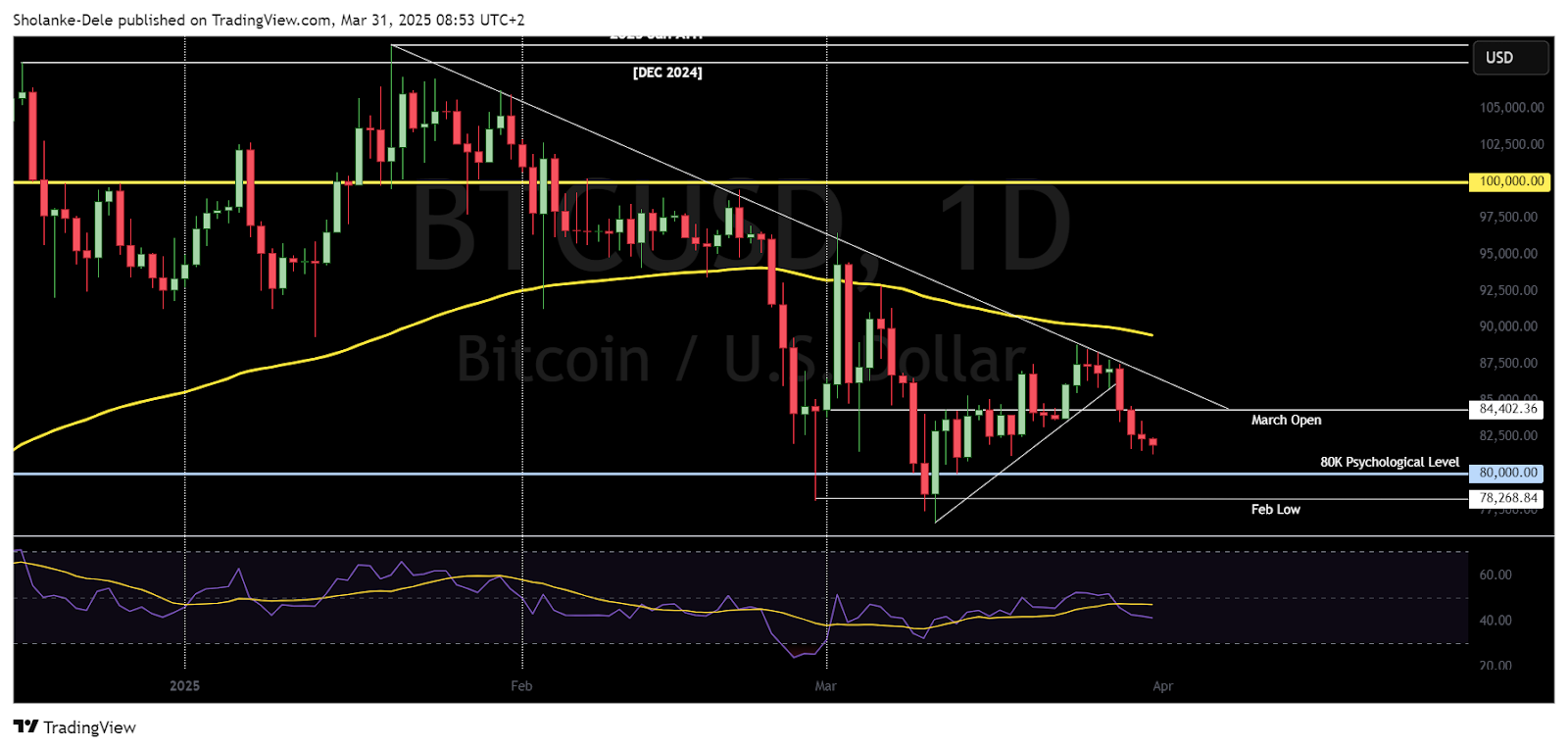
BTC/USD price dynamics (January - March 2025). Source: TradingView
From a technical perspective, the 50-day and 100-day Exponential Moving Averages (EMA) are bearish, reinforcing resistance at $89,000. Meanwhile, the Bitcoin Relative Strength Index (RSI) on the daily timeframe is in bearish territory, signaling a continuation of selling pressure. With BTC struggling to hold above $82,000, the next key support level to watch is $80,000.
With macroeconomic uncertainty persisting and technical indicators pointing lower, Bitcoin’s outlook remains fragile as Q2 approaches. If Bitcoin fails to reclaim ground above $82,000, a deeper slide toward $80,000 could unfold, with further downside risks if selling pressure intensifies.
Bitcoin's rally to $89,000 on March 24 faced strong resistance, leading to a shift in market structure. Since then, lower highs and lower lows have confirmed growing selling pressure.









-
 Afghanistan
-
 Albania
-
 Algeria
-
 Angola
-
 Argentina
-
 Armenia
-
 Australia
-
 Austria
-
 Azerbaijan
-
 Bahamas
-
 Bahrain
-
 Bangladesh
-
 Belarus
-
 Belgium
-
 Bolivia
-
 Botswana
-
 Brazil
-
 Brunei
-
 Bulgaria
-
 Cambodia
-
 Cameroon
-
 Canada
-
 Chile
Chile
-
 China
China
-
 Colombia
-
 Congo
Congo
-
 Costa Rica
-
 Cote d'Ivoire
-
 Croatia
-
 Cuba
Cuba
-
 Cyprus
-
 Czechia
-
 DR Congo
-
 Denmark
-
 Dominican Republic
-
 Ecuador
-
 Egypt
Egypt
-
 El Salvador
-
 Estonia
-
 Eswatini
-
 Ethiopia
-
 Finland
-
 France
-
 Georgia
-
 Germany
-
 Ghana
Ghana
-
 Greece
-
 Haiti
Haiti
-
 Hong Kong
-
 Hungary
-
 India
India
-
 Indonesia
-
 Iran, Islamic republic
-
 Iraq
Iraq
-
 Ireland
-
 Israel
-
 Italy
Italy
-
 Jamaica
-
 Japan
Japan
-
 Jordan
-
 Kazakhstan
-
 Kenya
Kenya
-
 Korea
Korea
-
 Kuwait
-
 Kyrgyzstan
-
 Laos
Laos
-
 Latvia
-
 Lebanon
-
 Lesotho
-
 Libya
Libya
-
 Lithuania
-
 Luxembourg
-
 Madagascar
-
 Malaysia
-
 Malta
Malta
-
 Mauritius
-
 Mexico
-
 Moldova
-
 Mongolia
-
 Montenegro
-
 Morocco
-
 Mozambique
-
 Myanmar
-
 Namibia
-
 Nepal
Nepal
-
 Netherlands
-
 New Zealand
-
 Nigeria
-
 North Macedonia
-
 Norway
-
 Oman
Oman
-
 Pakistan
-
 Palestine
-
 Panama
-
 Papua New Guinea
-
 Paraguay
-
 Peru
Peru
-
 Philippines
-
 Poland
-
 Portugal
-
 Puerto Rico
-
 Qatar
Qatar
-
 Reunion
-
 Romania
-
 Rwanda
-
 Saudi Arabia
-
 Serbia
-
 Singapore
-
 Slovakia
-
 Slovenia
-
 Somalia
-
 South Africa
-
 Spain
Spain
-
 Sri Lanka
-
 Sweden
-
 Switzerland
-
 Syria
Syria
-
 Taiwan
-
 Tajikistan
-
 Tanzania
-
 Thailand
-
 Trinidad and Tobago
-
 Tunisia
-
 Turkey
-
 UAE
UAE
-
 Uganda
-
 Ukraine
-
 United Kingdom
-
United States
-
 Uruguay
-
 Uzbekistan
-
 Venezuela
-
 Vietnam
-
 Yemen
Yemen
-
 Zambia
-
 Zimbabwe
- Forex
- Crypto












