

Why is Kaia falling today? Key support levels to watch

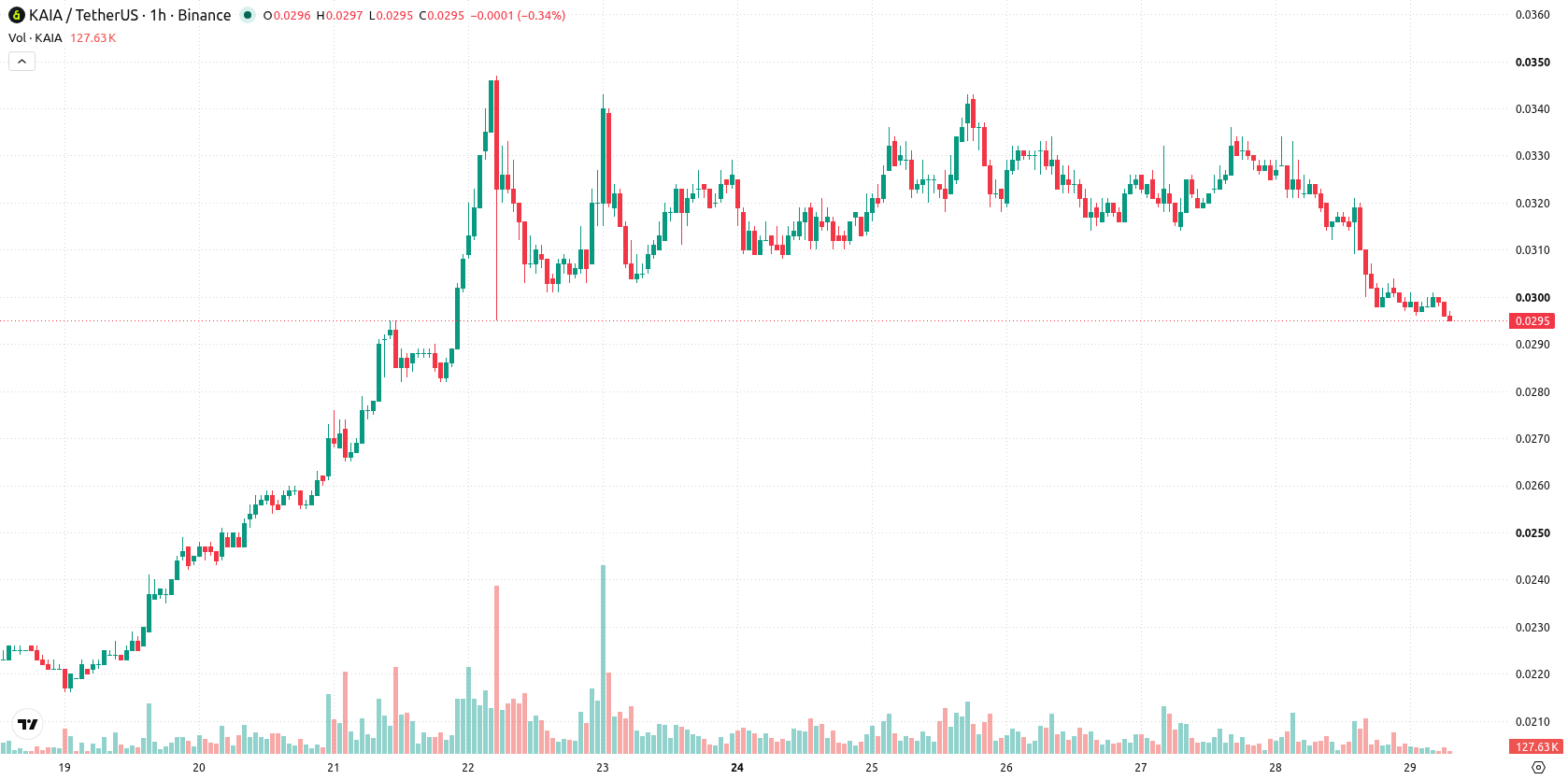
Kaia (KAIA) is trading at $0.0298 after a daily drop of 7.71%. The asset has moved below its key moving averages, reflecting renewed bearish sentiment in the session.
 0.0487
0.0682
0.0487
0.0682
Highlights
- KAIA/USD trades below key moving averages, indicating persistent bearish momentum across short-, medium-, and long-term horizons.
- Momentum and trend indicators show strong seller dominance, with MACD and ADX on sell, and conflicting oscillator signals suggest erratic short-term activity.
- Intraday price has dropped 7.71% to $0.0298, with a forecasted 2 to 3 day trading range of $0.0287 to $0.0309 and a high probability of further declines.
Bearish momentum confirmed as major supports breached
On the hourly chart, KAIA is trading below the MA-20 at $0.0305, MA-50 at $0.0317, and the long-term MA-200 at $0.0426. The Ichimoku Kijun line at $0.0312 marks immediate resistance. Momentum indicators confirm selling pressure: MACD signals a strong sell, ADX indicates a sell bias, and RSI stands at 34.53, with both CCI and Bull/Bear Power affirming seller dominance. Notably, Stoch RSI shows an intraday overbought condition, diverging from the more oversold readings of the other oscillators and pointing to the presence of mixed short-term sentiment.
Downside continuation likely given limited rebound prospects
Over the next 2 to 3 trading days, KAIA is expected to trade within a range of $0.0287 to $0.0309, representing the typical volatility band relative to current levels. The probability of upward movement is judged to be very low, while a continuation to the downside remains highly likely. Price consolidation within this corridor is the main scenario, but a move above $0.0312 would open a bullish path, whereas a break below $0.0287 could extend the current downtrend.
Earlier, analysts noted that Kaia was demonstrating persistent bearish momentum with consolidation likely to prevail. The latest price action and technical readings further reinforce this outlook, making the $0.0287 level a critical support to monitor for signs of continued downside risk.










-
 Afghanistan
-
 Albania
-
 Algeria
-
 Angola
-
 Argentina
-
 Armenia
-
 Australia
-
 Austria
-
 Azerbaijan
-
 Bahamas
-
 Bahrain
-
 Bangladesh
-
 Belarus
-
 Belgium
-
 Bolivia
-
 Botswana
-
 Brazil
-
 Brunei
-
 Bulgaria
-
 Cambodia
-
 Cameroon
-
 Canada
-
 Chile
Chile
-
 China
China
-
 Colombia
-
 Congo
Congo
-
 Costa Rica
-
 Cote d'Ivoire
-
 Croatia
-
 Cuba
Cuba
-
 Cyprus
-
 Czechia
-
 DR Congo
-
 Denmark
-
 Dominican Republic
-
 Ecuador
-
 Egypt
Egypt
-
 El Salvador
-
 Estonia
-
 Eswatini
-
 Ethiopia
-
 Finland
-
 France
-
 Georgia
-
 Germany
-
 Ghana
Ghana
-
 Greece
-
 Haiti
Haiti
-
 Hong Kong
-
 Hungary
-
 India
India
-
 Indonesia
-
 Iran, Islamic republic
-
 Iraq
Iraq
-
 Ireland
-
 Israel
-
 Italy
Italy
-
 Jamaica
-
 Japan
Japan
-
 Jordan
-
 Kazakhstan
-
 Kenya
Kenya
-
 Korea
Korea
-
 Kuwait
-
 Kyrgyzstan
-
 Laos
Laos
-
 Latvia
-
 Lebanon
-
 Lesotho
-
 Libya
Libya
-
 Lithuania
-
 Luxembourg
-
 Madagascar
-
 Malaysia
-
 Malta
Malta
-
 Mauritius
-
 Mexico
-
 Moldova
-
 Mongolia
-
 Montenegro
-
 Morocco
-
 Mozambique
-
 Myanmar
-
 Namibia
-
 Nepal
Nepal
-
 Netherlands
-
 New Zealand
-
 Nigeria
-
 North Macedonia
-
 Norway
-
 Oman
Oman
-
 Pakistan
-
 Palestine
-
 Panama
-
 Papua New Guinea
-
 Paraguay
-
 Peru
Peru
-
 Philippines
-
 Poland
-
 Portugal
-
 Puerto Rico
-
 Qatar
Qatar
-
 Reunion
-
 Romania
-
 Rwanda
-
 Saudi Arabia
-
 Serbia
-
 Singapore
-
 Slovakia
-
 Slovenia
-
 Somalia
-
 South Africa
-
 Spain
Spain
-
 Sri Lanka
-
 Sweden
-
 Switzerland
-
 Syria
Syria
-
 Taiwan
-
 Tajikistan
-
 Tanzania
-
 Thailand
-
 Trinidad and Tobago
-
 Tunisia
-
 Turkey
-
 UAE
UAE
-
 Uganda
-
 Ukraine
-
 United Kingdom
-
United States
-
 Uruguay
-
 Uzbekistan
-
 Venezuela
-
 Vietnam
-
 Yemen
Yemen
-
 Zambia
-
 Zimbabwe
- Forex
- Crypto












