
The tweet was deleted by the author.
But we saved everything 🙂.

The U.S. crypto community is holding its breath ahead of July 30—the date set for the release of a key report from the President’s Digital Asset Working Group. The document could shape the future of Bitcoin in the U.S. economy and mark the first official step toward establishing a national digital reserve. For the first time at such a high level, concrete mechanisms for integrating cryptocurrencies into U.S. financial policy are being considered.
• On July 30, the U.S. will release a landmark cryptocurrency report, initiated by an executive order from Donald Trump and compiled over a 180-day period.
• The report is expected to disclose how much Bitcoin the U.S. currently holds.
• Despite the initiative, the market is showing a downturn, and analysts are debating the merits of holding volatile assets in government reserves.
Bo Hines, Executive Director of the President’s Digital Asset Advisory Council, confirmed that the highly anticipated policy report could significantly influence the role of cryptocurrencies in U.S. economic strategy.
The study, initiated by President Donald Trump in January, aims to provide concrete recommendations for creating a Strategic Bitcoin Reserve (SBR), according to NewsBTC.
The report is expected to reveal how much Bitcoin is currently in federal custody—mostly from law enforcement seizures. Estimates suggest around 200,000 BTC are being held. Insiders say the plan may recommend using these coins as the foundation for a new national digital asset fund. Proposed mechanisms include budget-neutral strategies such as reallocating existing funds to purchase additional BTC without increasing federal spending.
The report will place special emphasis on security and transparency. It is expected to propose strict audit standards and secure storage protocols. Notably, a minimum 20-year holding period for BTC is under discussion—mirroring long-term strategies used for gold reserves—to reduce volatility risk and enhance financial stability.
The initiative’s potential impact is being amplified by active legislation. The recently signed GENIUS Act establishes a regulatory framework for stablecoin issuance by banks and trusted institutions. In addition, the Senate has introduced a crypto market structure bill aimed at defining the authority of the SEC and CFTC. Senator Cynthia Lummis has also reintroduced the BITCOIN Act, which would authorize the U.S. Treasury to purchase 1 million BTC over five years.
As lawmakers press forward, the crypto market faces short-term challenges. Over the past 24 hours, the top five cryptocurrencies by market cap posted losses: Bitcoin –0.6%, Ethereum –2.8%, XRP –10.4%, BNB –3.6%, and Solana –7.2%.
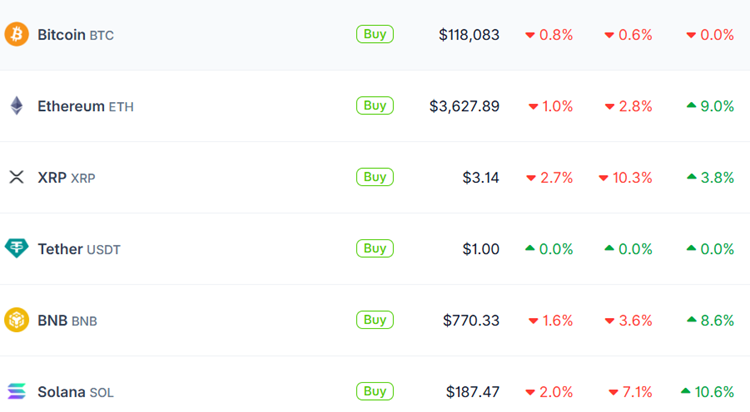
Cryptocurrency market performance on July 24. Source: CoinGecko
Analysts remain split: some view this as a pivotal moment for institutional Bitcoin adoption, while others warn of the risks associated with placing volatile assets in government ownership. Either way, July 30 is shaping up to be a defining moment in the evolving relationship between cryptocurrencies and the U.S. government.
Read also: Crypto liquidations top $600M as Ethereum leads market losses

 Afghanistan
 Albania
 Algeria
 Angola
 Argentina
 Armenia
 Australia
 Austria
 Azerbaijan
 Bahamas
 Bahrain
 Bangladesh
 Belarus
 Belgium
 Bolivia
 Botswana
 Brazil
 Brunei
 Bulgaria
 Cambodia
 Cameroon
 Canada
 Chile
Chile
 China
China
 Colombia
 Congo
Congo
 Costa Rica
 Cote d'Ivoire
 Croatia
 Cuba
Cuba
 Cyprus
 Czechia
 DR Congo
 Denmark
 Dominican Republic
 Ecuador
 Egypt
Egypt
 El Salvador
 Estonia
 Eswatini
 Ethiopia
 Finland
 France
 Georgia
 Germany
 Ghana
Ghana
 Greece
 Haiti
Haiti
 Hong Kong
 Hungary
 India
India
 Indonesia
 Iran, Islamic republic
 Iraq
Iraq
 Ireland
 Israel
 Italy
Italy
 Jamaica
 Japan
Japan
 Jordan
 Kazakhstan
 Kenya
Kenya
 Korea
Korea
 Kuwait
 Kyrgyzstan
 Laos
Laos
 Latvia
 Lebanon
 Lesotho
 Libya
Libya
 Lithuania
 Luxembourg
 Madagascar
 Malaysia
 Malta
Malta
 Mauritius
 Mexico
 Moldova
 Mongolia
 Montenegro
 Morocco
 Mozambique
 Myanmar
 Namibia
 Nepal
Nepal
 Netherlands
 New Zealand
 Nigeria
 North Macedonia
 Norway
 Oman
Oman
 Pakistan
 Palestine
 Panama
 Papua New Guinea
 Paraguay
 Peru
Peru
 Philippines
 Poland
 Portugal
 Puerto Rico
 Qatar
Qatar
 Reunion
 Romania
 Rwanda
 Saudi Arabia
 Serbia
 Singapore
 Slovakia
 Slovenia
 Somalia
 South Africa
 Spain
Spain
 Sri Lanka
 Sweden
 Switzerland
 Syria
Syria
 Taiwan
 Tajikistan
 Tanzania
 Thailand
 Trinidad and Tobago
 Tunisia
 Turkey
 UAE
UAE
 Uganda
 Ukraine
 United Kingdom
United States
United Kingdom
United States
 Uruguay
 Uzbekistan
 Venezuela
 Vietnam
 Yemen
Yemen
 Zambia
 Zimbabwe