The tweet was deleted by the author.
But we saved everything 🙂.
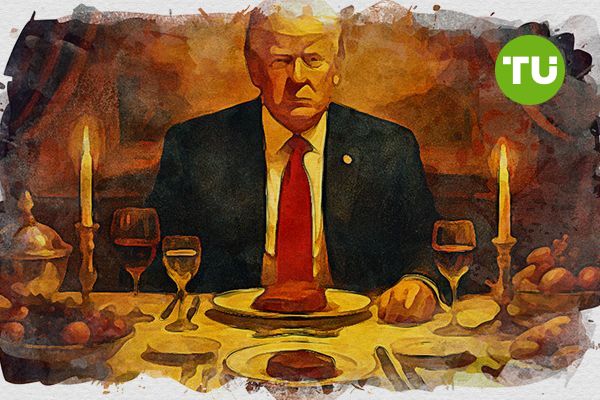
On May 22, an exclusive dinner with U.S. President Donald Trump will take place at the Trump National Golf Club near Washington, D.C. But the guest list wasn’t determined by political loyalty or campaign donations — it was based on the number of memecoins held in attendees' wallets. Only the top 220 holders of the TRUMP token were invited to dine with the president.
The event sparked intense debate well before anyone even took their seat. The reason lies not only in the high-profile host, but in the highly unusual method of selection. For the first time, a political event of this scale is targeting memecoin holders.
The dinner was first announced in April, prompting a rapid surge in the TRUMP token’s value — over 60% in a single day. Despite being a memecoin, TRUMP instantly became a ticket to real-world political access. This shift from traditional political fundraising to tokenized loyalty is unprecedented — and, as market reaction shows, effective.
For the crypto community, the message was clear: the gap between politics and digital assets is narrowing. Trump has previously voiced support for the industry, particularly around easing crypto regulation. This dinner serves as another signal that Web3 may soon play a formal role in the political conversation.
Officially, attendees will receive a TRUMP-themed NFT minted on Solana, a formal dinner at an exclusive club, and the opportunity to take a photo with the president. For a select few, the benefits go even further — including a private tour of the White House, an experience typically reserved for diplomats and senior officials.
Analysts suggest that the real value of the event lies in informal conversations, networking with key political players, and the chance to discuss the future of the crypto market.The dinner may also offer early insights into potential regulatory shifts, as well as introductions to insiders shaping U.S. crypto policy.
Despite the transparency of blockchain, identifying the individuals behind the largest wallets remains a challenge. The top wallet, labeled “SUN,” has now been officially confirmed to belong to Justin Sun, founder of TRON. In a post on X (formerly Twitter), he acknowledged his attendance at the dinner as the top TRUMP holder and expressed his eagerness to "talk crypto and discuss the future of our industry" with President Trump.
The second-largest wallet, “MeCo,” is believed to be connected to MemeCore, a Singapore-based blockchain team. The wallet was funded via Binance and contains both TRUMP and a small amount of Solana.
The third wallet, labeled “CASE,” was funded through Wintermute, a major crypto market maker. Analysts suggest this may have been an over-the-counter (OTC) transaction or a private placement.
Two additional wallets — “GAnt” and “REKT” — were created more recently. One received funds via Binance and Coinbase, while the other was funded through ChangeNOW, a non-KYC platform. This adds weight to critics' concerns that such transactions may have allowed non-U.S. entities to gain backdoor access to the political process.
The “pay-to-play” concept — where access is granted in exchange for money — is nothing new in U.S. politics. But using a memecoin as a ticket to dine with the president has already been dubbed “pay-to-play 2.0” by critics.
Technically, this isn’t campaign financing. But in practice, TRUMP has become a gateway to political access. The arrangement has drawn scrutiny from Senators Elizabeth Warren and Adam Schiff, who have called for a federal investigation, citing potential violations of the U.S. Constitution — specifically the Emoluments Clause.
Watchdog group Accountable.US also raised concerns, pointing to possible financial ties between token proceeds and CIC Digital, an affiliate of the Trump Organization.
Despite the hype surrounding the event, data from Nansen shows that a large portion of retail traders ended up in the red. Of more than 2,600 participants, approximately 70% recorded losses, with total realized losses exceeding $21 million. It’s a familiar pattern: most buyers entered during peak excitement, but speculative trading rarely leads to broad profits.
Interest in the token has also begun to fade. According to Google Trends, search activity for TRUMP has been on the decline since January — despite consistently high trading volumes.
This story may leave behind mixed impressions, but it reveals something fundamental: the crypto market is no longer just about technology or investment — it's becoming a channel of influence. And that influence extends not only to regulators, but to the political culture itself.
This dinner may be just a footnote in crypto history. But it shows that those holding the “right” token may now have a seat at the table — and politicians, it seems, are ready to listen. Even if it takes a well-set dinner to start the conversation.

 Afghanistan
 Albania
 Algeria
 Angola
 Argentina
 Armenia
 Australia
 Austria
 Azerbaijan
 Bahamas
 Bahrain
 Bangladesh
 Belarus
 Belgium
 Bolivia
 Botswana
 Brazil
 Brunei
 Bulgaria
 Cambodia
 Cameroon
 Canada
 Chile
Chile
 China
China
 Colombia
 Congo
Congo
 Costa Rica
 Cote d'Ivoire
 Croatia
 Cuba
Cuba
 Cyprus
 Czechia
 DR Congo
 Denmark
 Dominican Republic
 Ecuador
 Egypt
Egypt
 El Salvador
 Estonia
 Eswatini
 Ethiopia
 Finland
 France
 Georgia
 Germany
 Ghana
Ghana
 Greece
 Haiti
Haiti
 Hong Kong
 Hungary
 India
India
 Indonesia
 Iran, Islamic republic
 Iraq
Iraq
 Ireland
 Israel
 Italy
Italy
 Jamaica
 Japan
Japan
 Jordan
 Kazakhstan
 Kenya
Kenya
 Korea
Korea
 Kuwait
 Kyrgyzstan
 Laos
Laos
 Latvia
 Lebanon
 Lesotho
 Libya
Libya
 Lithuania
 Luxembourg
 Madagascar
 Malaysia
 Malta
Malta
 Mauritius
 Mexico
 Moldova
 Mongolia
 Montenegro
 Morocco
 Mozambique
 Myanmar
 Namibia
 Nepal
Nepal
 Netherlands
 New Zealand
 Nigeria
 North Macedonia
 Norway
 Oman
Oman
 Pakistan
 Palestine
 Panama
 Papua New Guinea
 Paraguay
 Peru
Peru
 Philippines
 Poland
 Portugal
 Puerto Rico
 Qatar
Qatar
 Reunion
 Romania
 Rwanda
 Saudi Arabia
 Serbia
 Singapore
 Slovakia
 Slovenia
 Somalia
 South Africa
 Spain
Spain
 Sri Lanka
 Sweden
 Switzerland
 Syria
Syria
 Taiwan
 Tajikistan
 Tanzania
 Thailand
 Trinidad and Tobago
 Tunisia
 Turkey
 UAE
UAE
 Uganda
 Ukraine
 United Kingdom
United States
United Kingdom
United States
 Uruguay
 Uzbekistan
 Venezuela
 Vietnam
 Yemen
Yemen
 Zambia
 Zimbabwe