
WTI crude oil steadies near $56 as geopolitical risks slow five-year selloff

WTI crude oil is attempting to stabilize on Thursday after a steep and prolonged selloff that pushed prices to their weakest levels in nearly five years. While the broader trend remains firmly bearish, a mix of geopolitical tension and inventory draws has helped ease immediate downside pressure, shifting the market from free fall into a fragile consolidation phase.
Highlights
- WTI rebounds above $56 after falling to its lowest levels in nearly five years.
- Geopolitical risk rises as the U.S. tightens pressure on Venezuelan and Russian oil flows.
- EIA data shows a 1.27M barrel crude draw, offering limited support to prices.
The rebound comes after months of persistent selling that left crude deeply oversold and sentiment heavily skewed to the downside. Despite the bounce, traders remain cautious, viewing the move as stabilization rather than confirmation of a durable bottom.
Downtrend remains intact despite short-term relief
On the daily chart, WTI continues to trade well below all major EMAs, underscoring the depth of the prevailing downtrend. Price remains capped beneath the 20, 50, 100, and 200-day EMAs, with the declining 50-day and 100-day averages clustered in the $59 to $61 zone acting as firm dynamic resistance. Failed recovery attempts throughout November and early December established a clear sequence of lower highs, reinforcing that the dominant structure remains one of distribution rather than recovery.
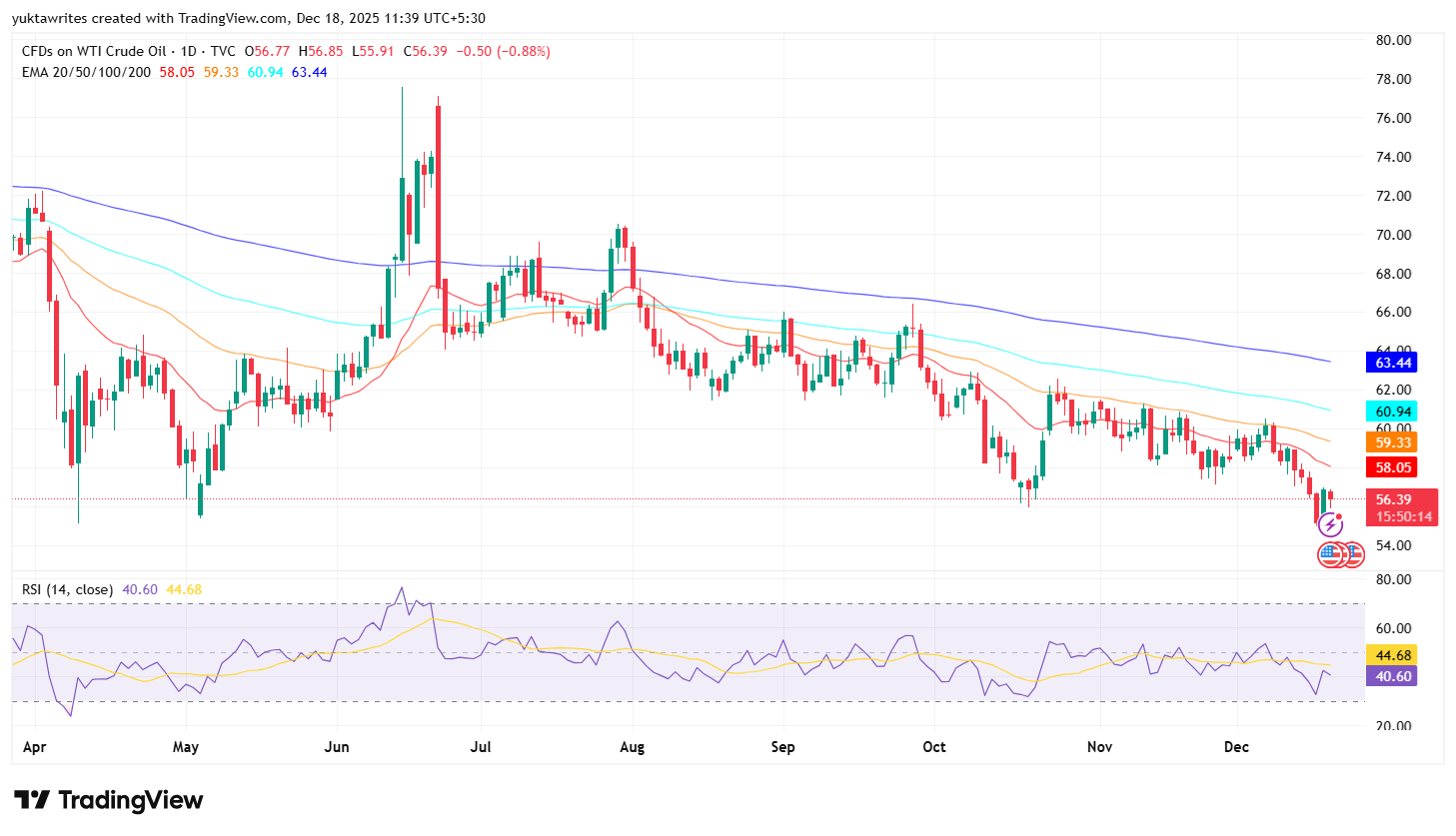
WTI crude oil price dynamics (Source: TradingView)
Even with the recent rebound above $56, crude is still trading near the lower boundary of its medium-term range. The inability to reclaim any key trend indicators suggests that sellers retain control at higher levels. Momentum readings support this view. The daily RSI is hovering in the low-40s, signaling weak underlying demand and an absence of sustained buying interest. While this leaves room for short-term rebounds, it does not yet meet the historical conditions typically associated with durable trend reversals in oil, which have required RSI to reclaim the mid-50s alongside price acceptance above the 50-day average.
Intraday stabilization meets heavy resistance
Shorter timeframes show a modest improvement in tone. On the 30-minute chart, WTI has rebounded from recent lows near $55, holding above Supertrend support and briefly flipping the short-term bias higher. The move has been orderly rather than impulsive, pointing to short-covering and tactical positioning rather than aggressive risk-on behavior. Parabolic SAR has shifted below price, offering near-term support around $56 to $56.2.
However, upside progress has already begun to stall near $56.8 to $57, an area that previously acted as a breakdown zone. Selling pressure has re-emerged there, suggesting that market participants continue to use rallies to reduce exposure rather than build new long positions. Until WTI can push decisively beyond this band, the intraday recovery is likely to remain vulnerable.
Geopolitics and inventories slow the slide
Fundamental developments have played a key role in halting the recent decline. Geopolitical risk has reintroduced a modest supply premium after the U.S. ordered a shutdown of maritime traffic linked to sanctioned Venezuelan oil shipments. In parallel, Washington’s push toward tougher energy sanctions on Russia has raised concerns about potential supply disruptions tied to the Ukraine conflict. These factors have helped stabilize prices, particularly in a market that was already heavily oversold.
Inventory data has added incremental support. The latest EIA report showed U.S. crude inventories falling by 1.27M barrels, marking a second consecutive weekly draw and exceeding market expectations. A notable decline at the Cushing hub, the largest in nearly two months, provided additional relief given its importance to physical pricing. However, rising gasoline and distillate inventories tempered the bullish signal, highlighting uneven end-demand conditions and limiting the scope for a stronger rebound.
Key levels define the outlook
From a technical standpoint, WTI now sits at an important inflection point. Holding above the $55.5 to $56 zone keeps the door open for a broader retracement toward $58 to $59.5, where the declining 20-day and 50-day EMAs converge. That area represents a critical test for any recovery attempt, as repeated failures there have defined the downtrend since early autumn. A sustained daily close above $60 would be required to shift the medium-term outlook toward consolidation rather than continuation.
On the downside, a loss of the $55 handle would expose WTI to renewed selling pressure, with limited structural support until the psychological $52 to $53 region. Given the still-bearish higher-timeframe structure, traders are likely to remain cautious, treating rebounds as tactical opportunities rather than evidence of a completed bottom.
In earlier analysis, we highlighted WTI’s vulnerability as repeated failures below the $60 area and persistent selling pressure signaled a deepening downtrend. The current stabilization aligns with that view, reflecting relief driven by geopolitics and inventory data rather than a structural trend shift.





Latest WTI News








-
 Afghanistan
-
 Albania
-
 Algeria
-
 Angola
-
 Argentina
-
 Armenia
-
 Australia
-
 Austria
-
 Azerbaijan
-
 Bahamas
-
 Bahrain
-
 Bangladesh
-
 Belarus
-
 Belgium
-
 Bolivia
-
 Botswana
-
 Brazil
-
 Brunei
-
 Bulgaria
-
 Cambodia
-
 Cameroon
-
 Canada
-
 Chile
Chile
-
 China
China
-
 Colombia
-
 Congo
Congo
-
 Costa Rica
-
 Cote d'Ivoire
-
 Croatia
-
 Cuba
Cuba
-
 Cyprus
-
 Czechia
-
 DR Congo
-
 Denmark
-
 Dominican Republic
-
 Ecuador
-
 Egypt
Egypt
-
 El Salvador
-
 Estonia
-
 Eswatini
-
 Ethiopia
-
 Finland
-
 France
-
 Georgia
-
 Germany
-
 Ghana
Ghana
-
 Greece
-
 Haiti
Haiti
-
 Hong Kong
-
 Hungary
-
 India
India
-
 Indonesia
-
 Iran, Islamic republic
-
 Iraq
Iraq
-
 Ireland
-
 Israel
-
 Italy
Italy
-
 Jamaica
-
 Japan
Japan
-
 Jordan
-
 Kazakhstan
-
 Kenya
Kenya
-
 Korea
Korea
-
 Kuwait
-
 Kyrgyzstan
-
 Laos
Laos
-
 Latvia
-
 Lebanon
-
 Lesotho
-
 Libya
Libya
-
 Lithuania
-
 Luxembourg
-
 Madagascar
-
 Malaysia
-
 Malta
Malta
-
 Mauritius
-
 Mexico
-
 Moldova
-
 Mongolia
-
 Montenegro
-
 Morocco
-
 Mozambique
-
 Myanmar
-
 Namibia
-
 Nepal
Nepal
-
 Netherlands
-
 New Zealand
-
 Nigeria
-
 North Macedonia
-
 Norway
-
 Oman
Oman
-
 Pakistan
-
 Palestine
-
 Panama
-
 Papua New Guinea
-
 Paraguay
-
 Peru
Peru
-
 Philippines
-
 Poland
-
 Portugal
-
 Puerto Rico
-
 Qatar
Qatar
-
 Reunion
-
 Romania
-
 Rwanda
-
 Saudi Arabia
-
 Serbia
-
 Singapore
-
 Slovakia
-
 Slovenia
-
 Somalia
-
 South Africa
-
 Spain
Spain
-
 Sri Lanka
-
 Sweden
-
 Switzerland
-
 Syria
Syria
-
 Taiwan
-
 Tajikistan
-
 Tanzania
-
 Thailand
-
 Trinidad and Tobago
-
 Tunisia
-
 Turkey
-
 UAE
UAE
-
 Uganda
-
 Ukraine
-
 United Kingdom
-
United States
-
 Uruguay
-
 Uzbekistan
-
 Venezuela
-
 Vietnam
-
 Yemen
Yemen
-
 Zambia
-
 Zimbabwe
- Forex
- Crypto












