
Tesla stock down 1.8% after Q4 deliveries miss estimates
As of January 5, Tesla stock is trading at $441.50, down 1.8% over the past 24 hours. The stock remains under pressure following a disappointing Q4 delivery report, with technical indicators signaling growing downside risks.
Highlights
- Tesla delivered 418,227 vehicles in Q4 2025, missing estimates and falling 16% year-over-year.
- Despite the miss, investor focus is shifting toward Tesla’s AI and autonomy strategy, with key announcements expected in the upcoming earnings call.
- Technically, the stock remains range-bound between $420 and $470, with a bearish tilt unless it breaks above resistance.
The 20-day simple moving average (SMA), currently hovering around $465, has begun to flatten after weeks of upward slope, suggesting a potential shift in short-term trend. Tesla remains above its 50-day SMA, but barely so, and any further selling could push the stock into a bearish crossover. The 200-day SMA, a critical long-term support, sits near $243, reflecting the sharp gains TSLA achieved in 2025—yet also underscoring how far the stock could theoretically fall if sentiment collapses.
Immediate resistance is evident at the $460–470 zone, a level that has served as both a support and rejection point throughout December. This zone aligns with prior breakout levels and a cluster of short-term moving averages. If bulls can’t reclaim this zone soon, the rally that began in late October risks reversal. On the downside, initial support lies at $420, a key pivot from early November. A break below that level could expose the $390–400 area, last tested in September.
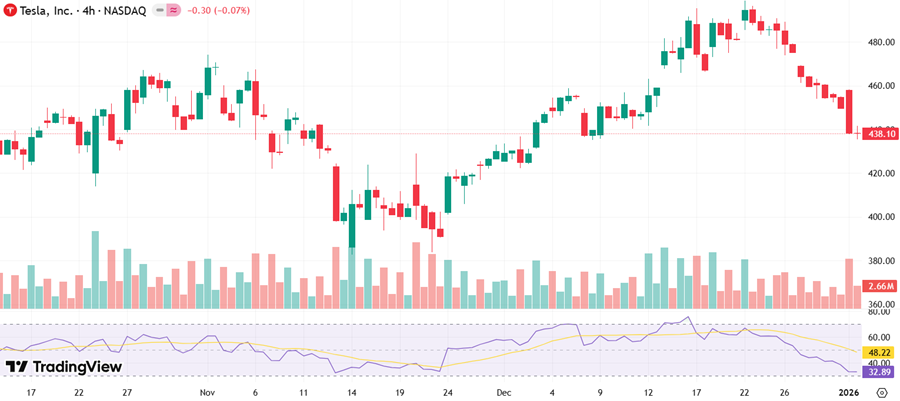
Tesla stock price dynamics (November 2025 - January 2025). Source: TradingView
Momentum indicators offer mixed signals. The Relative Strength Index (RSI) has pulled back to the mid-50s after nearing overbought conditions in late December, while the MACD line is flattening beneath the signal line, indicating waning bullish strength. Volume trends also show a slight bias toward distribution, with higher volume observed on red days compared to green ones over the past week.
Q4 delivery miss weighs despite AI optimism
Tesla’s Q4 2025 vehicle deliveries came in at 418,227, missing consensus expectations of around 422,850 and falling roughly 16% year-over-year. This marks Tesla’s second consecutive annual delivery decline, with full-year figures reaching just 1.64 million vehicles—well below the company's long-standing 2 million target.
While the company did not provide specific commentary on the delivery miss, analysts attribute the weakness to several macro and regulatory headwinds. The expiration of the $7,500 EV tax credit in the U.S. at the end of Q3 pulled forward demand, while Tesla’s price hikes and waning Model 3/Y interest impacted late-year sales. Additionally, Tesla continues to face increasing pressure from Chinese EV makers, especially in the European market, where registrations fell sharply in Q4.
Despite the underwhelming delivery report, Tesla stock initially rose—albeit briefly—before reversing lower. Some of the optimism was driven by Wedbush and other bullish analysts calling the numbers "better than feared," noting that internal whisper estimates were closer to 410,000. Investor attention is also shifting from vehicle sales toward Tesla’s future as a technology platform, with CEO Elon Musk expected to make further announcements around Full Self-Driving (FSD) and robotaxi development during the Q4 earnings call.
Range-bound with bearish bias
Looking ahead, Tesla is likely to remain range-bound in the near term, with a bearish tilt unless it can reclaim key technical levels. The base-case scenario sees Tesla oscillating between $420 and $470, as investors await clarity on earnings, 2026 guidance, and developments in autonomy. Until earnings deliver fresh upside catalysts, risk-reward appears skewed to the downside amid softening sentiment and limited short-term growth triggers.
In a bullish scenario, sustained buying above $470—particularly on volume above 90 million shares—could push the stock toward $500–520 by early February, supported by investor enthusiasm for Tesla's AI and software-driven margin expansion narrative. This would require a strong narrative shift from delivery-driven valuation to full belief in Tesla’s positioning as a future autonomous and energy platform leader.
Tesla is under pressure after South Korea’s L&F slashed its contract with the company by 99%, citing the collapse of expected orders tied to the 4680 battery cells. The move signals major production setbacks and potentially weak demand for the Cybertruck, which relies on this next-generation battery platform.





Latest Tesla News





-
 Afghanistan
-
 Albania
-
 Algeria
-
 Angola
-
 Argentina
-
 Armenia
-
 Australia
-
 Austria
-
 Azerbaijan
-
 Bahamas
-
 Bahrain
-
 Bangladesh
-
 Belarus
-
 Belgium
-
 Bolivia
-
 Botswana
-
 Brazil
-
 Brunei
-
 Bulgaria
-
 Cambodia
-
 Cameroon
-
 Canada
-
 Chile
Chile
-
 China
China
-
 Colombia
-
 Congo
Congo
-
 Costa Rica
-
 Cote d'Ivoire
-
 Croatia
-
 Cuba
Cuba
-
 Cyprus
-
 Czechia
-
 DR Congo
-
 Denmark
-
 Dominican Republic
-
 Ecuador
-
 Egypt
Egypt
-
 El Salvador
-
 Estonia
-
 Eswatini
-
 Ethiopia
-
 Finland
-
 France
-
 Georgia
-
 Germany
-
 Ghana
Ghana
-
 Greece
-
 Haiti
Haiti
-
 Hong Kong
-
 Hungary
-
 India
India
-
 Indonesia
-
 Iran, Islamic republic
-
 Iraq
Iraq
-
 Ireland
-
 Israel
-
 Italy
Italy
-
 Jamaica
-
 Japan
Japan
-
 Jordan
-
 Kazakhstan
-
 Kenya
Kenya
-
 Korea
Korea
-
 Kuwait
-
 Kyrgyzstan
-
 Laos
Laos
-
 Latvia
-
 Lebanon
-
 Lesotho
-
 Libya
Libya
-
 Lithuania
-
 Luxembourg
-
 Madagascar
-
 Malaysia
-
 Malta
Malta
-
 Mauritius
-
 Mexico
-
 Moldova
-
 Mongolia
-
 Montenegro
-
 Morocco
-
 Mozambique
-
 Myanmar
-
 Namibia
-
 Nepal
Nepal
-
 Netherlands
-
 New Zealand
-
 Nigeria
-
 North Macedonia
-
 Norway
-
 Oman
Oman
-
 Pakistan
-
 Palestine
-
 Panama
-
 Papua New Guinea
-
 Paraguay
-
 Peru
Peru
-
 Philippines
-
 Poland
-
 Portugal
-
 Puerto Rico
-
 Qatar
Qatar
-
 Reunion
-
 Romania
-
 Rwanda
-
 Saudi Arabia
-
 Serbia
-
 Singapore
-
 Slovakia
-
 Slovenia
-
 Somalia
-
 South Africa
-
 Spain
Spain
-
 Sri Lanka
-
 Sweden
-
 Switzerland
-
 Syria
Syria
-
 Taiwan
-
 Tajikistan
-
 Tanzania
-
 Thailand
-
 Trinidad and Tobago
-
 Tunisia
-
 Turkey
-
 UAE
UAE
-
 Uganda
-
 Ukraine
-
 United Kingdom
-
United States
-
 Uruguay
-
 Uzbekistan
-
 Venezuela
-
 Vietnam
-
 Yemen
Yemen
-
 Zambia
-
 Zimbabwe
- Forex
- Crypto











