

Tesla stock jumps 2.2% despite analyst doubts over robotaxi profitability
As of January 12, Tesla stock is trading at $445.61, up 2.2% in the past 24 hours. The rally comes amid a broader rebound in tech stocks, although questions continue to swirl around Tesla’s stretched valuation and uncertain near-term growth prospects.
Highlights
- Tesla stock rose 2.2% to $445.61 despite growing analyst concerns about the long-term profitability of its robotaxi business.
- Top investor Daniel Sparks warned that high capital expenditures and intense competition could turn autonomy into a low-margin, commoditized service.
- The upcoming Q4 earnings on January 28 will be a key test of whether the recent rally can continue.
From a technical perspective, Tesla remains in an upward trend that began in late September 2025. The stock has now broken above its 50-day and 200-day moving averages, signaling bullish momentum. Immediate support sits near $428, the prior breakout level from early January. Resistance is found at $466, a short-term high from late December.
The Relative Strength Index (RSI) is approaching 65, indicating near-overbought conditions, but not extreme levels that would imply a correction is imminent. Volume has been relatively stable over the past two weeks, showing neither aggressive accumulation nor distribution. Overall, short-term technical indicators remain constructive, but with some caution warranted given the rapid move from $400 to $445 in less than two weeks.
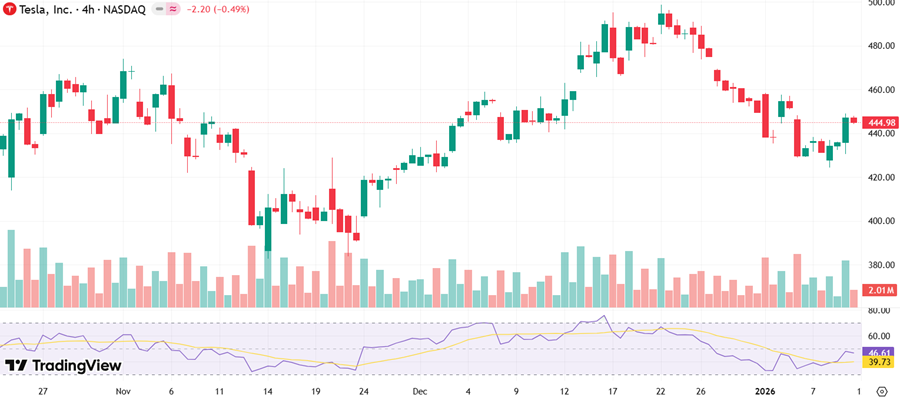
Tesla stock price dynamics (November 2025 - January 2025). Source: TradingView
Options market activity also reflects rising interest in upside exposure. Call option volume has outpaced puts in recent sessions, particularly around the $460 and $480 strike levels expiring later in January, suggesting traders are positioning for a potential breakout. Implied volatility has risen modestly but remains below historical peaks, indicating that the market is anticipating movement without pricing in extreme risk.
Robotaxi optimism clashes with cost and margin risks
Investor skepticism toward Tesla is increasingly centered on the economics of its robotaxi ambitions rather than the technology itself. According to TipRanks, investor Daniel Sparks argues that while autonomy remains an exciting narrative, the financial reality may be far less compelling for shareholders. His core concern is that investors are extrapolating a highly profitable future without fully accounting for the costs and competitive dynamics that could undermine returns.
The first red flag Sparks highlights is capital intensity. Tesla’s capital expenditures reached nearly $9 billion in 2025, and management has already signaled that spending will rise sharply in 2026. The company’s CFO recently stated that capex is expected to “increase substantially,” reflecting heavy investment in AI infrastructure, autonomy hardware, and manufacturing capacity. Sparks fears these outlays could expand faster than revenue growth, putting pressure on free cash flow and reducing the payoff from robotaxi operations, especially if commercialization takes longer than expected.
The second, and more structural, issue is profitability. Sparks argues that robotaxis are likely to operate in a highly competitive, price‑sensitive market rather than a high‑margin tech niche. He points to competition not only from EV makers such as BYD, Rivian, and Lucid, but also from tech giants like Alphabet and Amazon, as well as established ride‑hailing platforms Uber and Lyft. In such an environment, differentiation may be limited, forcing providers to compete primarily on price. Sparks warns that this could turn autonomous ride‑hailing into a commoditized service with thin margins, leaving little upside for investors at current valuations.
Earnings catalyst could trigger breakout or pullback
Tesla is scheduled to report Q4 earnings on January 28, and the results will be pivotal in determining whether the recent rally has legs. Analysts expect muted EPS growth due to flat vehicle deliveries and elevated operating costs from AI and robotics investments. If Tesla can beat expectations and show clear progress in FSD adoption or monetization, the stock could break above the $466 resistance and target $500 in Q1.
However, if earnings disappoint or the company provides cautious forward guidance, the stock could retest support levels near $400. A more bearish scenario could see a retracement to the $360–370 zone, particularly if macro conditions tighten or investor sentiment shifts toward profitability over growth.
Renewed analyst optimism around Tesla’s Full Self-Driving ambitions has fueled recent bullish sentiment. New Street Research sees Tesla as “uniquely positioned” to lead the robotaxi market, assigning a $600 target based on its data advantage and scalable infrastructure.





Latest Tesla News




-
 Afghanistan
-
 Albania
-
 Algeria
-
 Angola
-
 Argentina
-
 Armenia
-
 Australia
-
 Austria
-
 Azerbaijan
-
 Bahamas
-
 Bahrain
-
 Bangladesh
-
 Belarus
-
 Belgium
-
 Bolivia
-
 Botswana
-
 Brazil
-
 Brunei
-
 Bulgaria
-
 Cambodia
-
 Cameroon
-
 Canada
-
 Chile
Chile
-
 China
China
-
 Colombia
-
 Congo
Congo
-
 Costa Rica
-
 Cote d'Ivoire
-
 Croatia
-
 Cuba
Cuba
-
 Cyprus
-
 Czechia
-
 DR Congo
-
 Denmark
-
 Dominican Republic
-
 Ecuador
-
 Egypt
Egypt
-
 El Salvador
-
 Estonia
-
 Eswatini
-
 Ethiopia
-
 Finland
-
 France
-
 Georgia
-
 Germany
-
 Ghana
Ghana
-
 Greece
-
 Haiti
Haiti
-
 Hong Kong
-
 Hungary
-
 India
India
-
 Indonesia
-
 Iran, Islamic republic
-
 Iraq
Iraq
-
 Ireland
-
 Israel
-
 Italy
Italy
-
 Jamaica
-
 Japan
Japan
-
 Jordan
-
 Kazakhstan
-
 Kenya
Kenya
-
 Korea
Korea
-
 Kuwait
-
 Kyrgyzstan
-
 Laos
Laos
-
 Latvia
-
 Lebanon
-
 Lesotho
-
 Libya
Libya
-
 Lithuania
-
 Luxembourg
-
 Madagascar
-
 Malaysia
-
 Malta
Malta
-
 Mauritius
-
 Mexico
-
 Moldova
-
 Mongolia
-
 Montenegro
-
 Morocco
-
 Mozambique
-
 Myanmar
-
 Namibia
-
 Nepal
Nepal
-
 Netherlands
-
 New Zealand
-
 Nigeria
-
 North Macedonia
-
 Norway
-
 Oman
Oman
-
 Pakistan
-
 Palestine
-
 Panama
-
 Papua New Guinea
-
 Paraguay
-
 Peru
Peru
-
 Philippines
-
 Poland
-
 Portugal
-
 Puerto Rico
-
 Qatar
Qatar
-
 Reunion
-
 Romania
-
 Rwanda
-
 Saudi Arabia
-
 Serbia
-
 Singapore
-
 Slovakia
-
 Slovenia
-
 Somalia
-
 South Africa
-
 Spain
Spain
-
 Sri Lanka
-
 Sweden
-
 Switzerland
-
 Syria
Syria
-
 Taiwan
-
 Tajikistan
-
 Tanzania
-
 Thailand
-
 Trinidad and Tobago
-
 Tunisia
-
 Turkey
-
 UAE
UAE
-
 Uganda
-
 Ukraine
-
 United Kingdom
-
United States
-
 Uruguay
-
 Uzbekistan
-
 Venezuela
-
 Vietnam
-
 Yemen
Yemen
-
 Zambia
-
 Zimbabwe
- Forex
- Crypto












