
WTI crude oil price slips below $59 as Venezuela supply risk offsets Middle East tensions

WTI crude oil is trading on the defensive, slipping back below the $59 handle on Monday after failing to extend last week’s rebound. While geopolitical risk remains elevated due to unrest in Iran, traders are increasingly focused on the possibility of Venezuelan supply returning to the market, keeping upside momentum in check.
Highlights
- WTI retreats below $59 as rallies stall under key moving-average resistance.
- Venezuela supply expectations weigh on sentiment despite Iran-related risks.
- Broader structure remains bearish with price capped below long-term EMAs.
The latest pullback reflects a market caught between competing narratives. On one side, instability in the Middle East continues to support a geopolitical risk premium, particularly given Iran’s proximity to the Strait of Hormuz, a critical chokepoint for global oil flows. On the other, expectations that Venezuelan barrels could re-enter global markets have reintroduced a supply overhang that traders are reluctant to ignore. The result is a cautious tape, where price struggles to sustain gains despite periodic headline-driven spikes.
Technical structure favors sellers
From a technical standpoint, WTI’s broader structure continues to lean bearish. On the daily chart, price remains below both the 100-day and 200-day EMAs, which are descending near the $60.1 and $62.6 levels, respectively. These longer-term averages have consistently capped recovery attempts, reinforcing the view that recent rebounds are corrective rather than the start of a new uptrend.
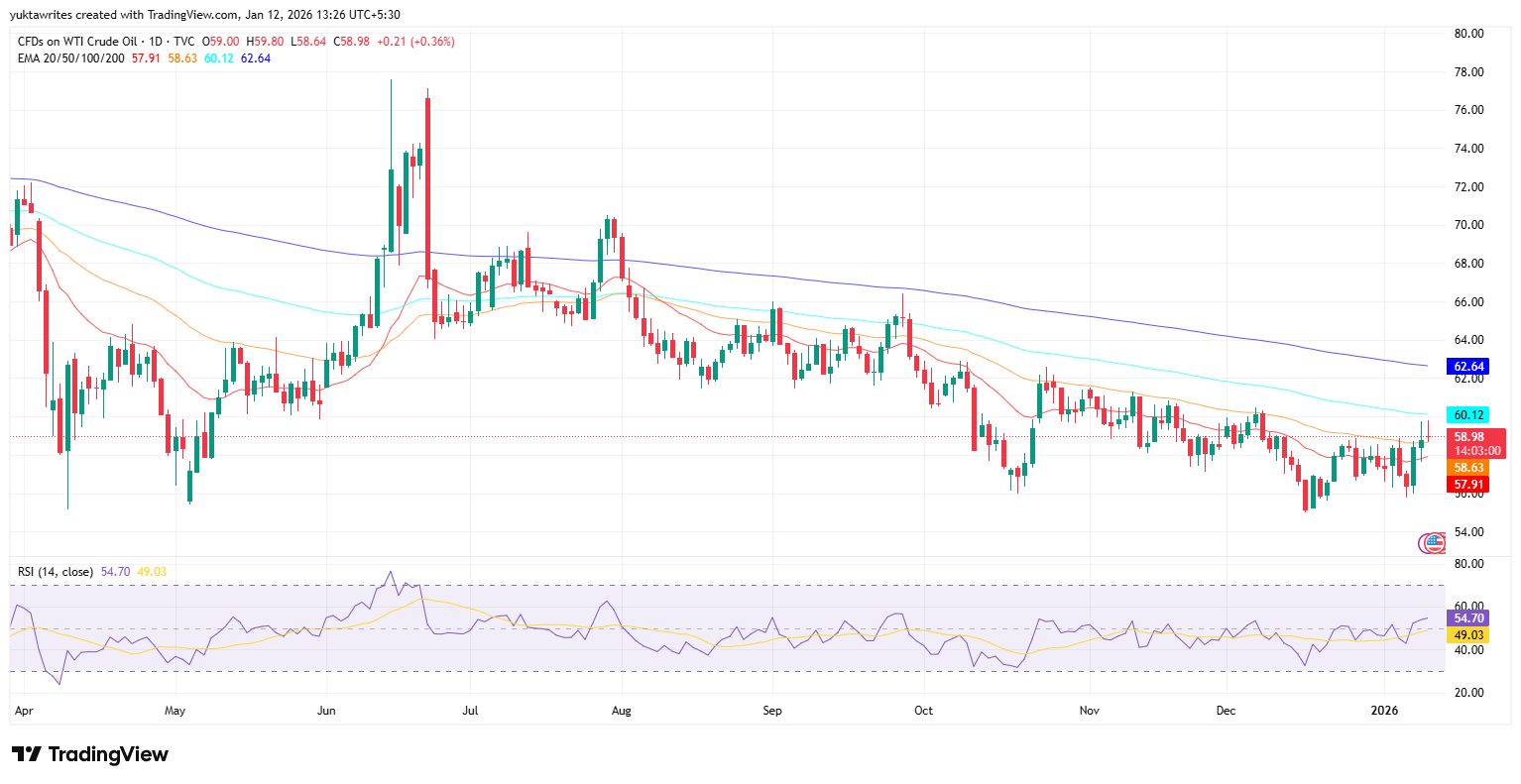
WTI CRUDE OIL price dynamics (Source: TradingView)
Shorter-term averages are also acting as a ceiling. The 20-day and 50-day EMAs are clustered just above current prices, forming a tight resistance band between roughly $58.6 and $59.2. WTI has repeatedly failed to establish acceptance above this zone, and each push into it has attracted selling pressure. As long as price remains below this cluster, upside attempts are likely to fade rather than accelerate.
Momentum indicators reflect this lack of conviction. Daily RSI is hovering in the mid-50s, a neutral reading that signals neither strong bullish momentum nor outright exhaustion. This aligns with recent price action, which has been characterized by a wide but well-defined range rather than a clean directional move. Buyers have repeatedly defended the mid-$57 area, but follow-through has been limited, suggesting demand remains tactical rather than structural.
On lower timeframes, the caution is even clearer. After rebounding sharply from the $56 to $56.5 zone, WTI pushed toward $59.8 before rolling over again. On the 30-minute chart, Supertrend has flipped lower and Parabolic SAR has moved above price, indicating near-term control has shifted back to sellers. Immediate intraday support sits around $58.4 to $58.6. A break below this area would likely reopen the path toward $57.5 and potentially a retest of the $56.8 lows.
Supply narrative dominates fundamentals
Fundamentally, the Venezuelan supply story has become a key drag on bullish positioning. The prospect that up to 50 million barrels could return to U.S. and global markets has altered the risk calculus, particularly at a time when global demand growth remains uneven. Even the possibility of incremental supply has been enough to cap rallies, as traders reassess the balance between geopolitical risk and tangible changes to supply.
At the same time, Iran-related risks remain a critical wildcard. Ongoing unrest and the potential for escalation near the Strait of Hormuz cannot be dismissed, and any clear disruption to flows would quickly force a repricing. However, the market has grown hesitant to price in worst-case scenarios without concrete evidence of supply interruptions. For now, geopolitical headlines are providing support on dips rather than driving sustained breakouts.
This tension has kept WTI locked in a range, with headlines capable of triggering short-term volatility but not yet strong enough to shift the broader trend. The market’s reaction function suggests traders are prioritizing observable supply changes over hypothetical risks, at least until conditions change.
Key levels and outlook
Looking ahead, levels remain well defined. On the downside, support near $57.5 is critical. A sustained break below that zone would likely expose the $56.8 area and potentially re-open the broader downtrend toward the mid-$55s. On the upside, WTI would need to reclaim and hold above $60.2 to meaningfully challenge the bearish structure and force a reassessment of sentiment.
For now, WTI remains a range-bound market with a bearish bias. Rallies continue to be sold into resistance, while buyers remain selective and reactive rather than aggressive. Traders should stay nimble, as geopolitical and sanctions-related headlines can quickly disrupt otherwise orderly technical setups, but until price reclaims key moving averages, the path of least resistance remains sideways to lower.
Earlier analysis highlighted that WTI was likely to remain capped below the $60-$62 zone unless a clear supply disruption emerged. Current price action continues to validate that view, with geopolitical risk supporting dips but not yet overpowering the supply-driven headwinds.





Latest WTI News









-
 Afghanistan
-
 Albania
-
 Algeria
-
 Angola
-
 Argentina
-
 Armenia
-
 Australia
-
 Austria
-
 Azerbaijan
-
 Bahamas
-
 Bahrain
-
 Bangladesh
-
 Belarus
-
 Belgium
-
 Bolivia
-
 Botswana
-
 Brazil
-
 Brunei
-
 Bulgaria
-
 Cambodia
-
 Cameroon
-
 Canada
-
 Chile
Chile
-
 China
China
-
 Colombia
-
 Congo
Congo
-
 Costa Rica
-
 Cote d'Ivoire
-
 Croatia
-
 Cuba
Cuba
-
 Cyprus
-
 Czechia
-
 DR Congo
-
 Denmark
-
 Dominican Republic
-
 Ecuador
-
 Egypt
Egypt
-
 El Salvador
-
 Estonia
-
 Eswatini
-
 Ethiopia
-
 Finland
-
 France
-
 Georgia
-
 Germany
-
 Ghana
Ghana
-
 Greece
-
 Haiti
Haiti
-
 Hong Kong
-
 Hungary
-
 India
India
-
 Indonesia
-
 Iran, Islamic republic
-
 Iraq
Iraq
-
 Ireland
-
 Israel
-
 Italy
Italy
-
 Jamaica
-
 Japan
Japan
-
 Jordan
-
 Kazakhstan
-
 Kenya
Kenya
-
 Korea
Korea
-
 Kuwait
-
 Kyrgyzstan
-
 Laos
Laos
-
 Latvia
-
 Lebanon
-
 Lesotho
-
 Libya
Libya
-
 Lithuania
-
 Luxembourg
-
 Madagascar
-
 Malaysia
-
 Malta
Malta
-
 Mauritius
-
 Mexico
-
 Moldova
-
 Mongolia
-
 Montenegro
-
 Morocco
-
 Mozambique
-
 Myanmar
-
 Namibia
-
 Nepal
Nepal
-
 Netherlands
-
 New Zealand
-
 Nigeria
-
 North Macedonia
-
 Norway
-
 Oman
Oman
-
 Pakistan
-
 Palestine
-
 Panama
-
 Papua New Guinea
-
 Paraguay
-
 Peru
Peru
-
 Philippines
-
 Poland
-
 Portugal
-
 Puerto Rico
-
 Qatar
Qatar
-
 Reunion
-
 Romania
-
 Rwanda
-
 Saudi Arabia
-
 Serbia
-
 Singapore
-
 Slovakia
-
 Slovenia
-
 Somalia
-
 South Africa
-
 Spain
Spain
-
 Sri Lanka
-
 Sweden
-
 Switzerland
-
 Syria
Syria
-
 Taiwan
-
 Tajikistan
-
 Tanzania
-
 Thailand
-
 Trinidad and Tobago
-
 Tunisia
-
 Turkey
-
 UAE
UAE
-
 Uganda
-
 Ukraine
-
 United Kingdom
-
United States
-
 Uruguay
-
 Uzbekistan
-
 Venezuela
-
 Vietnam
-
 Yemen
Yemen
-
 Zambia
-
 Zimbabwe
- Forex
- Crypto












