
Tesla stock slides 2.4% amid Jefferies doubts on robotaxi scaling
As of January 20, Tesla stock is trading at $428.01, down 2.4% in the past 24 hours. The recent dip places the stock below its short-term moving averages, with technical indicators turning increasingly cautious.
Highlights
- Tesla stock fell 2.4% to $428.01 amid Jefferies’ criticism of delays in the company’s robotaxi expansion.
- Technical indicators remain bearish, with the stock trading below key moving averages and support near $400.
- Further downside is possible if Tesla fails to clarify its FSD strategy or deliver strong earnings.
Tesla is now trading beneath the 50-day and 200-day moving averages, both of which are sloping downward, reinforcing a bearish trend. The Relative Strength Index (RSI) is hovering near 44, reflecting weakening momentum without being oversold—signaling potential for more downside pressure.
The MACD (Moving Average Convergence Divergence) remains negative, and the histogram is widening, suggesting that bearish momentum is gaining strength. Volume has remained relatively average, which indicates that while the selloff is steady, it’s not yet panic-driven. However, the current price is hovering just above a key psychological support at $425, with secondary support levels forming near $400 and $380. These could act as stabilization points if the decline continues. On the upside, resistance lies between $450 and $460, with the 200-day average near the top of that range.
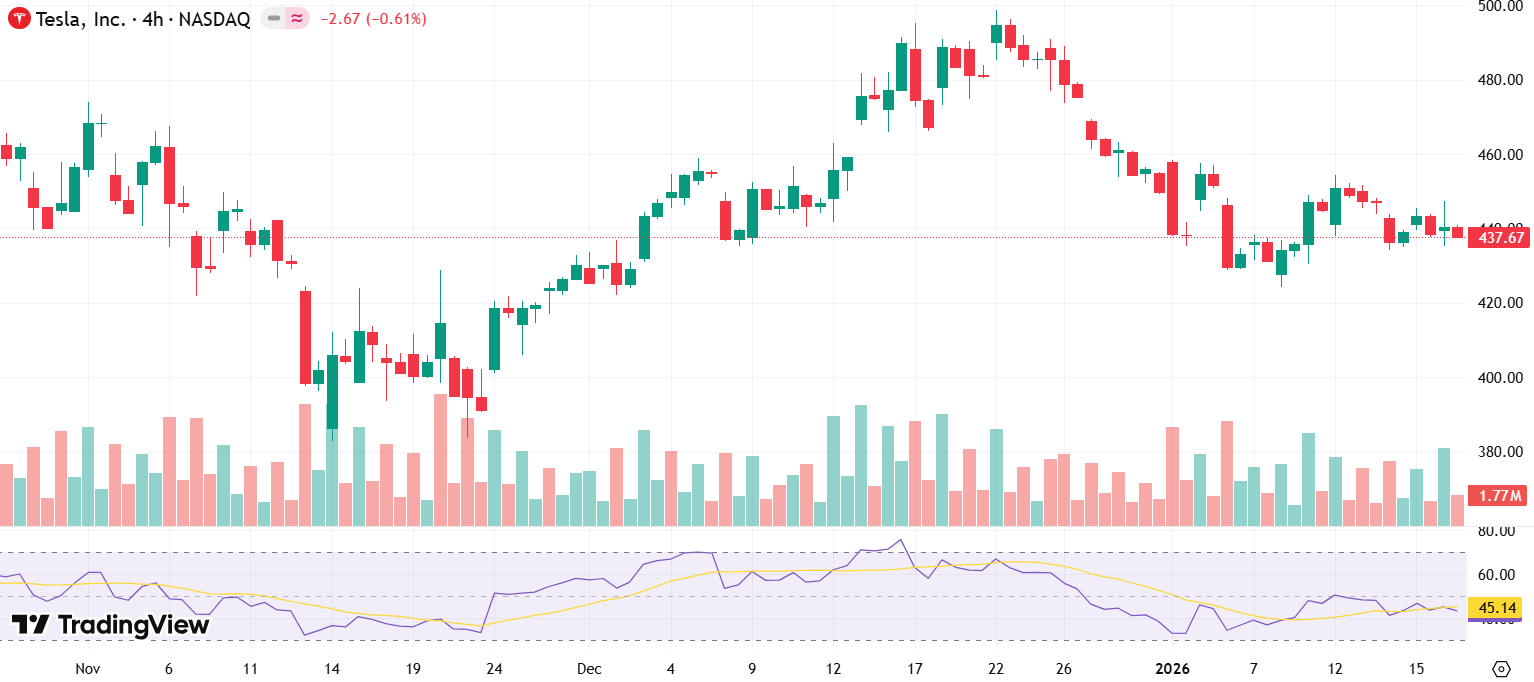
Tesla stock price dynamics (November 2025 - January 2025). Source: TradingView
The 1-year target estimate from analysts remains near $411, below the current market price, underscoring a broadly cautious stance by institutions. In terms of valuation, Tesla’s high P/E ratio of 73 continues to raise questions about whether future growth projections adequately justify the current multiple, especially in a high-rate environment where capital-intensive growth is under greater scrutiny.
Robotaxi delay raises strategic doubts among analysts
Jefferies made headlines this week by criticizing Tesla’s apparent reluctance to scale its robotaxi business, despite technological readiness and partial regulatory approval. The firm expressed confusion over why Tesla has not deployed its Full Self-Driving (FSD) Version 14.2 in city-scale robotaxi operations in locations like San Francisco and Austin. Tesla has received favorable testing feedback, and even permits in Nevada, but scaling remains limited and vague. Jefferies suggests that this delay risks falling behind competitors that are actively deploying autonomous fleets.
This statement adds to growing concern over the execution risk tied to Tesla’s future-focused ventures, particularly its AI and autonomy divisions. Investors have long priced in significant growth from areas beyond EV sales, including Dojo AI chips, Optimus robots, and autonomous taxis. However, with little clarity on commercial timelines, sentiment is shifting toward skepticism.
The delay in robotaxi expansion contributes to investor fatigue, particularly as the core EV business shows signs of margin compression and delivery growth normalizing. The market is increasingly demanding near-term results, not just long-term vision. Tesla’s communication strategy, which often relies on high-level announcements with little operational detail, may be contributing to the confusion and pressure on the stock.
Range-bound until catalyst, downside risk if $400 breaks
A bullish scenario would require Tesla to announce a tangible expansion of its FSD rollout or provide earnings data showing margin resilience and strong global demand. If this happens, TSLA could rally toward $480–$500, reclaiming its 200-day average and squeezing out short sellers. Such a move would likely re-ignite institutional interest, particularly from funds that trimmed exposure during recent drawdowns.
In a bearish scenario, if the $400 support level fails, the next floor sits around $380, followed by a stronger demand zone near $360. A breakdown through these levels could trigger broader selling, particularly if earnings guidance disappoints or further negative headlines emerge about delays or regulatory setbacks. Continued weakness in China deliveries or commentary around slowing U.S. EV adoption could further intensify the downside pressure.
Elon Musk announced the revival of Tesla’s Dojo3 supercomputer project, reversing earlier plans to shut it down. The renewed effort is driven by progress on the AI5 chip design, which Musk called a key catalyst.








-
 Afghanistan
-
 Albania
-
 Algeria
-
 Angola
-
 Argentina
-
 Armenia
-
 Australia
-
 Austria
-
 Azerbaijan
-
 Bahamas
-
 Bahrain
-
 Bangladesh
-
 Belarus
-
 Belgium
-
 Bolivia
-
 Botswana
-
 Brazil
-
 Brunei
-
 Bulgaria
-
 Cambodia
-
 Cameroon
-
 Canada
-
 Chile
Chile
-
 China
China
-
 Colombia
-
 Congo
Congo
-
 Costa Rica
-
 Cote d'Ivoire
-
 Croatia
-
 Cuba
Cuba
-
 Cyprus
-
 Czechia
-
 DR Congo
-
 Denmark
-
 Dominican Republic
-
 Ecuador
-
 Egypt
Egypt
-
 El Salvador
-
 Estonia
-
 Eswatini
-
 Ethiopia
-
 Finland
-
 France
-
 Georgia
-
 Germany
-
 Ghana
Ghana
-
 Greece
-
 Haiti
Haiti
-
 Hong Kong
-
 Hungary
-
 India
India
-
 Indonesia
-
 Iran, Islamic republic
-
 Iraq
Iraq
-
 Ireland
-
 Israel
-
 Italy
Italy
-
 Jamaica
-
 Japan
Japan
-
 Jordan
-
 Kazakhstan
-
 Kenya
Kenya
-
 Korea
Korea
-
 Kuwait
-
 Kyrgyzstan
-
 Laos
Laos
-
 Latvia
-
 Lebanon
-
 Lesotho
-
 Libya
Libya
-
 Lithuania
-
 Luxembourg
-
 Madagascar
-
 Malaysia
-
 Malta
Malta
-
 Mauritius
-
 Mexico
-
 Moldova
-
 Mongolia
-
 Montenegro
-
 Morocco
-
 Mozambique
-
 Myanmar
-
 Namibia
-
 Nepal
Nepal
-
 Netherlands
-
 New Zealand
-
 Nigeria
-
 North Macedonia
-
 Norway
-
 Oman
Oman
-
 Pakistan
-
 Palestine
-
 Panama
-
 Papua New Guinea
-
 Paraguay
-
 Peru
Peru
-
 Philippines
-
 Poland
-
 Portugal
-
 Puerto Rico
-
 Qatar
Qatar
-
 Reunion
-
 Romania
-
 Rwanda
-
 Saudi Arabia
-
 Serbia
-
 Singapore
-
 Slovakia
-
 Slovenia
-
 Somalia
-
 South Africa
-
 Spain
Spain
-
 Sri Lanka
-
 Sweden
-
 Switzerland
-
 Syria
Syria
-
 Taiwan
-
 Tajikistan
-
 Tanzania
-
 Thailand
-
 Trinidad and Tobago
-
 Tunisia
-
 Turkey
-
 UAE
UAE
-
 Uganda
-
 Ukraine
-
 United Kingdom
-
United States
-
 Uruguay
-
 Uzbekistan
-
 Venezuela
-
 Vietnam
-
 Yemen
Yemen
-
 Zambia
-
 Zimbabwe
- Forex
- Crypto











