
Texas Instruments stock forecast for 2030: TXN eyes $280 as capex falls to $2–3B

Texas Instruments just delivered the flashpoint investors have been anticipating: CEO Haviv Ilan and CFO Rafael Lizardi formally announced a decisive reduction in capital expenditures, from $4.6 billion in 2025 to a $2 to $3 billion range in 2026. This signals the end of a six-year elevated investment cycle and the beginning of a sustained free cash flow harvest phase.
TXN stock breaks down from $230 highs
Texas Instruments trades at $193.23, down 2.40%, in a severe breakdown from highs near $230 reached in late February. The stock is trading below all major EMAs. Price sits below the 20 EMA at $209.34, 50 EMA at $203.05, 100 EMA at $194.22, and 200 EMA at $188.13.Highlights
- Texas Instruments trades at $193.23, down 2.40%, breaking below all major EMAs in severe downtrend from $230 highs.
- Stock could reach $250-300 by 2030 if $8 FCF per share materializes and industrial recovery broadens beyond aerospace.
- TXN cuts capex from $4.6B to $2-3B, acquires Silicon Labs for $7.5B, targets $8 FCF per share in 2026.
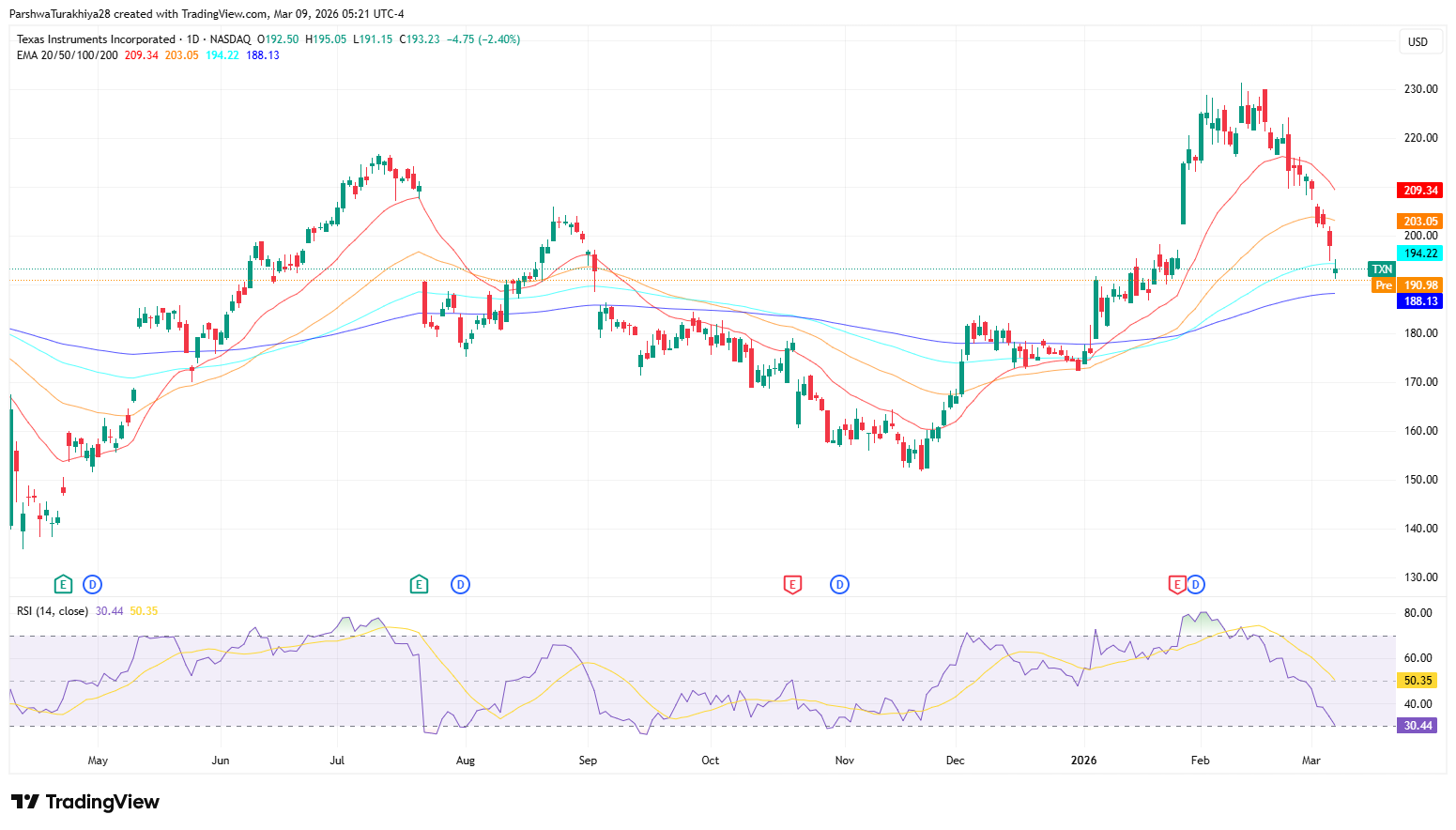
TXN price dynamics (Source: TradingView)
The chart shows a sharp rally from $180 lows in late 2025 to $230 peaks in February, followed by an aggressive breakdown. Price failed at the $230 resistance and has now broken below all major support levels. All moving averages are converging or beginning to roll over. RSI at 30.44 sits in oversold territory, suggesting intense selling pressure.
The breakdown below $209, then $203, and now testing $194 represents a complete technical failure. Support sits at the 200 EMA around $188, with next support at $180-185. The 100 EMA at $194.22 is immediate resistance. Recovery would require reclaim of $200-203, then the 20 EMA near $209.
Capex pivot unlocks free cash flow
At the Morgan Stanley Technology, Media & Telecom Conference on March 4, Ilan stated there is a good probability of hitting at least $8 of free cash flow per share in 2026, with what he described as a lot of opportunity for upside.For context, TXN generated $3.20 in free cash flow per share in 2025. Getting to $8 would represent roughly a 150% increase.
$7.5B Silicon Labs acquisition
On February 4, 2026, Texas Instruments announced a definitive agreement to acquire Silicon Labs for $231 per share in an all-cash transaction, representing a total enterprise value of approximately $7.5 billion.The acquisition marks TXN's largest since its $6.5 billion purchase of National Semiconductor in 2011. Silicon Labs recorded $785 million in revenue in 2025, with roughly 70% of its employees being engineers.
Industrial demand showing broad recovery
Ilan told the Morgan Stanley audience that industrial demand is showing a qualitatively different pattern than a year ago: the company grew close to 20% year on year in industrial. Finally, traditional industrial segments like automation, medical, and building automation are starting to show strength again. He added that improvement has continued into the first two months of Q1 2026.Texas Instruments announced a collaboration with Nvidia to develop technology for humanoid robots, integrating TI's mmWave radar sensor with Nvidia's Jetson Thor computing platform. TI is demonstrating the technology at Nvidia GTC from March 16-19 in San Jose.
Recently, Texas Instruments broke down from $230 to $193 after announcing a capex cut to $2-3 billion and acquiring Silicon Labs for $7.5 billion, with the stock testing the 200 EMA as support following CEO comments targeting $8 free cash flow per share in 2026.


Latest Texas Instruments News







-
 Afghanistan
-
 Albania
-
 Algeria
-
 Angola
-
 Argentina
-
 Armenia
-
 Australia
-
 Austria
-
 Azerbaijan
-
 Bahamas
-
 Bahrain
-
 Bangladesh
-
 Belarus
-
 Belgium
-
 Bolivia
-
 Botswana
-
 Brazil
-
 Brunei
-
 Bulgaria
-
 Cambodia
-
 Cameroon
-
 Canada
-
 Chile
Chile
-
 China
China
-
 Colombia
-
 Congo
Congo
-
 Costa Rica
-
 Cote d'Ivoire
-
 Croatia
-
 Cuba
Cuba
-
 Cyprus
-
 Czechia
-
 DR Congo
-
 Denmark
-
 Dominican Republic
-
 Ecuador
-
 Egypt
Egypt
-
 El Salvador
-
 Estonia
-
 Eswatini
-
 Ethiopia
-
 Finland
-
 France
-
 Georgia
-
 Germany
-
 Ghana
Ghana
-
 Greece
-
 Haiti
Haiti
-
 Hong Kong
-
 Hungary
-
 India
India
-
 Indonesia
-
 Iran, Islamic republic
-
 Iraq
Iraq
-
 Ireland
-
 Israel
-
 Italy
Italy
-
 Jamaica
-
 Japan
Japan
-
 Jordan
-
 Kazakhstan
-
 Kenya
Kenya
-
 Korea
Korea
-
 Kuwait
-
 Kyrgyzstan
-
 Laos
Laos
-
 Latvia
-
 Lebanon
-
 Lesotho
-
 Libya
Libya
-
 Lithuania
-
 Luxembourg
-
 Madagascar
-
 Malaysia
-
 Malta
Malta
-
 Mauritius
-
 Mexico
-
 Moldova
-
 Mongolia
-
 Montenegro
-
 Morocco
-
 Mozambique
-
 Myanmar
-
 Namibia
-
 Nepal
Nepal
-
 Netherlands
-
 New Zealand
-
 Nigeria
-
 North Macedonia
-
 Norway
-
 Oman
Oman
-
 Pakistan
-
 Palestine
-
 Panama
-
 Papua New Guinea
-
 Paraguay
-
 Peru
Peru
-
 Philippines
-
 Poland
-
 Portugal
-
 Puerto Rico
-
 Qatar
Qatar
-
 Reunion
-
 Romania
-
 Rwanda
-
 Saudi Arabia
-
 Serbia
-
 Singapore
-
 Slovakia
-
 Slovenia
-
 Somalia
-
 South Africa
-
 Spain
Spain
-
 Sri Lanka
-
 Sweden
-
 Switzerland
-
 Syria
Syria
-
 Taiwan
-
 Tajikistan
-
 Tanzania
-
 Thailand
-
 Trinidad and Tobago
-
 Tunisia
-
 Turkey
-
 UAE
UAE
-
 Uganda
-
 Ukraine
-
 United Kingdom
-
United States
-
 Uruguay
-
 Uzbekistan
-
 Venezuela
-
 Vietnam
-
 Yemen
Yemen
-
 Zambia
-
 Zimbabwe
- Forex
- Crypto












