

Alphabet (GOOGL) is accelerating its transition toward an “AI-first company” model, making Gemini the central element across nearly the entire Google ecosystem. The biggest recent event was Google I/O 2026, where the company unveiled Gemini 3.5 Flash, the multimodal Gemini Omni platform, and the Gemini Spark AI agent.
Google management effectively announced the beginning of the “Agentic Gemini Era” — a new phase in which artificial intelligence not only responds to queries, but autonomously performs tasks across Google services.
Search becomes the main battlefield in the AI race
The most significant changes involve Search. Google describes the update as the “biggest transformation of Search in 25 years”: AI modes and Gemini are now being integrated directly into search results, creating a conversational interface instead of the traditional list of links. At the same time, AI features are expanding across Chrome, Gmail, Docs, YouTube, and Android XR. The company is also re-entering the smart-glasses market through partnerships with Samsung, Warby Parker, and Gentle Monster, aiming to compete with Meta in the AI wearables segment.
Investors focus on cloud and AI infrastructure
From an investment perspective, the market is currently valuing Alphabet primarily based on its ability to monetize AI infrastructure. Google Cloud remains one of the company’s fastest-growing segments thanks to strong enterprise demand for AI computing and Gemini-based services. Analysts note that Google is not relying on a single “hype-driven” product, but rather on deep AI integration across its massive existing user base in Search, Workspace, and YouTube. An important competitive advantage also comes from Google’s proprietary TPU chips, which help reduce dependence on Nvidia and give the company greater control over computing costs.
Regulatory pressure and competition remain key risks
At the same time, pressure on Alphabet continues to increase. Investors reacted cautiously to the absence of a full Gemini 3.5 Pro release at I/O 2026, as the market expected a more aggressive response to OpenAI and Anthropic. Additional risks stem from ongoing antitrust investigations in the United States and Europe, where regulators are closely examining Gemini’s integration into Search and Google’s advertising business. Nevertheless, Alphabet’s current strategy appears more pragmatic than many competitors’: the company is focusing less on flashy AI demonstrations and more on large-scale commercialization of AI within its already dominant digital ecosystem.
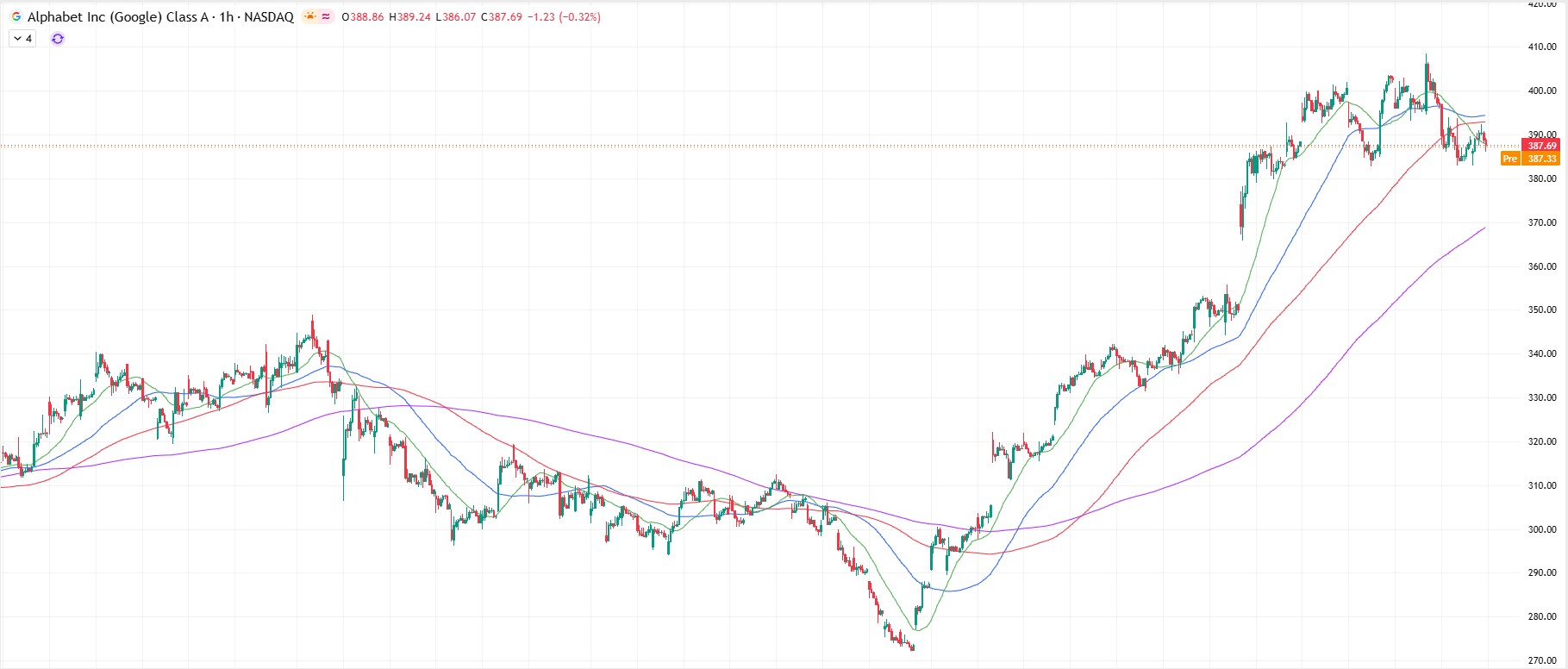
The bulls once again failed to break through resistance around the $405 level, while support near $385 continues to hold back bearish pressure. Failure to break resistance could trigger a broader liquidation of long positions, while a successful breakout would likely open the way toward the $410–415 range.
In my article Alphabet remains under pressure as traders take profits on long positions, I previously noted that if the decline continues, increased bullish activity should be expected.








-
 Afghanistan
-
 Albania
-
 Algeria
-
 Angola
-
 Argentina
-
 Armenia
-
 Australia
-
 Austria
-
 Azerbaijan
-
 Bahamas
-
 Bahrain
-
 Bangladesh
-
 Belarus
-
 Belgium
-
 Bolivia
-
 Botswana
-
 Brazil
-
 Brunei
-
 Bulgaria
-
 Cambodia
-
 Cameroon
-
 Canada
-
 Chile
Chile
-
 China
China
-
 Colombia
-
 Congo
Congo
-
 Costa Rica
-
 Cote d'Ivoire
-
 Croatia
-
 Cuba
Cuba
-
 Cyprus
-
 Czechia
-
 DR Congo
-
 Denmark
-
 Dominican Republic
-
 Ecuador
-
 Egypt
Egypt
-
 El Salvador
-
 Estonia
-
 Eswatini
-
 Ethiopia
-
 Finland
-
 France
-
 Georgia
-
 Germany
-
 Ghana
Ghana
-
 Greece
-
 Haiti
Haiti
-
 Hong Kong
-
 Hungary
-
 India
India
-
 Indonesia
-
 Iran, Islamic republic
-
 Iraq
Iraq
-
 Ireland
-
 Israel
-
 Italy
Italy
-
 Jamaica
-
 Japan
Japan
-
 Jordan
-
 Kazakhstan
-
 Kenya
Kenya
-
 Korea
Korea
-
 Kuwait
-
 Kyrgyzstan
-
 Laos
Laos
-
 Latvia
-
 Lebanon
-
 Lesotho
-
 Libya
Libya
-
 Lithuania
-
 Luxembourg
-
 Madagascar
-
 Malaysia
-
 Malta
Malta
-
 Mauritius
-
 Mexico
-
 Moldova
-
 Mongolia
-
 Montenegro
-
 Morocco
-
 Mozambique
-
 Myanmar
-
 Namibia
-
 Nepal
Nepal
-
 Netherlands
-
 New Zealand
-
 Nigeria
-
 North Macedonia
-
 Norway
-
 Oman
Oman
-
 Pakistan
-
 Palestine
-
 Panama
-
 Papua New Guinea
-
 Paraguay
-
 Peru
Peru
-
 Philippines
-
 Poland
-
 Portugal
-
 Puerto Rico
-
 Qatar
Qatar
-
 Reunion
-
 Romania
-
 Rwanda
-
 Saudi Arabia
-
 Serbia
-
 Singapore
-
 Slovakia
-
 Slovenia
-
 Somalia
-
 South Africa
-
 Spain
Spain
-
 Sri Lanka
-
 Sweden
-
 Switzerland
-
 Syria
Syria
-
 Taiwan
-
 Tajikistan
-
 Tanzania
-
 Thailand
-
 Trinidad and Tobago
-
 Tunisia
-
 Turkey
-
 UAE
UAE
-
 Uganda
-
 Ukraine
-
 United Kingdom
-
United States
-
 Uruguay
-
 Uzbekistan
-
 Venezuela
-
 Vietnam
-
 Yemen
Yemen
-
 Zambia
-
 Zimbabwe
- Forex
- Crypto











